No two depression diagnoses are the same, so each case requires an individual treatment approach. When standard treatments such as cognitive behavioral therapy and oral antidepressants fail, people with depression should know they’re not out of options — they have others at their disposal.
Estimated reading time:4minutes
One lesser talked-about treatment, transcranial magnetic stimulation (TMS), may be worth considering.
Geoffrey Grammer, M.D., a psychiatrist and the chief medical officer of Greenbrook Mental Wellness Centers, which administers Neurostar TMS, explained that TMS “targets brain circuits involved in mood in ways that differ from traditional antidepressants.”
When TMS may be helpful — and how it works
In 2008, the U.S. Food and Drug Administration authorized NeuroStar TMS, under the De Novo regulatory pathway, as the first TMS system for treatment of major depressive disorder after not experiencing improvement from a prior antidepressant medication. It can be a good fit for individuals with treatment-resistant depression, who have tried at least two antidepressant medications, and either are unhappy with the results or cannot tolerate the side effects of medication.
Grammer said in a real-world study, data shows 83% of patients saw significant improvement in their depression symptoms with NeuroStar TMS.1 “It’s a paradigm changer,” Grammer said.
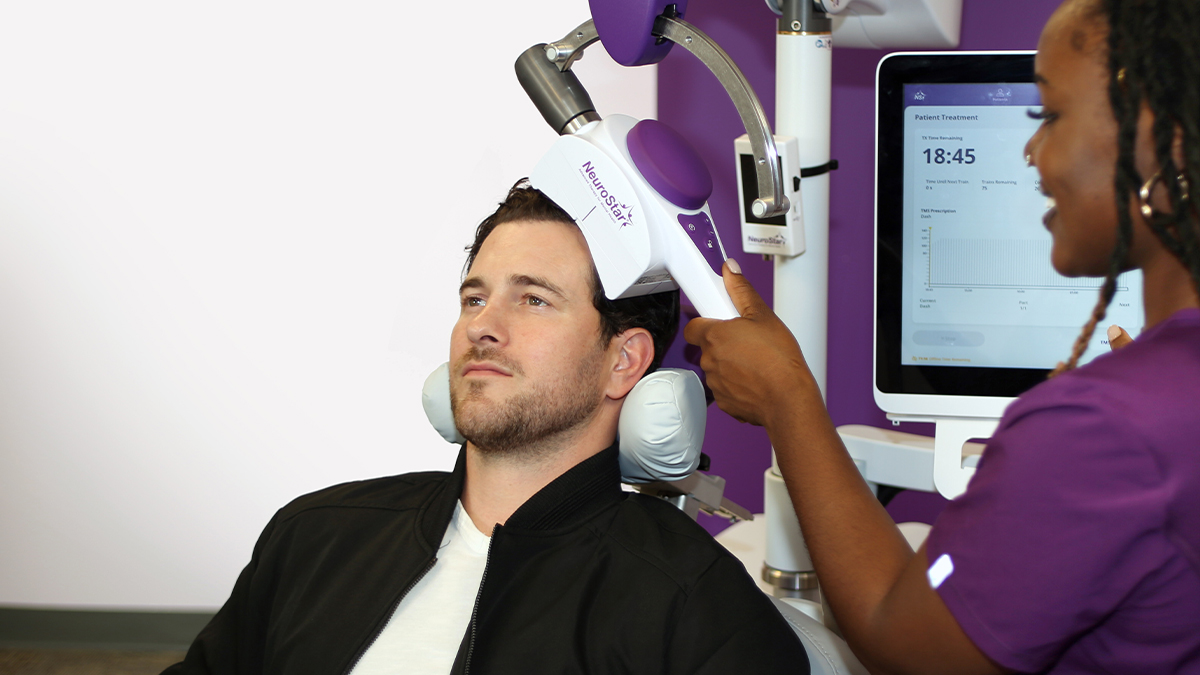
TMS uses magnetic pulses, similar in strength to an MRI, to stimulate brain circuits involved in mood regulation, Grammer said. Treatment involves 36 outpatient sessions over seven to nine weeks, each lasting about 20 minutes, usually in a psychiatrist’s office or specialized outpatient treatment center. A medical staff member places the magnetic coil on the scalp, allowing the magnetic fields to stimulate areas of the brain believed to be under-active in depression.
“Think of it like physical therapy for the brain,” Grammer explained.
Patients remain awake and fully alert, and can return to their normal activities afterward. Common side effects include mild discomfort at the treatment site or a headache during treatment, which usually subside within the first two weeks.
“For people whose symptoms haven’t improved with medications alone, this approach can offer another meaningful chance at relief,” Grammer said.
Over 300 million individuals in the United States have insurance policies that cover TMS, if a patient meets medical criteria. Most insurance plans require TMS candidates to have tried two or more pharmaceutical antidepressant medications.
Reducing self-blame and exploring options
Grammer emphasized that depression is a medical illness that often needs medical treatment. Antidepressants help many people, but they have limits. Roughly one-third of adults treated with oral medication for major depression do not respond adequately despite trying multiple antidepressants, he said.2
“That is why we need treatments that work in different ways,” Grammer said. “TMS offers another option when medications have not provided enough relief.”
Liam Donovan, 23, one NeuroStar TMS patient, noted his father underwent the treatment first and found success, but he was “skeptical” it would work for him, too. He ended up coming to love the structure his treatments offered.
“My family noticed I was laughing and smiling more. I became more active. I was coming out of the hole of depression,” Donovan said. “After treatment, my dad told me that I looked good and sounded better.”


NeuroStar TMS patient Daniel Cooke, a U.S. Navy veteran, echoed Donovan. “NeuroStar TMS has helped lift my depression, so that I can make important personal and professional strides in life,” Cooke said. “Since NeuroStar TMS, I have gotten married and opened my own private therapy practice. These milestones were very hard to imagine when at the depths of my depression.”
- Sackeim HA, et al. (2020). Clinical Outcomes in a Large Registry of Patients with Major Depressive Disorder Treated with Transcranial Magnetic Stimulation. J Affective Disorders, 277(12):65-74.
- https://www.health.harvard.edu/blog/new-insights-into-treatment-resistant-depression-20101209891
Visit NeuroStar.com for prescribing and safety information.