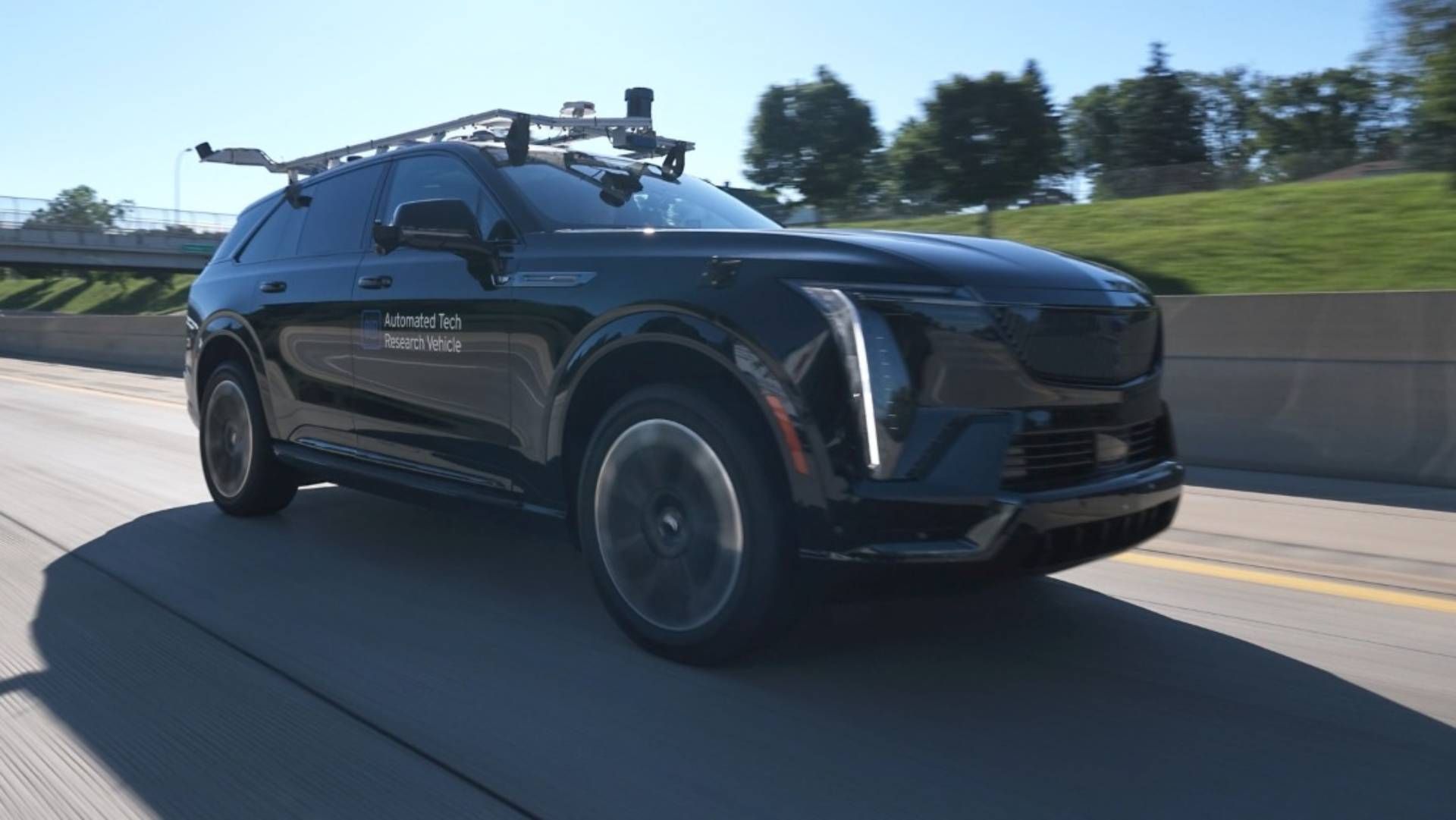
General Motors will expand the availability of its autonomous Level 3 highway-driving technologies to its most popular models, the next step in a “Concept Horizon” vision for the future that includes your vehicle “[handling] mundane tasks for you, like heading out into bumper-to-bumper traffic to pick up groceries,” the automaker said late October, goals that describe Level 4 autonomy. The innovation was announced at a GM Forward event in New York City on October 21, along with a host of other plans for next-generation vehicles and platforms.
Article content
Article content
The autonomous highway-driving tech will debut in 2028 on the Cadillac Escalade IQ, but will expand shortly after to more affordable, higher-volume models, including gas-powered models and EVs; and three-row SUVs and trucks like the Chevrolet Silverado. The advances in self-driving capability will progress in part thanks to AI, GM says, but also via the consolidation of various networks and systems and the introduction of a new liquid-cooled central compute unit (CCU) with “roughly 40x more compute capability than today’s vehicles,” and “with 30% less wiring length and mass.”
Part of the role played by AI will be in terms of large-scale simulations for training purposes; GM boasts that “every day, our stack drives more than three billion virtual miles.”
This sort of virtual research will also underpin
This sort of virtual research will also underpin the automaker’s next-generation EV platform; the goal there hinges in part on making electric vehicles more affordable by pivoting to the use of cheaper, more energy-dense lithium-manganese-rich (LMR) battery chemistry. “We tested more than 300,000 battery designs virtually before building a single physical prototype,” GM says of how it arrived at the packaging for these new LMR cells.
Article content
Article content
Article content
The broader aim is to, as with the autonomous tech, bring the fourth-gen EV architecture into the mainstream. The programs are also similar in that the EV innovations include more centralized computing, as well as a scaling back in terms of complexity. “Our new propulsion systems utilize more compact motors and power electronics that reduce parts count by 40% compared to today,” GM reps said during the presentation. The EVs built on the new platform will be 15% lighter and 20% more energy-efficient.
Besides the target launch of the next-gen autonomous systems in the ’28 Escalade IQ, General Motors was mum on the specific timeline for these new technologies—but the implication seemed to be that they’re not all that far off. We’ll be sure to bring you more details as the plans get more concrete.