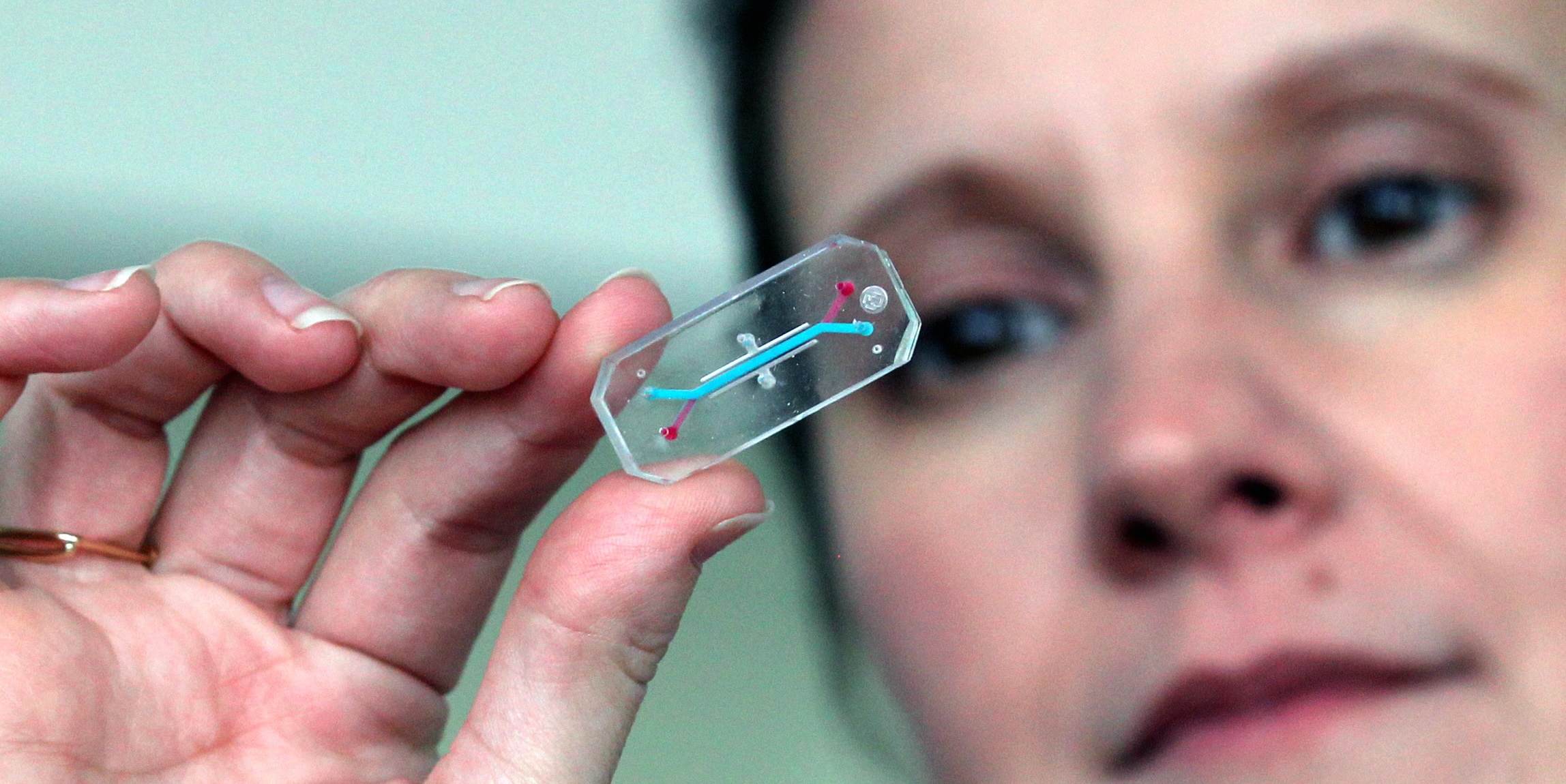
Could a USB-sized vagina model unlock women’s healthcare?
There is a big problem in the world of women’s healthcare: It is under-researched and underfunded, receiving around only 5% of global funding. As a result, the male body has become the default, often at the expense of women, who experience conditions differently from men and have a whole range of specific healthcare needs.
At Harvard University’s Wyss Institute, with Gates Foundation help, a team of scientists have been looking to fix this disparity, and to create a better model for women’s health research—using small, clear USB drive-sized devices, each “containing” a vagina and a cervix.
Organs-on-a-chip might sound like something dreamed up in a sci-fi movie, but it’s a development already having a real impact in the here and now. A fairly new technology, the first, a lung-on-a-chip, was created in 2010, also at the Wyss Institute. The chips are made of clear polymer with hollow channels, which are lined with living human cells, each replicating a human organ. They can be used for things like drug and toxicity testing, or disease modelling, and are now finally being used to tackle a range of women’s health conditions.
There is growing confidence in new models like
There is growing confidence in new models like these, including hope in some parts of the scientific community that organ-on-a-chip technology could replace animal testing models, which aren’t just unethical, but often irrelevant for human biology. (Earlier this year, the team at Wyss also won the science category of the Lush Prize, which aims to support efforts to replace animal testing.) There’s also hope that one day scientists will be able to create a full body-on-a-chip, where the various organ chips are connected together to model the whole system.
Dr. Anna Stejskalová, a postdoctoral researcher on the Wyss project who has now moved to Imperial College London, believes the technology could lead to huge advances in women’s healthcare.
“Many women suffer from this condition called bacterial vaginosis,” Stejskalová cites as one example, an overgrowth of a non-optimal microbiome (a community of microorganisms), which around 30% of women develop each year. This imbalance of bacteria can cause unusual discharge and an increased risk of infertility or pregnancy complications.
There’s a big effort, she explains, to create
There’s a big effort, she explains, to create probiotics which could flip the microbiome into a healthy state, something the vagina-on-a-chip and cervix-on-a-chip might help scientists figure out before doing any human clinical trials. The chips have also been used to study how effective and safe it is for women to use a new type of non-hormonal contraceptive that targets sperm.
In her research group at Imperial College London, Stejskalová will be using various organ chips to address other health conditions, including pregnancy complications and endometriosis. Previously, while at the Wyss Institute, she and her team also developed the endocervix chip for evaluating preterm labor, one of the leading causes of death in children under five years old.
“Currently we have no way to stop preterm labor from happening, or even of guessing who will deliver preterm,” she says, explaining that the only routine indicator is a premature shortening of the cervix visible on an ultrasound during the second trimester.
The Wyss team was able to reproduce parts
The Wyss team was able to reproduce parts of this scenario on the chip, mimicking the shortening, and screening potential treatments. This is something which could never be tested on a pregnant woman, as the risk to the pregnancy would be much too high. Though they only have preliminary results, Wyss researchers are already starting to develop methods that can lead towards new therapeutic strategies.
Stejskalová also helped develop the fallopian tube chip—currently being used in contraceptive testing—and other organs-on-chips alongside key members of the Wyss team, including Dr. Zohreh Izadifar. Collectively, these chips are the closest living laboratory models to human vaginal and cervical tissues available today.
“The vagina and cervix chips have the potential to make a major impact on women’s health because they address a long-standing gap in biomedical research,” Izadifar says. “For decades, many conditions that disproportionately affect women have been understudied, and that has limited our understanding of disease mechanisms and slowed the development of better treatments.”
In the long term, the use of this
In the long term, the use of this technology could help shift women’s healthcare from symptom management alone towards more precise, effective, and preventive treatments for millions of patients worldwide, Izadifar adds.
The chips created at the Wyss Institute are commercially available to other researchers, and organ chips are already being used by the pharmaceutical industry to evaluate different drugs. Some chips are healthy generic models, which could be used to test for things like the toxicity of products. Other chips are disease-specific, like for bacterial vaginosis. (There is a push to standardize organ chips which have a specific use that “really mimic this specific condition,” Stejskalová explains.)
All this work is vital, given women’s health research has been so severely underfunded for so long—a trend that continues today. In one recent example, analysis from The Times showed that the UK government has committed 60% more funding for new men’s health research (for things like prostate cancer, men’s suicide prevention, and substance abuse interventions for older men) than for women’s health research.
Dr. Nicola Tempest is a consultant gynecologist
Dr. Nicola Tempest is a consultant gynecologist and works as a researcher with Wellbeing of Women, a UK-based women’s health charity which campaigns, provides education, and funds research. She uses endometrium-on-a-chip as well as human tissue in her research, and has a theory as to why women’s healthcare research has historically been so undervalued.
“I think at the beginning, it was because people thought that we didn’t need women’s health research, and they thought if we’re doing research on men, then women are just little men,” she says, adding that, obviously, women’s bodies are entirely different.
Up until the 1990s, women were excluded from clinical trials, in part following the fallout from the thalidomide tragedy, where the drug used for morning sickness caused severe birth defects after it was taken by pregnant women. There was also a belief that fluctuating hormones and menstrual patterns would be too difficult to manage in trials, and future fertility could be impacted—all contributing to why the male body was treated as the norm.
Because of this exclusion, there are many areas
Because of this exclusion, there are many areas where women-specific research is still needed, including how and why they experience heart attacks differently than men do, as opposed to extrapolating from research into heart attacks more generally.
“I do think that there has been a lot more hype around women’s health, but that hasn’t translated into funding yet,” Tempest says. “I still think that there are a lot of people in these high-up positions that choose who gets grants and who gets funding, that maybe don’t see women’s health at the forefront of what they think should be funded.”
With more vocal advocates around menopause in recent years, Tempest hopes there will now be deeper research into areas like Hormone Replacement Therapy (HRT). But even when there is more awareness, the research doesn’t always follow. She describes securing funding as an uphill battle, and often still finds herself having to sell the idea of women’s health.
The dearth of women’s research is not only
The dearth of women’s research is not only due to a lack of funding, adds Dr. Stejskalová, but a lack female researchers—which means there’s no one in the room asking the right questions. A growing number of women in academia and the medical industry has been important for reshaping this ecosystem, she says, and so too have advocates championing the importance of this work.
Organ chips are revolutionizing healthcare, and the invention of chips specific to female anatomy offers a vital step for expanding that revolution across the gender spectrum. Now, we’re one step closer to having female bodies become the default for studying women’s health.