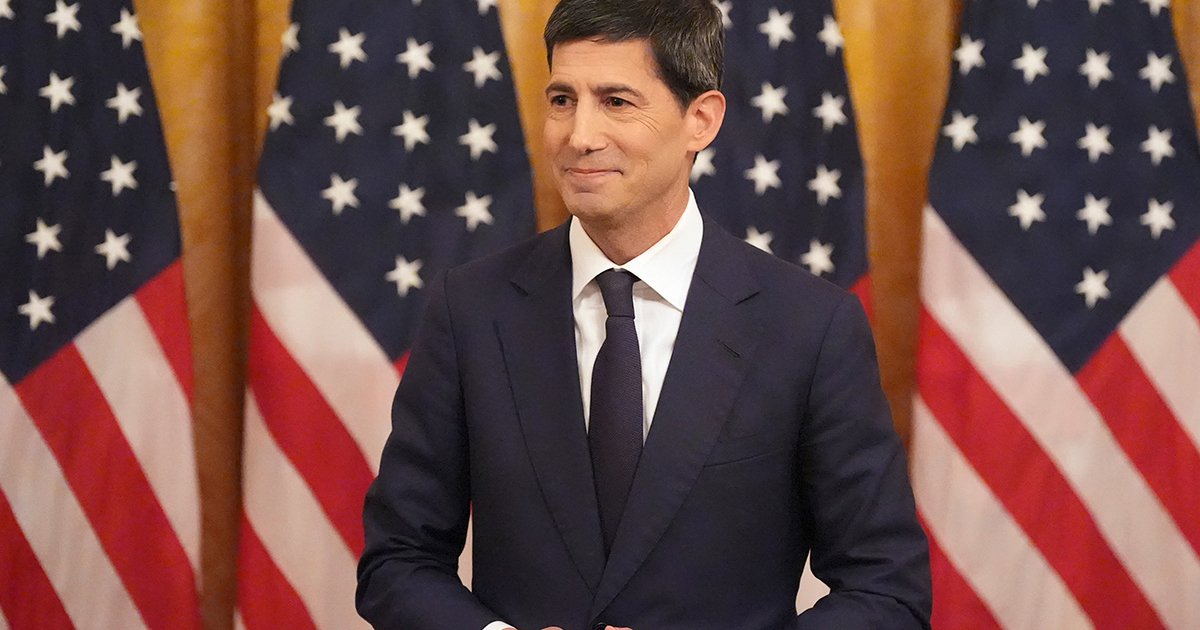
Federal Reserve Chairman Kevin Wersh speaks during his inauguration in the East Room of the White House on May 22. (Alex Brandon/AP)
| Update:
key takeaways:
- The Federal Reserve held its benchmark rate steady on June 17, but about half of policymakers indicated they could support a rate hike later this year.
- The change reflects concerns about inflation persisting at a three-year high and reverses earlier estimates that had expected a rate cut.
- The Fed’s outlook and communications approach may evolve under new Chairman Kevin Wersh, as officials consider a possible rate increase if inflation does not subside.
WASHINGTON — The Federal Reserve left its key rate unchanged on June 17, yet nearly half of the central bank’s policymakers said they could support a rate hike later this year, an unexpectedly hawkish outcome that will dismay President Trump and suggests growing concerns about persistent inflation.
In an unusually brief statement after their two-day meeting, Fed officials omitted language that suggested their next move would be to cut their key rate. The brief statement reflects the influence of Trump’s new chairman, Kevin Wersh, who has previously criticized the Fed for commenting too broadly on the economy.
In a set of quarterly projections, nine Fed officials said they expect at least one rate hike this year, with six supporting two or more. That’s a sharp change from March, when no policymakers planned an increase and the committee projected a cut in 2026. The shift is an acknowledgment that inflation is at its highest level in three years and that several officials have said in recent speeches that if inflation does not decline, higher rates may be necessary by the end of the year.
All told, another eight officials indicated they would support keeping the rate unchanged, and one ruled out a cut.
Here’s another sign of how Warsh might change the way the Fed operates: He appears to have offered no forecast about how the Fed might change its key rate. The chart showing projections showed only 18 points, even though there are 19 policymakers. He has previously criticized projections for potentially locking the Fed into a specific policy approach. The Fed also provided guidance from its policy statement.
Warsh also told reporters at a press conference that he was forming five task forces to examine such areas as how the Fed communicates, the sources of data it uses in making policy decisions and the structure of its quarterly economic projections, with the goal of ensuring that the Fed “keeps clear-eyed and focused on the future.”
The policy meeting is the first for Wersch, who was appointed by Trump after the president sharply criticized Wersch’s predecessor, Jerome Powell, for not lowering rates low enough. The attacks largely backfired as they prompted Powell to remain on the Fed’s governing board, where he voted to keep rates at around 3.6% on Wednesday.
Wersh now faces a tough choice: The Fed typically wants to combat inflation by slowing borrowing and spending and raising interest rates to cool the economy. Yet such a move could draw the ire of the White House and raise the cost of mortgages, auto loans and other borrowing just before the midterm elections.
If the Iran war is resolved, gas prices are likely to continue falling and inflation may ease in the coming months. But prices for many goods and services – such as clothing, dental care and child care – were rising before the Iran war, and inflation has been above the Fed’s 2% target for five years, suggesting the economy may still be under inflationary pressure.
Warsh said Fed officials are unanimous in their commitment to providing price stability.
“We’ve missed the mark (on inflation) by five years and we’ll fix that,” he said.
Warsh also faces an economic environment that is vastly different from the one he faced when he campaigned for Fed chair last year. At the time, he was outspoken in favor of lower interest rates, as Trump has sought. He pointed to the development of AI as a technology that could expand the economy’s ability to produce goods and services cheaply, which would reduce inflation over time.
Federal Reserve issues #FOMC statement: https://t.co/JSpXeae2Wc
– Federal Reserve (@federalreserve) 17 June 2026
Even then many economists were skeptical of his claim. At least in the short term, analysts say increased investment in semiconductors and computing equipment is contributing to higher inflation.
Indeed, since the Iran war began on February 28, inflation has risen to a three-year high of 4.2%, driven mostly by expensive gas generated by the Iran war. The Fed typically fights high inflation by raising its key interest rate to reduce spending and growth.
Trump has announced a preliminary peace deal that could end the three-month conflict, but it is unclear whether the peace will last. And even if oil flows freely from the Middle East again, it could be months before prices for commodities like gas, groceries and airline fares drop.
At the same time, hiring has picked up in recent months, removing a key justification for cutting rates. In January, the Fed estimated it would cut rates twice this year, as part of its quarterly economic projections. A big reason for those potential cuts is that employers were shedding jobs and policymakers were concerned the unemployment rate would rise. The central bank typically cuts its key rates to boost economic growth and hiring.
But a government report earlier this month showed that hiring jumped in May, when employers added 172,000 jobs, the third consecutive month of solid job gains.
On Wall Street, stocks fell after economic projections revealed expectations of higher rates at the end of the year among some Fed officials. Asked whether changes, such as revising what’s included in those projections, could spook markets, Warsh said, “I think financial markets perform best when they react to incoming data. They work less effectively when they ask, ‘How will the Federal Reserve react to that information?’ ”