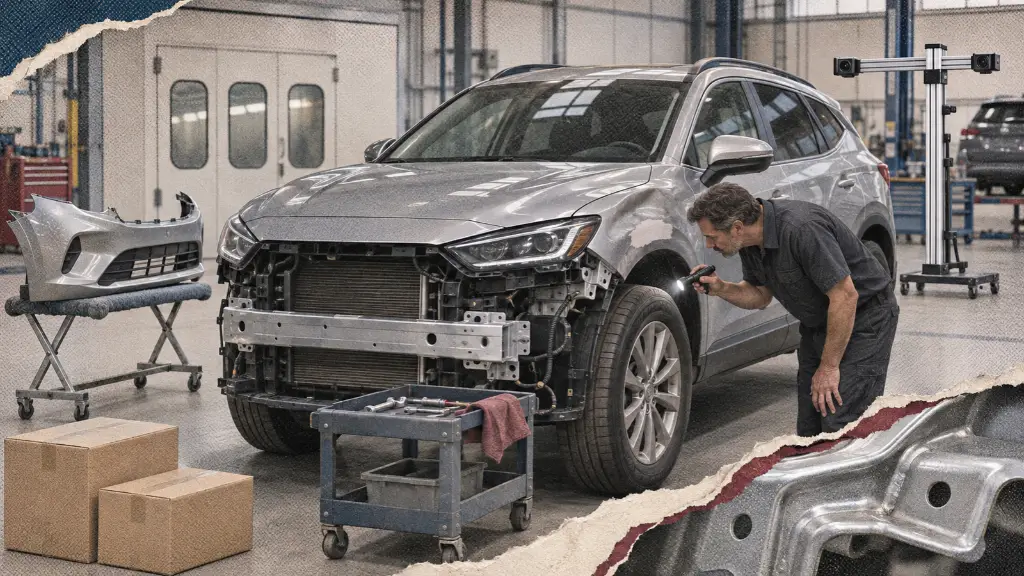
Federal Reserve advisor Kristen Dziczek says repairers are seeing how tariffs, vehicle technology, insurance costs and consumer finances are affecting the industry, while labor availability and auto credit remain key indicators to watch in 2027.
- Collision repair shops provide an early view of economic pressures through changing parts costs, repair complexity, insurance deductibles and consumer spending decisions.
- Hybrids now account for about 16.7% of the vehicle market, while the EV reset has redirected automaker investment and shifted industry attention toward electrification alternatives.
- Auto credit delinquencies, lending standards, repair costs, insurance gaps and the labor pipeline are among the issues Dziczek says the industry should monitor in 2027.
During The Industry Exchange at the Collision Industry Conference in Las Vegas, over the weekend, Kristen Dziczek, Senior Policy Advisor at the Federal Reserve Bank of Chicago, said collision repairers see firsthand how broader economic changes affect consumers and businesses.According to Dziczek, shops currently feel the effects of:
- Tariffs increasing the cost of parts
- New vehicle technology requiring additional calibrations and creating payment disputes
- Higher insurance deductibles
- Lower losses per mile but higher losses per collision.
She also notes that the automotive industry accounts for about 5% of U.S. GDP and employs more than 1 million people. While the industry connects major economic sectors, including steel, aluminum, copper, microchips, oil, critical minerals, lenders, insurers and repair businesses, she said conversations with industry participants help the Federal Reserve understand economic conditions beyond what mathematical models and traditional data show.
Despite elevated gas prices, tariffs and supply chain disruptions, vehicle sales have held steady at around 16 million units, and Dziczek said consumers have kept buying without a significant pullback. Still, the buyer mix points to strain, since new-vehicle buyers tend to have six-figure incomes while auto delinquencies have reached their highest level since 2010.
Meanwhile, the EV reset has shifted attention toward hybrids, which account for approximately 16.7% of the vehicle market, while EVs overall account for about 24%. Dziczek said the EV reset cost automakers approximately $100 billion in capital, while other global markets continue advancing electrification.
New repair challenges pending
Dziczek also identified two technology developments with significant implications for collision repair, such as manufacturing changes that reduce vehicle part counts and advances in ADAS and automation. Automakers are adopting gigacasting and other methods to simplify production and lower costs.
Ford, for example, announced in August 2025 a roughly $5 billion investment in EV production, including a new platform that targets a starting price of about $30,000 for a midsize electric truck. Ford said the platform uses fewer parts, including a wiring harness more than 4,000 feet shorter than the one in its first-generation electric SUV. However, Dziczek said fewer parts can make vehicles easier to manufacture but not necessarily easier to repair.
ADAS features add to that complexity by requiring calibrations, and she noted that even vehicles with advanced safety features can sustain expensive damage when another vehicle strikes them. Dziczek also said the industry is watching federal regulatory activity around automated driving and safety standards.
AI is changing manufacturing & service
Automakers now use AI in product design, supply chains, engineering, manufacturing quality, safety and vehicle systems. Dziczek described a vehicle that monitors its performance, alerts the driver when it starts to fall outside specifications, schedules service and orders parts through the dashboard. Some manufacturing operations already run without workers on site.
According to a recent federal study, manufacturing’s AI adoption remains slightly below that of other business sectors but is increasing rapidly, and Dziczek said the rate of change is about twice that of the overall economy. Technology-driven productivity gains could lower production costs, but savings depend on scale, market forces, policy and consumer decisions. Meanwhile, consumers continue paying more for vehicles as they choose additional features, and insurance, maintenance and repair add to ownership costs.
On the other hand,Dziczek said repair costs are rising, driven in part by labor costs and labor availability, while repair rates vary by vehicle brand, repair type and parts costs. Insurance costs are also complex, and consumers may not understand the consequences of choosing lower-cost coverage.
Ultimately, the Federal Reserve distinguishes temporary price shocks from sustained inflationary pressures, and Dziczek said tariffs have so far created a one-time price shock rather than an ongoing inflationary trend. Auto prices rose 1.5% in the most recent month discussed, compared with overall inflation of approximately 3.7%. She warned that disruptions involving the Strait of Hormuz could affect fuel, plastics, aluminum, helium and semiconductor production, creating broader economic pressure.
Tagsauto industryAuto Newsautomotive tariffscar businesscollision repair shopFederal Reservegas pricesRetail Automotive