Every time electricity moves through a conventional data-center power chain, it loses energy at each AC-to-DC conversion stage. AI workloads amplify that problem, because GPU clusters swing power demand rapidly and unpredictably.
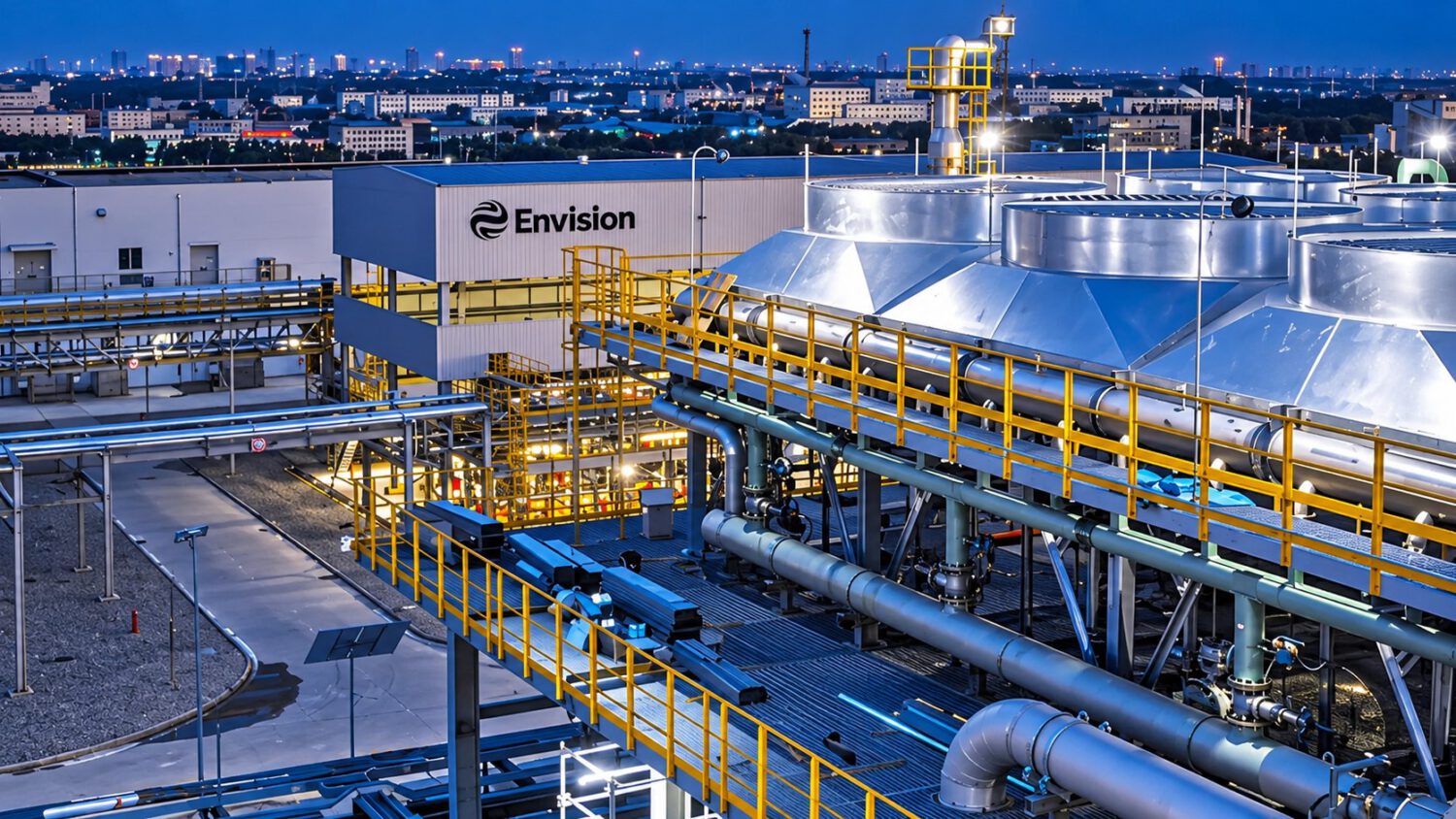
Envision Energy says it has addressed that with Dubhe, its integrated 800-volt DC power platform, now operating at the company’s Galaxy AI campus in Ulanqab, Inner Mongolia. The campus began operations in August 2026.
How the Architecture Works
Solid-state transformers take grid-level AC and deliver DC directly to AI racks, removing the conversion steps where efficiency typically bleeds away.
The core of the system is a solid-state transformer: a compact, semiconductor-based device that replaces conventional iron-core transformers. It takes 10 kilovolt medium-voltage AC from the grid and converts it directly to an 800-volt DC bus.
That direct conversion is designed to reduce the intermediate stages where energy is typically lost as heat. Fewer stages means less equipment between the grid and the rack.
Integrated battery storage is intended to absorb the rapid demand spikes that GPU clusters generate, providing power support within seconds and several minutes of backup during interruptions. The Dubhe Controller, supported by Envision’s Dubhe Energy Foundation Model, coordinates the transformers, batteries, and DC voltage regulation hardware to balance renewable supply against live computing demand.
The Stated Advantages
Fewer conversion stages, smaller equipment, and denser racks are among the benefits Envision asserts; no independent audit has verified those outcomes.
Envision says the architecture reduces conversion equipment size, enables denser AI rack deployments, and lowers resistive transmission losses by distributing power at higher voltage. Higher voltage means lower current for a given load, which in principle reduces the amount of copper cabling required.
“Our integrated 800V DC system is now powering live computing workloads, demonstrating an end-to-end architecture that connects renewable energy supply with computing demand.” Kevin Huang, Senior Vice President and President of Energy Storage and AIDC Power Systems, Envision Energy.
Deployment Versus Scale
The company confirms real workloads are running, but the 3-gigawatt campus and one million accelerators are future targets, not current facts.
The Galaxy campus is planned to reach 3 GW of capacity and eventually support up to one million AI accelerators operating in parallel. The announcement did not disclose the current live load, the number of accelerators presently connected, or the installation’s operating capacity.
The company also says more than 80% of campus power is planned to come from direct renewable electricity connections. That figure, like the accelerator count, describes an intended future state.
The Verification Gap
Efficiency gains, copper savings, and power-utilization figures all come from Envision, and no independent measurements have been identified in the reviewed reporting.
The announcement and reviewed reports do not provide independently audited figures for the system’s total efficiency improvement, power-utilization effectiveness, rack density gains, or copper reduction. The “world’s first” designation is Envision’s own claim; no independent validation was identified in the available reporting.
The 800-volt DC architecture is also slated for Mission Gobi, Envision’s initiative targeting 5 GW of AI data-center capacity in desert regions by 2030. Whether the technology holds up at that scale will depend on long-duration reliability testing, standardized protection practices, and independent validation not yet provided in the reviewed reporting.