BT BIG STORY: Car sales hit a high during the festive season. Will rising prices slam the brakes? – BusinessToday
Search
Advertisement
Business News
auto
BT BIG STORY: Car sales hit a high during the festive season. Will rising prices slam the brakes?
Carmakers are riding a wave of strong demand, but higher input costs and fresh price increases could test consumers’ appetite for new vehicles
Carmakers in India have posted record sales so far in FY27, aided by the Goods and Services Tax (GST) rate rationalisation that made passenger vehicles more affordable from September last year.
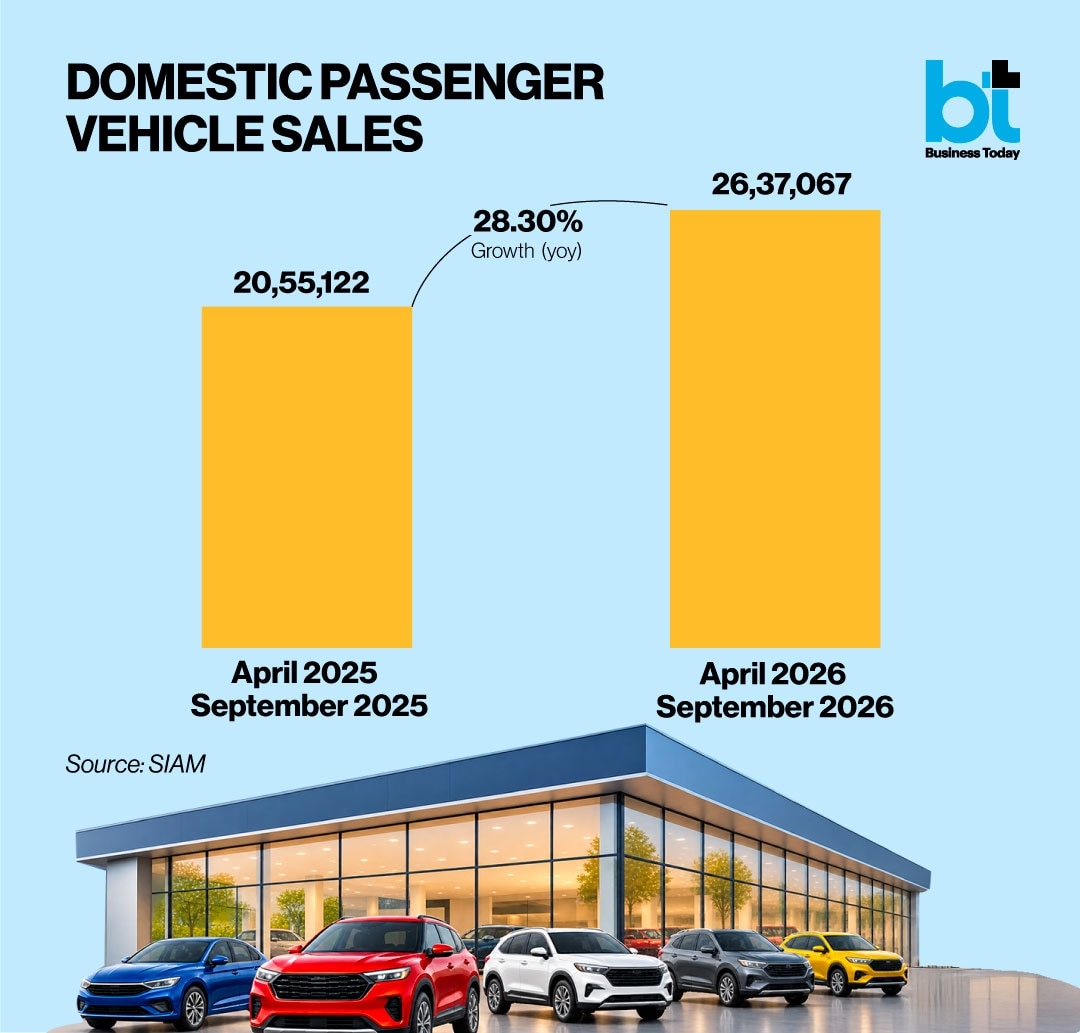
According to data from the Society of Indian Automobile Manufacturers (SIAM), passenger vehicle wholesales grew 28% year-on-year to 2.64 million units in the first six months of FY27. Growth was even stronger in the second quarter, with volumes rising 30% to 1.37 million units.
Maruti Suzuki, India’s biggest carmaker by volume, reported a 37.8% year-on-year increase in domestic wholesale volumes to 5,65,000 units in Q2 FY27. Hyundai’s domestic sales rose 18.8% to 1,65,772 units.
Can this record-sales momentum last through the festive season? Despite recent price increases, commentary from both carmakers’ earnings calls points to sustained demand.
There is reason for optimism: Maruti Suzuki’s order book has grown despite robust sales.
“What is particularly encouraging is the order pipeline continues to strengthen even alongside these high retail volumes,” Rahul Bharti, Senior Executive Officer, Corporate Affairs, Maruti Suzuki, said in an analyst call after the automaker announced its earnings for the quarter ended September.
“Pending customer orders increased from 2,00,000 units at the end of September to 2,70,000 units by Dussehra on October 20, 2026,” he said, adding that the underlying demand environment remains robust.
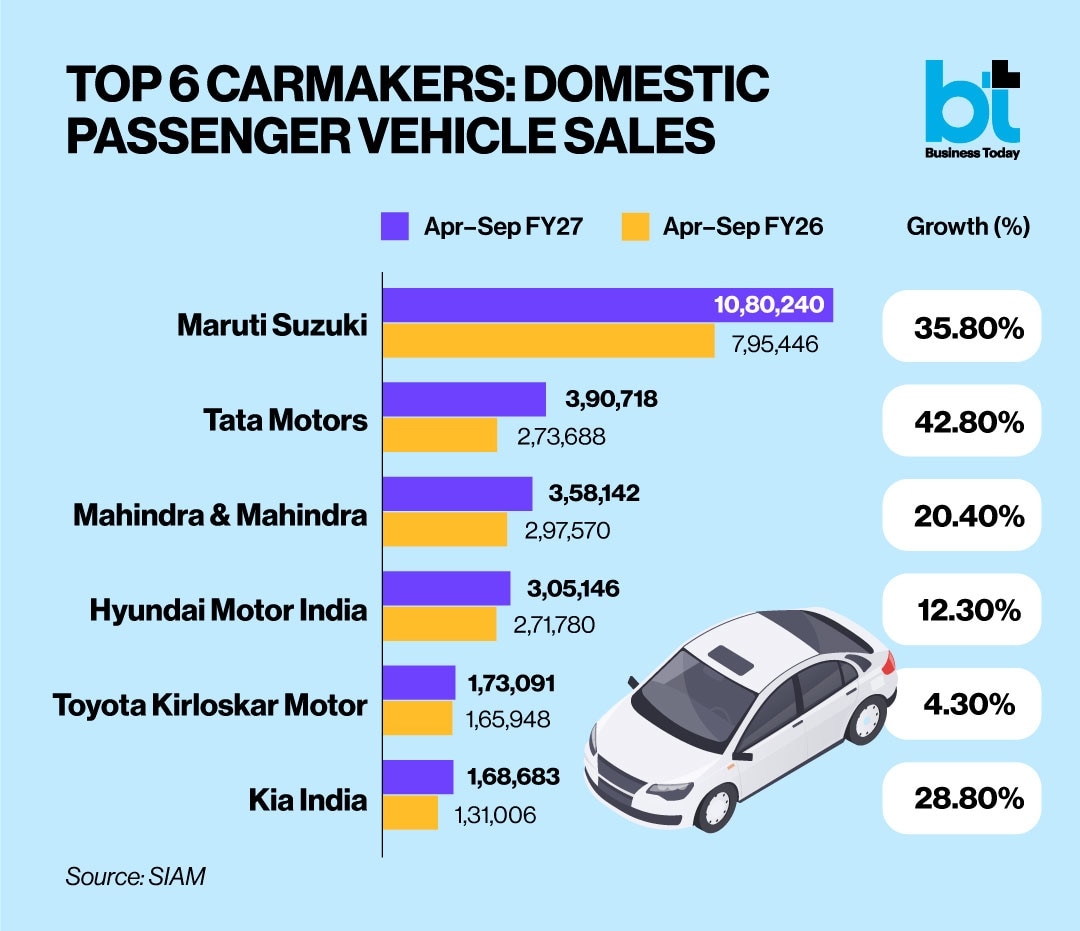

Maruti Suzuki expects domestic sales to grow by at least 10% in the second half of FY27. Hyundai Motor India is confident of meeting its domestic sales growth guidance of 8-10% for FY27, banking on new products led by its newly launched SUV Beyond.
The momentum continued in October. Maruti Suzuki recorded its highest-ever monthly domestic sales of 2,16,789 units, up 20% year-on-year. Mahindra & Mahindra reported its highest-ever monthly domestic SUV sales of 73,338 units, up 2%, while Hyundai Motor India posted record domestic sales of 62,799 units, up 16.7%.
Tata Motors Passenger Vehicles recorded domestic sales of 73,894 units, an increase of 21% from October 2025. Kia India also posted its highest-ever monthly domestic wholesales since entering the Indian market, selling 33,462 units, up 13.22% from 29,556 units a year earlier.
Is the growth sustainable?
Record car sales over the past year have been driven mainly by lower taxes following the GST rate cut. However, carmakers may raise prices again as commodity costs, especially those of steel and copper, remain elevated. Most passenger vehicle companies have already raised prices three times in 2026.
Hyundai Motor India is weighing a price hike before January if commodity costs remain elevated, while Maruti Suzuki India Ltd plans further price increases over the next six months to offset rising input costs.
Further price increases could erode affordability, a key driver of car ownership, particularly for first-time buyers.
“A lot of input costs hike has not been passed on to the customer. This will be passed in the coming months. Car prices will go up going forward. This could also pull down the growth,” said Puneet Gupta, Director, India & ASEAN Automotive Market, Mobility Global.
“In the first six months of FY27, growth has been in higher double digits. Now, the base is already very high, growth will be a problem,” said Gupta. “Growth percentage will not be in double digits at least in the next two quarters. Double-digit growth rates are gone,” he added. For the full fiscal year FY27, Gupta forecasts 11-12% growth for the car industry.
Gupta said most factors influencing auto sales were unfavourable, pointing to the recent repo rate hike.

Around 80% of cars sold in India are bought on credit.
“We may see another rate hike in the coming months. Fuel prices are already going up. Stock markets are down. Most of the driving factors are not in favour of the auto industry. We have seen whenever the repo rate goes up, disposable income comes down because a big part of earnings goes into EMI,” Gupta said, adding that all these factors will pull down growth for the passenger vehicle industry.
Despite these headwinds, Gupta sees enough momentum to sustain sales over the next six months. “Considering the momentum built up over the last one year, there have been a lot of bookings which are yet to be converted. Inventory levels at dealerships are low, so carmakers can fill in inventory at the dealer network,” he added.
Srikumar Krishnamurthy, Senior Vice President and Co-Group Head, Corporate Ratings, ICRA, says the ongoing festive season comes against last year’s elevated sales base, driven by the GST 2.0 effect.
“Our channel checks indicate healthy enquiries and conversions so far. However, whether this momentum can be sustained throughout the festive period remains to be seen, given inventory concerns for specific models and vehicle price increases in recent months, despite continued promotional offers,” Krishnamurthy added.
All eyes on the US midterm elections
Despite margin pressure from higher commodity costs, India’s biggest carmaker plans to wait until after the US midterm elections before deciding on price increases.
“There is US midterm elections in November. There is some possibility, nobody knows though, that post that geopolitical tensions may settle down. Instead of taking a short-term knee-jerk reaction, we could possibly wait for a quarter and see where the commodities stabilise,” Bharti told analysts during the company’s Q2 earnings call.
Speaking during Maruti Suzuki’s post-earnings media conference call, Partho Banerjee, Senior Executive Officer of Sales and Marketing, cited IMD data showing a rainfall deficit of almost 24% in some states due to the El Niño effect.
“Right now, the impact is not there… Some of the states are facing stress. In the times to come, there could be some stress in the rural market,” said Banerjee.
Over 50% of Maruti Suzuki’s sales come from rural areas.
Hyundai, meanwhile, expects rural growth to continue outpacing urban growth despite rainfall deficits in certain states. Rural India contributes 26.9% to Hyundai’s sales volume.
According to Gupta, drought could affect the rabi crop in some rural areas, potentially pushing up inflation and triggering another repo rate hike.
ABOUT THE AUTHOR
Karan Dhar is Associate Editor at Business Today. He has over a decade of experience as a business journalist. He tracks mobility, retail, FMCG and other corporate developments.
Published on:Nov 3, 2026 6:00 AM IST