By Reginald Jerome De Mans*
I wore a pair of Gurkha trousers that day. Those wide-waisted eccentricities that looked so cute on friends’ fit posts, their criss-crossing straps were so spectacularly uncomfortable, they reminded me of the old sower/reaper meme:
“I’m wearing Ghurka pants: Haha fuck yes!!! Yes!! I have to take them off and on again to use the bathroom: Well this is bullshit. What the fuck.”
He also told me about forum groupthink, which is the phenomenon of subtle tendencies adopted by readers of discussion forums, inspired by the prevailing discourse there. Today it seems as quaint and bygone as the self-correcting test of antiquity for one Which I kept using.
Apart from the Ghurka trousers, various intriguing artefacts in my wardrobe testify to the persistence of that lost time. But is that all I have to show for the hundreds of wasted hours?


Time wasters in the early 2000s, often young professionals or students, found that those forums had their own petri dish of every possible subculture on the Internet. What made them subcultures rather than cultures or hobbies? For one thing, it’s embarrassing to admit interest in them publicly.
A forum allowed virtual participation – anonymously behind a silly username – and people from all over the world came together for a community to share knowledge and experience, to the extent that we had anything to add to the written sources (mainly Flusser and Roetzel, and the occasional unreliable magazine article).
What resulted was by no means pleasant or healthy, but it created community: a shared interest allowed the men to discuss just about anything. Then the handful of people who came to lead the discourse attracted followers who emulated them, creating standards.
Leading the discourse requires speaking with only a little authority, at least until the time comes to present evidence – experience with a given tailor or manufacturer, experience with what a given city has to offer, or posting an appropriate photo. The rest of us have to clear our minds of some of the ideas we might have otherwise received.
What filled our minds, along with the silly jokes, was the confluence of priorities and standards that found themselves aligning based on a handful of posters that set the tone. And those preferences defined by groupthink became their own recognizable characteristics, their own inside jokes, in a way.
Once the forum heads had set aside what we thought we knew, one of the most prominent tropes they instilled in us was a widespread preference for British manufacturers.
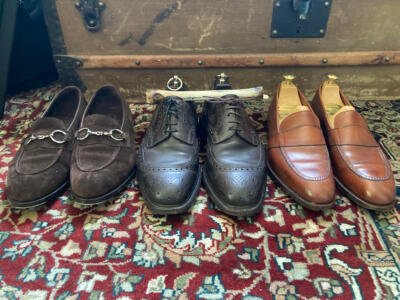
Of course, gatekeeping and judgmentalism won’t accept anything but the best, so these can’t be any British shoes, but Edward Green in particular liked hair more than John Lobb Paris ready-to-wear for some reason.
Green’s model names (especially the infamous Dover, an example of Green’s particular expertise in invisibly sewing skin to boar’s bristles) became as famous to many of us as saints’ calendars. Even I eventually succumbed to Dover and bought a two-tone version, which I eventually found out about and sold.
Since forum members love bargaining as much as they love showing each other off, they even tried parallel importing these shoes, from international retailers who promised the lowest prices.
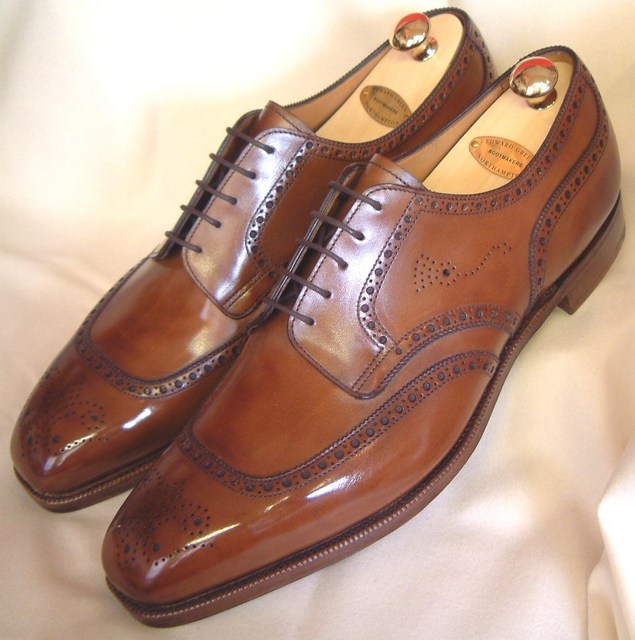
My most group-think was the Green Order Windsor, a heavily brocaded derby whose peculiarity (apart from having a thistle punched in the side) was that, rather than having a wingtip or cap toe, it had a U-shaped tip.
It was a group order from the previously secret London Lounge, a forum with restricted membership, and they had specified that it was to be built on the old Edward Green last, the gently squared ‘Great 88’ (since replaced by several generations of last that refined the shape – the 808, Ralph Lauren’s 89, the 888 and so on).
Groupthink from a different forum inspired me to order the shoe in cordovan. Then I got caught up in online discussions about deer bones and wasted countless hours trying to rub those things together with a bone. Over time I learned that cordovan is extremely heavy, wears very hot, doesn’t polish like normal leather shoes… and deer bones can remain in roadkill.
The nonsense about rubbing them on hides for their supposed magical oils is useless, except if one is polishing some waxy leather. And, a confession I can’t believe I’m doing, I bought an oriental rug so I could take pictures of my new shoes on it the way other members of the forum did…
Groupthink led me to another purchase beyond my usual tastes, LongWings, whose wing tip extends to the back of the shoe. However ordering them from Green caused one group to think against the other, as they were neither from Alden nor Cordovan (classic manufacturers and materials).
I generally managed to avoid most of the American species of groupthink, including the obsession over perfect Oxford cloth button-down shirting, collar rolls, and generosity of fit.
The American trade look and its ethos took a very defined shape among a deeply felt sub-population in the mid-2000s, taking a strange turn in 2009 when large numbers of genuine Harris Tweed sports coats arrived at the Boston branch of discounter Primark, following the disastrous decision by the main Harris Tweed buyer to reduce Harris Tweed’s myriad patterns to five. Members of one forum began purchasing and returning sports coats to place on Harris Tweed-branded hangers.
I succumbed to a trick of the trade, ordering a suit with 3-roll-2 buttoning points that he liked very much. Not one to adhere to every detail of a given norm, I had it made by a British tailor (on reflection, conventions favor British fabric, but not British-made, except for the shaggy dog sweaters that old drummers used to knit). However, the result wasn’t great, looking like a normal two-button jacket with an almost invisible residual third…
In the same suit I asked my tailor to include a little Gallic allusion Cran Parisien (or fish mouth) lapel notch. And this is where we get into the French flavor of groupthink.
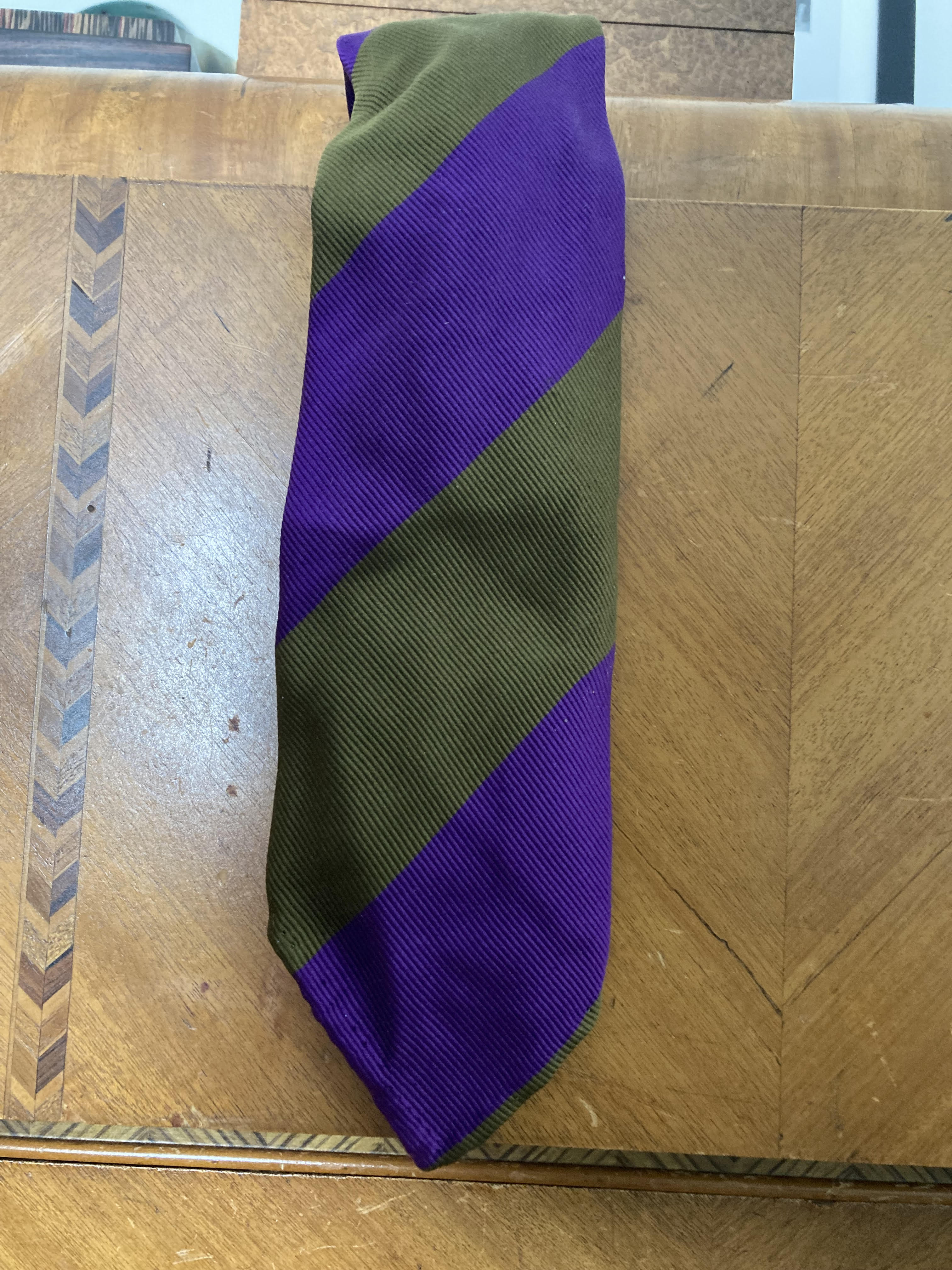
Cran Parisien I came from a list of Arnies, and any mention of Arnies on stage couldn’t avoid touching on its house specialty, the Forestier work jacket. As often happens, my illusion actually broke on one try – I found it loose and unpleasant – but I bought a ridiculous seven times as many of them. Cravats d’atelier With hand rolled edges.
I admit that I contributed to the myths by sharing what I knew about Arnese and other Paris makers in the salad days of the forum (and, dare I say it, in a book written many years ago, Swan song).
In those days, wearing a handkerchief of any kind, let alone a fancy printed pocket square, was a rare thing, and that led me to discover the medieval-printed handkerchiefs once made by Drake for Holland & Holland.
Then another member showed me that the Paris branch of Hilditch & Key had once specialized in releasing similar prints on cashmere rather than the silk or wool used by Drake. That particular revelation became one of many rabbit holes I led fellow forum members down.
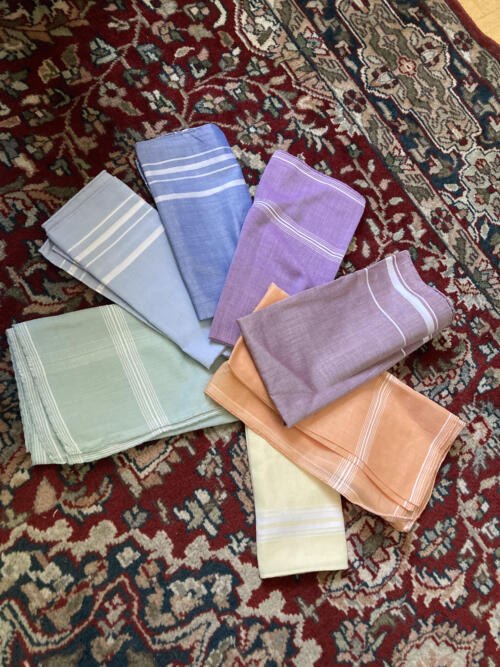

I remember the day when French weaver Simonnot-Godard’s cotton handkerchiefs became a sensation. One spring day in 2007 the late shirtmaker Alexander Kabbaz mentioned stocking them, and the next moment they started appearing everywhere, these extremely fine, fancy handkerchiefs that became the house cotton handkerchiefs of Charvet and Hermès…
stage piece de resistance There was a Simonnot-Godard piece whose quadrants were different types of madras plaid, so the wearer could have one of four ugly patterns sticking out of their breast pocket at any time. I admit I bought it and eventually outgrew it, but I have owned (and continue to acquire more) their beautiful fine cotton handkerchiefs in solid pastel colors.
The key, I think, is to gain enough confidence to reject some of the things that are imposed on us, and find out what we really want. I never bought SG’s much-vaunted Chambray shirting fabric, although based on my old guide to different types of shirting fabrics, Kabbaz asked me to try Zendalin from Charvet’s leftover stock.


Otherwise, Forum-approved fabrics were generally British, with flashy luxury textile houses such as Dormeuil, Scabal and Loro Piana derided as overpriced and often flimsy. Perhaps reverse arrogance also played a role.
In any case, I spent most of my time ordering custom tailoring in flight to British security. I set out to try the platform-favorite Fresco fabric, one of the various weaves that supposedly make suits easier to wear in warm weather (in the end, warmth and comfort should both be relative)…
In 2008, I joined the crowd of online friends buying longwear from J&J Minnis before its acquisition, out of fear that whatever the new Minnis would produce would be in short supply.
I was all dressed up in a Forum-approved drape-cut suit, double-breasted with a 4×1 ‘Kent’ keystone buttoning point, so named after the Duke of Kent, who made his older brother the Duke of Windsor look responsible and balanced. The forum uproar about the drape cut and its exponents in Savile Row highlighted Anderson and Sheppard’s old adage that some swore by them, some swore by them.
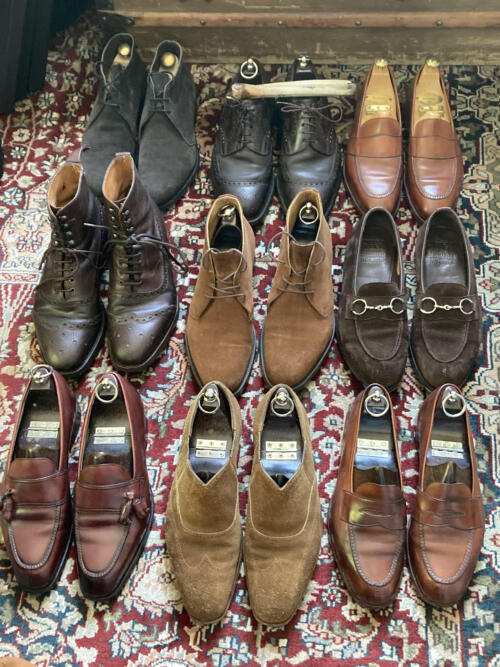
What did groupthink mean? Protecting purity, a secret signal that is transmitted only on the Internet of shared tastes. Many of us needed that purity, because when we got into it we lost confidence in our own ideas and taste in clothes.
Eventually we learned to trust our own choices again – to find our own truths, whether before or after exiting the stage orbit due to job changes, spouse and family demands, or simply maturity.
Today, social media is the most powerful generator of groupthink, but this is different. The forums were participatory: even if not egalitarian – the opinions of some members were given very high weight – opinions were based on the tastes of the dynamically changing group, unlike social media executives who merely impart their knowledge to the audience.
From my description above, it may seem that all I have left are a few artifacts and ghosts, memories of absurd discussions that helped pass the time. But some priorities have stood the test of time. I’ve just taken delivery of my umpteenth pair of Greens, for example, a remake of their bit loafer The Millfield, although I no longer post for fanciful effect the way I used to.
I also wear their old Minis-cloth suits often (usually with a Simonnot-Goddard handkerchief in the chest pocket) and love their fabric, even I’m quite happy with the new Minis product, one of my most recent suits is made in Prince of Wales check flannel from their current line.
Looking back, my platform days support a broader lesson I learned: Welcome knowledge, but consider the source and the context in which it is presented.
There have been many times in real life that I had to unlearn everything I thought I knew in order to relearn something from the basics. However, it is important to have access to a critical mass of knowledge that will allow me to be confident in my decision.
Some genuine friendships arose from the fleeting exchanges I had on forums, because looking back I realize I was not just looking for knowledge, but also a sense of community at a different time in my life.
Some connections, whether on group chats or in real life, have become firm friends, some constants of reliable and regular contact, where we exchange, as before, about more than clothes, but without the burden of carrying someone else’s preferences.
As in the old forums, our own quirks of dress and style often lead to good-natured ridicule from everyone else. Unlike before, now we all have enough trust in our priorities to laugh it off and move on.
*Last name of the author, a PS reader and frequent forum contributor