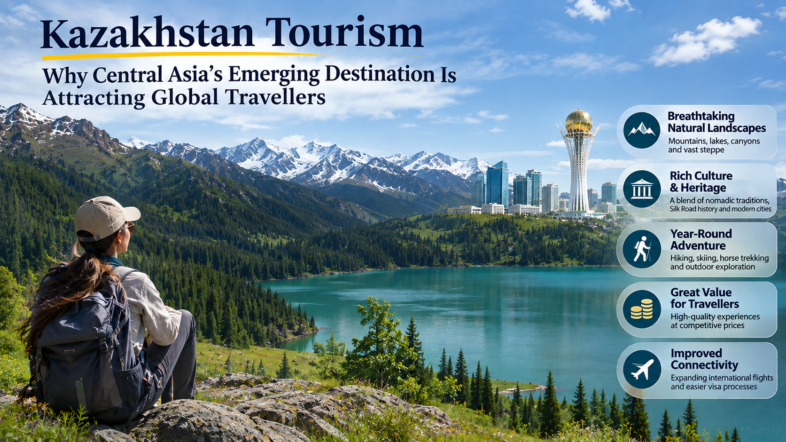
Nov 28: Kazakhstan is steadily gaining attention as an international travel destination, offering a combination of mountain landscapes, historic Silk Road cities, modern architecture and distinctive cultural experiences. Located between Europe and Asia, the country is attracting travellers looking for something different from conventional holiday destinations.
Beyond its appeal to visitors, Kazakhstan is developing a growing tourism economy. Investment in hotels, resorts, transport infrastructure and regional attractions is creating opportunities for hospitality groups, airlines, tour operators and local businesses.
The country’s visitor numbers reflect this growing interest. According to the Government of Kazakhstan, approximately 15.7 million foreign citizens visited the country in 2025, including 11.1 million tourists. International visitors spent around US$2.9 billion in the country.
The momentum has continued into 2026. Government figures indicate that Kazakhstan welcomed around 7 million foreign tourists during the first half of the year. Meanwhile, the national statistics agency reported that tourism services reached 91.2 billion tenge during the same period, an increase of 11.4% compared with the first half of 2025. This growth points to opportunities beyond visitor arrivals, extending into the wider hospitality and travel economy.
Almaty: Where City Life Meets the Mountains
For many international visitors, Almaty is a natural starting point for exploring Kazakhstan. Set against the Tian Shan mountain range, the city combines urban attractions with easy access to outdoor experiences.
Visitors can explore its parks, museums, cafés and traditional markets before heading towards the surrounding mountains. Shymbulak Ski Resort is a popular destination during winter, while the region offers hiking and sightseeing opportunities during the warmer months.
The nearby Big Almaty Lake, Charyn Canyon and Kolsai Lakes are also popular additions to travel itineraries. Their dramatic scenery attracts nature lovers, photographers and adventure travellers.
The region is particularly important to Kazakhstan’s resort economy. During the first half of 2026, the Almaty mountain cluster recorded more than 1.2 million visitors and generated 57.1 billion tenge in accommodation services, according to the national statistics agency.
For hospitality businesses, this creates opportunities across mountain resorts, hotels, guided excursions, transport services and outdoor recreation.
Astana: A Modern Capital with Growing Tourism Appeal
While Almaty attracts visitors with its mountains and outdoor experiences, Astana offers a different introduction to Kazakhstan.
The capital is known for its striking architecture, spacious public areas and cultural attractions. Landmarks such as the Baiterek Monument, the National Museum of the Republic of Kazakhstan and the Hazrat Sultan Mosque give visitors an opportunity to explore the country’s modern identity and cultural heritage.
Astana is also strengthening its position as a destination for business events, exhibitions, concerts and sporting competitions. These activities attract corporate travellers and event visitors, creating demand for hotels, restaurants, transport and other services.
The city recorded approximately 830,000 tourist visits during the first half of 2026, representing a 12% increase compared with the same period in 2025. Around 187,000 of these visitors were international travellers, according to figures announced by the Astana city administration.
This growth highlights the potential of business, cultural and event tourism to support the capital’s hospitality industry.
Burabay: A Relaxing Escape into Nature
Travellers looking for a quieter holiday can consider Burabay, a destination known for its lakes, forests and distinctive rock formations.
Located in the Akmola Region, Burabay offers a relaxed setting for family holidays and nature-based travel. Visitors can enjoy boating, walking, scenic drives and time by the lakes, making it a welcome change from the country’s larger cities.
The wider Shchuchinsk-Borovoye resort zone is also attracting visitors. It recorded more than 116,000 visitors during the first quarter of 2026, according to government figures.
As interest in nature-focused holidays grows, destinations such as Burabay have an opportunity to attract more visitors through improved accommodation, better transport access and well-organised outdoor experiences.
Mangystau and Turkestan: Two Different Sides of Kazakhstan
Kazakhstan’s appeal is not limited to its cities and mountain resorts. Its regional destinations offer experiences that can make a longer holiday even more interesting.
The Mangystau Region, along the Caspian Sea, is known for its unusual rock formations, desert landscapes and dramatic natural scenery. It is particularly appealing to adventure travellers and photographers looking for places beyond the usual tourist circuit.
Turkestan offers a different experience, with a strong connection to the region’s history and cultural heritage. The city is home to the Mausoleum of Khoja Ahmed Yasawi, a UNESCO World Heritage Site and one of Central Asia’s important historical landmarks.
Both destinations offer scope for specialised tourism experiences, including guided heritage tours, photography trips, regional food experiences and nature-based itineraries.
Tourism Investment Is Creating Opportunities for Hotels and Travel Businesses
Kazakhstan’s tourism ambitions are supported by investment in accommodation, transport and visitor infrastructure.
According to the Government of Kazakhstan, the tourism sector attracted more than 2.2 trillion tenge in investment during 2024 and 2025. A further 328 investment projects, valued at approximately 1.3 trillion tenge, are being implemented across the country. These projects are expected to create around 10,000 permanent jobs and support the development of 25 new internationally recognised hotel complexes.
The accommodation sector is expanding as well. Kazakhstan had more than 4,500 accommodation establishments by April 2026. A separate national tourism industry update reported 4,687 establishments operating during the first half of the year.
The resort market is also developing. During January–June 2026, Kazakhstan’s resort areas had 1,912 accommodation establishments and a total of 47,300 rooms. The number of rooms increased by 1.9% compared with the same period in 2025.
For international hotel brands, independent hospitality operators and investors, this expansion offers opportunities across luxury city hotels, boutique properties, mountain resorts and family-friendly accommodation.
However, adding more rooms is only part of the challenge. Maintaining service standards, training hospitality professionals and delivering consistent visitor experiences will be equally important if Kazakhstan wants to encourage repeat travel.
Better Connectivity Can Help Visitors Explore More of the Country
For a destination as geographically large as Kazakhstan, transport connectivity plays an important role in tourism development.
The government is working on road improvements, regional airport development and better access to resort areas. New tourist airport projects are planned in locations including Kenderli, Katon-Karagai and Zaysan, while road improvements are intended to make popular destinations easier to reach.
Better connections could encourage visitors to explore beyond the main cities. A traveller arriving in Almaty, for example, could combine a city stay with mountain excursions and visits to nearby lakes. Longer itineraries could include cultural experiences in Turkestan or nature-focused holidays in other regions.
For tour operators, the opportunity lies in making these journeys easier to plan through well-connected itineraries, reliable transport and locally guided experiences.
Sustainable Tourism: An Important Part of Future Growth
Kazakhstan’s natural environment is one of its biggest tourism assets. Its mountains, lakes, national parks and protected landscapes attract visitors interested in hiking, outdoor recreation and nature-based holidays.
The Government of Kazakhstan reported that visits to state national nature parks reached 3.7 million in 2025 and approximately 1.7 million during the first half of 2026.
This growing interest can support local businesses, including guesthouses, guides, restaurants and transport operators. It also makes responsible tourism planning increasingly important.
More visitors mean greater pressure on popular natural areas. Investment in waste management, visitor facilities, conservation and local tourism training will be essential to protect these destinations while allowing communities to benefit from tourism.
Why Kazakhstan Deserves a Place on International Travel Itineraries
One of Kazakhstan’s biggest strengths is the variety it offers within a single country. Travellers can experience modern city life, explore historic landmarks, spend time in mountain resorts and discover landscapes that remain relatively unfamiliar to many international tourists.
The country can appeal to several travel segments:
- Adventure travellers: Skiing, hiking, mountain excursions and outdoor activities.
- Cultural travellers: Silk Road heritage, museums, historic sites and local food.
- Families: Lakeside holidays, resort stays and city attractions.
- Business travellers: Conferences, exhibitions and corporate events in Almaty and Astana.
- Premium travellers: Upscale hotels, curated itineraries and specialised mountain experiences.
Kazakhstan can also become part of wider Central Asian travel itineraries, giving international visitors a reason to explore more than one country during a single trip.
For travel companies, this variety creates scope to develop packages for different budgets, interests and travel durations rather than relying on a single attraction or city.
The Road Ahead for Kazakhstan Tourism
Kazakhstan is building a stronger position in the international tourism market through infrastructure investment, expanding accommodation capacity and greater promotion of its regional attractions. Growing visitor numbers and the increase in tourism-related services indicate that the sector is becoming an increasingly important part of the country’s economy.
The next challenge will be to turn visitor interest into longer stays, repeat visits and sustainable business growth. Better connectivity, reliable hospitality services, effective destination marketing and the protection of natural and cultural attractions will all influence how successfully the country develops its international tourism profile.
For travellers looking for somewhere different, Kazakhstan offers a compelling mix of mountains, history, modern cities and outdoor experiences. As interest in Central Asia develops, the country has an opportunity to become one of the region’s most appealing travel destinations.