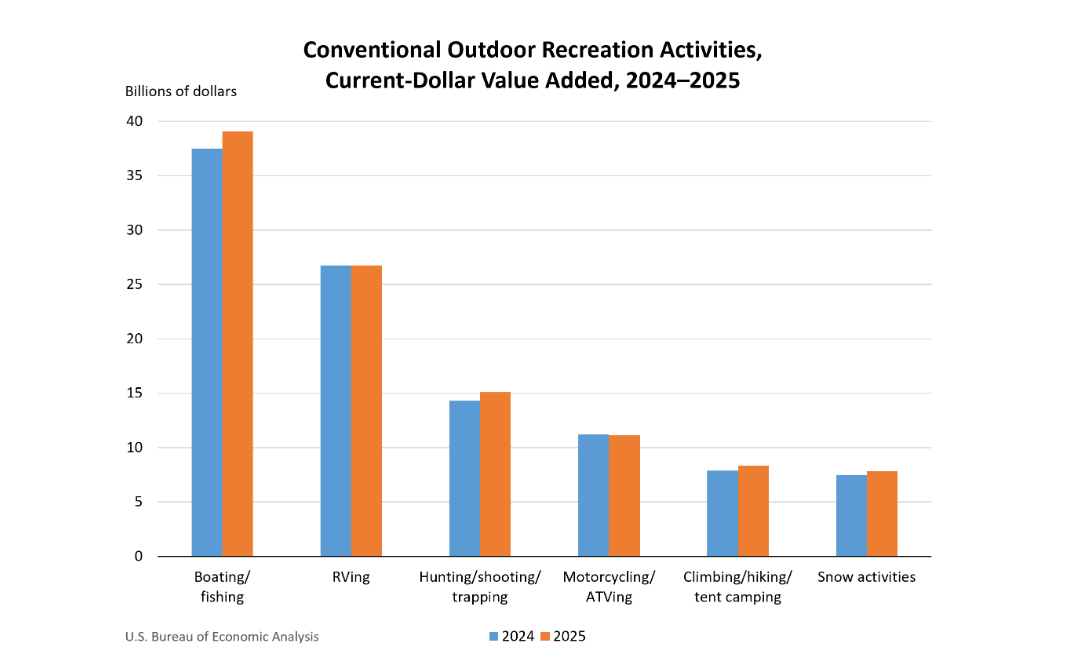
Motorcycling and ATVing generated $11.1 billion in economic value in 2025, maintaining their position as the fourth-largest conventional outdoor recreation activity in the United States, according to new federal data highlighted by MIC’s Ride Report.
The U.S. Bureau of Economic Analysis released its latest outdoor recreation economic data on November 18, showing that inflation-adjusted value added for the motorcycling and ATVing category increased 3.1% from 2024. (Images: BEA/MIC)
The U.S. Bureau of Economic Analysis (BEA) released its latest outdoor recreation economic data on November 18, showing that inflation-adjusted value added for the motorcycling and ATVing category increased 3.1% from 2024. The category includes motorcycles, all-terrain vehicles and recreational off-highway vehicles (side-by-sides).
Motorcycling and ATVing ranked behind boating and fishing,
Motorcycling and ATVing ranked behind boating and fishing, RVing, and hunting, shooting and trapping in current-dollar value added.
Overall, outdoor recreation generated $1.3 trillion in gross economic output and supported 5.3 million American jobs in 2025. The sector contributed $704.2 billion, or 2.3%, to U.S. gross domestic product. Inflation-adjusted growth reached 1.9%, compared with a revised 2.5% in 2024.
Motorcycle Industry Council (MIC) President and CEO Christy LaCurelle participated in an Outdoor Recreation Roundtable webinar Nov. 18 discussing the new BEA figures and the economic significance of outdoor recreation.
Millions of American families enjoy riding motorcycles, ATVs,
“Millions of American families enjoy riding motorcycles, ATVs, and side-by-sides, making it a key contributor to our nation’s outdoor recreation economy. BEA data helps measure that contribution and demonstrate its broader value,” LaCurelle says.
LaCurelle, who also leads the Recreational Off-Highway Vehicle Association and Specialty Vehicle Institute of America, said the powersports industry supports businesses of all sizes, creates jobs and generates economic activity nationwide, particularly in communities that serve as gateways to outdoor recreation.
The BEA’s annual outdoor recreation data provides a measurement of the industry’s contribution to the U.S. economy, including its impact on employment, economic output and GDP.
She also pointed to the importance of reliable
She also pointed to the importance of reliable economic data in demonstrating the industry’s contribution when advocating for public land access and investment in recreation infrastructure.
“Having reliable economic data strengthens the case for policies that support public land access and investment in recreation infrastructure, which in turn benefit our economy, our communities, and Americans’ health and well-being,” LaCurelle adds.
The BEA’s annual outdoor recreation data provides a measurement of the industry’s contribution to the U.S. economy, including its impact on employment, economic output and GDP. For powersports businesses, the figures offer another indication of the broader economic footprint of recreational riding and the businesses and communities supported by the activity.