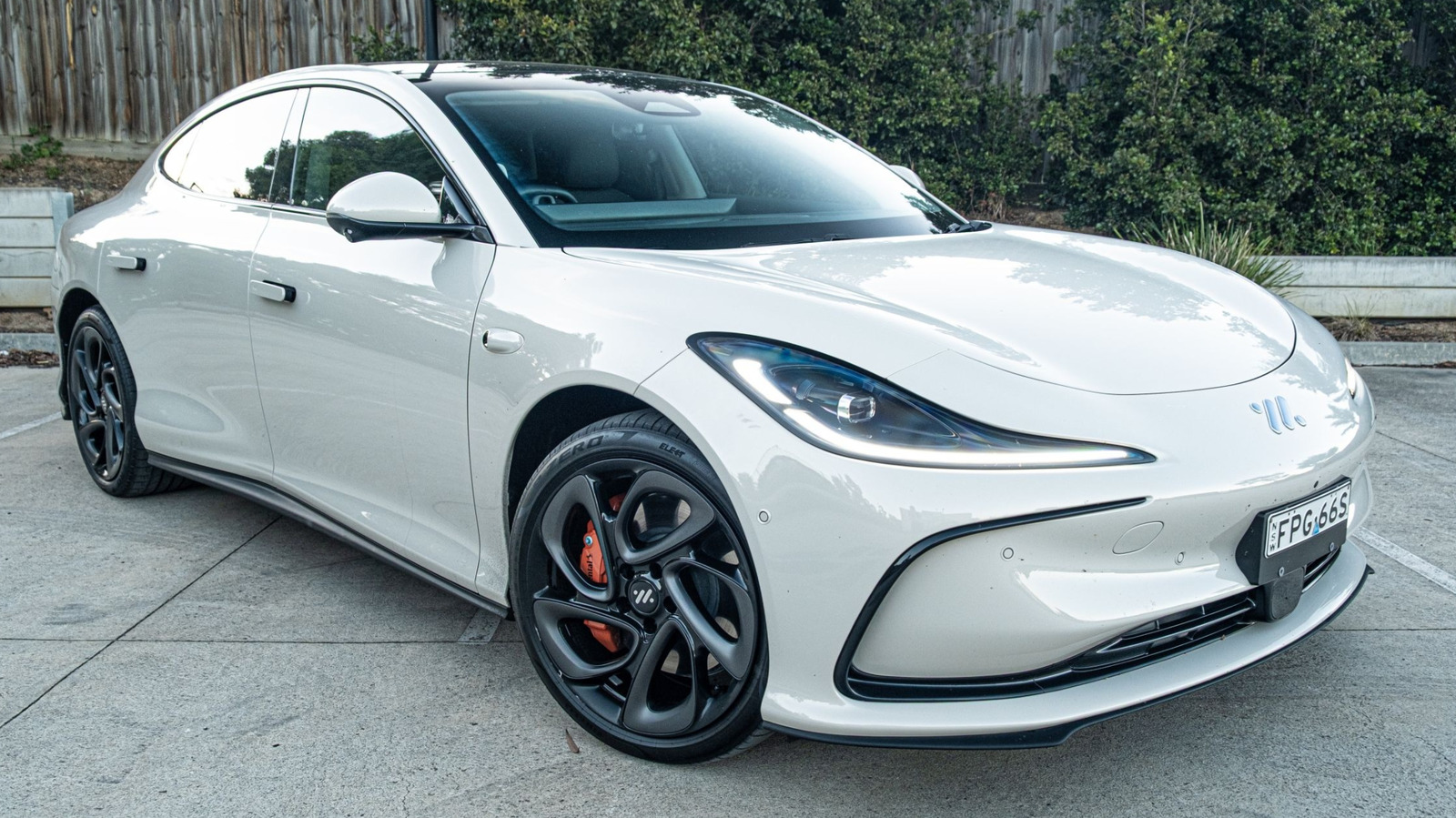
Can China’s latest 767-horsepower luxury EV do more than just rocket from 0-60?
Unless you live in Europe, Australia, or China, you may have never heard of IM Motors. The company was founded five years ago as a joint venture between SAIC Motor, Alibaba Group, and Zhangjiang Hi-Tech, and it’s among SAIC’s most premium brands. In Australia, it’s marketed as the luxury division of MG Motor.
Many of the new EVs emerging from China in recent years are SUVs. However, IM is one of those brands that believes sedans still play a crucial role in the future of the automobile industry, and we aimed to see if that’s true by spending time with one of its models. The oddly shaped sedan you’re looking at is the IM5 Performance, and it aims to take on the Tesla Model 3 Performance.
The IM5 Performance is rather insane, in all the best ways. Electric vehicles are routinely criticized for lacking personality, being a bore to drive, and largely failing to excite traditional automotive enthusiasts. The IM5 proved itself to be different.
What exactly is the IM5?
When the IM Motors brand was launched in Australia last year, the company’s official name was IM Presented by MG Motor. That wacky name appears to have been dropped, and it’s now simply being marketed as IM. The IM5 is one of two models it sells locally, with the other being the IM6. Whereas the IM5 rivals the Tesla Model 3, the IM6 has been crafted as a competitor to the Model Y.
There are three versions of the IM5, starting at a competitive AU$57,990 ($39,900), including all fees, and rising to AU$64,990 ($44,700), and AU$74,990 ($51,600) for the flagship Performance that we drove. It uses a sizeable 100-kWh nickel-manganese-cobalt (NMC) battery and two electric motors with a combined 767 horsepower (572 kW) and 591 pound-feet (802 Nm) of torque. To put those figures into perspective, a Hyundai Ioniq 6 N has 650 hp (478 kW) and 546 lb-ft (740 Nm) of torque, while the Model 3 Performance ‘makes do’ with 510 hp (380 kW) and 546 lb-ft (740 Nm).
The IM5 Performance’s claimed 0-100 kph (62 mph) time of 3.2 seconds is seriously rapid and matches the Ioniq 6 N, though is slightly slower than the Model 3 Performance’s 3.1 seconds. This in partly because the IM5 weighs about 400 kg (882 Nm) more, in large part due to the 100-kWh battery, whereas the Tesla has a 79-kWh pack.
A tech-heavy cabin
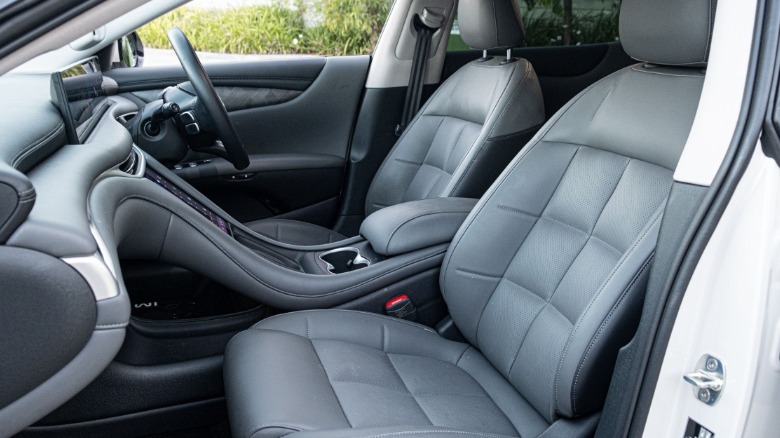
We’ve driven plenty of EVs from China over the past few years from ho-hum MGS6 SUV to China’s first-ever supercar, the Yangwang U9, and we’ve found that many of them have unimaginative interiors that look like exact replicas of what Tesla has done. The IM5 is a little different, sporting a cabin more reminiscent of a Porsche Taycan.
It includes a single, 26.3-inch display serving as both the digital gauge cluster and the infotainment display, and includes wireless Apple CarPlay and Android Auto as standard. Then, like a Porsche Taycan, the IM5 has a portrait-oriented 10.5-inch second screen that’s used to control most vehicle functions. It’s surprising that more modern cars don’t have a screen like this, as it’s easier to reach and control while on the move than the Tesla-style screens positioned further up on the dashboard.
The software used by IM is excellent, too. The screen is snappy and includes important shortcuts at the base of this portrait screen, including climate controls. On the home screen you’ll find certain commonly used vehicle functions, like the heated and ventilated seats, and a menu icon for the ADAS. Swipe right, and the screen brings up dozens of shortcut icons to turn on and off different systems, while a separate icon is used to access the vehicle settings. It operates much like a tablet. The learning curve is quite steep, but after my first drive, I quickly became familiar with it and was able to easily use it on the move without issues.
Taycan influences make the IM5 feel premium
Elsewhere, the IM5 Performance’s cabin is clad in soft-touch leather on the dashboard, door panels, center console, and steering wheel, giving it an upmarket and premium feel. It also comes standard with a wireless and ventilated phone charger and a pair of cup holders. The door pockets are small, as is the center console, so storage is a bit of an issue.
Like the front, the rear of the IM5 is a lovely place to spend time, and it has more headroom than a Model 3. Perhaps the biggest annoyance is that it includes a huge panoramic glass roof with no sunshade, just like a Tesla. The saving grace for the IM5 is that it’s available with an optional AU$109 ($75) sunshade, though it’s not retractable. Rear visibility is also extraordinarily poor as the window is absolutely tiny. The IM5 also has the smallest rear view mirror I’ve ever seen. If there was ever a car that needed a digital rear view mirror, it would be this one, but alas, it doesn’t have one.
It’s also worth noting that the car sold in Australia is not the same as the recently updated IM L6 launched in China earlier this year. The new model’s exterior is mostly the same, but the cabin has been overhauled, ditching the Taycan-inspired screen and swooping lines for a full-length display across the dashboard and a more traditional tunnel and console.
Supercar speeds in a sleek sedan
Set into Sport mode, and with the throttle pinned, the IM5 Performance picks up speed in a way that few other cars in this class can match. Using a Dragy GPS timer, we recorded consistent 3.2-second sprints to 100 kph (62 mph), matching the Ioniq 6 N we tested earlier this year, albeit without the drama of that EV’s launch control, gear changes, and fake turbo sounds.
Rolling acceleration is perhaps even more dramatic. It takes a breathtaking 2.2 seconds to go from 60 kph (37 mph) to 120 kph (75 mph), whereas the Hyundai needs about 2.5 seconds. The IM5 also retains much of its performance prowess even when the battery is drained. At a 25% state of charge, we recorded a 3.6-second run to 100 kph (62 mph).
Crucially, the IM5 isn’t one of those EVs that relies solely on stunning acceleration, as it has plenty of other tricks up its sleeve. The EV is equipped as standard with double wishbone front suspension and multi-link rear suspension, and rides nicely. Some have criticized the ride quality of European models, but we found it well suited to Australian roads. The dampers are adaptive, and in the softest setting, they soak up bumps without making the IM5 feel floaty or disconnected from the road.
Crab walking, but no one-pedal driving
The IM5 Performance also comes standard with air suspension, which IM calls its Lizard Digital Chassis. In addition to the air suspension and adaptive dampers, this includes a brake-by-wire system and four-wheel steering. When you approach the car, the suspension can be set to slightly rise before hunkering down as you get into the driver’s seat. It also includes a high-riding, off-road mode, though we don’t expect many owners to use it. Of course, trick air suspension is nothing new, but it’s rare in a car at this price point.
The four-wheel steering is also a welcome feature, giving it a tight turning circle of just 9.8 meters (32 feet). At slow speeds, the rear wheels turn in the opposite direction to the fronts, making the IM5 exceptionally easy to maneuver through tight car parks. At higher speeds, the wheels turn in the same direction as the fronts, effectively increasing the wheelbase for improved stability. For a 4.9-meter (192-inch) long EV, the IM5 Performance feels incredibly nimble. IM Motors has even included a Crab Walk feature in the IM5, similar to what the GMC Hummer EV made famous a few years ago. It’s limited to 18 kph (11 mph) and doesn’t have much practical purpose, but it is fun to use.
The steering is well calibrated, even though it feels a lot like a video game controller. One glaring omission is the lack of one-pedal driving. The IM5 Performance includes three regenerative braking settings, but none are particularly strong, so unlike many other EVs, you will need to rely on the mechanical brakes most of the time.
Quick-charging and self-parking
DC charging is a strong suit. The IM5 uses an 800-volt electrical architecture that supports charging speeds up to 396 kW, allowing it to charge from 30-80% in as little as 15 minutes. It also includes a vehicle-to-load feature.
One of the EV’s key selling points is the advanced one-touch iAD parking system. Pull into a parking lot, press the Park icon, and the IM5 will confidently reverse into a parking space without the driver touching the pedals or steering wheel. It also works well for parallel parking. These features aren’t new, but the IM self-parks better than most.
IM quotes a driving range of 575 km (357 miles) in the IM5 Performance. To achieve that, you’d need to average about 18.5 kWh/100 km, which is extraordinarily difficult. We ended our week averaging 22.4 kWh/100 km, though a heavy right foot can be blamed for much of that. One afternoon, we drove the IM5 in its available Super Eco Mode, which turns off one of the screens, limits power, and cuts the climate control system to maximize efficiency. In this mode, the lowest figure we saw was 17.3 kWh/100 km.
Verdict
The IM5 Performance is a well-sorted premium product that represents a quirky yet solid alternative to some of the established competition. Efficiency lags behind a Tesla Model 3 Performance and, tipping the scales at almost 2,300 kg (5,070 lbs), it can feel heavy at times. Fortunately, the quick charging speeds do somewhat help to make up for the sedan’s thirst to drain its sizeable battery. It’s also one of the rare EVs that we were actually excited to drive each day we had it.
For all the IM5 has going for it, buying a new one now probably isn’t the smartest move. MG is expected to launch the facelifted version in Australia next year, complete with an all-new interior and a 900-volt architecture. For now, locals are stuck with the older model, so looking at the used market might be a better idea. Like so many other Chinese car manufacturers, IM has dumped older variants into Australia and just months later, launched new and improved versions in China.