
Your watch says the pace hasn’t changed. Your legs say otherwise. Twelve runners and a foot pod went looking for the difference.
Published: Nov 6, 2026 9:55 am
You know the feeling when the pace on your watch looks fine, but your stride feels different from what it was at the start? Twelve trained trail runners—six women and six men—spent more than three and a half hours on a treadmill helping researchers put a number on that feeling.1Cartón-Llorente, A., García-Pinillos, F., & Jaén-Carrillo, D. (2026). Power-based running durability in trained runners: Preliminary evidence of speed-adjusted mechanical drift as a marker of fatigue. European Journal of Sport Science, 26(11), e70275. PubMed Central. https://doi.org/10.1002/ejsc.70275
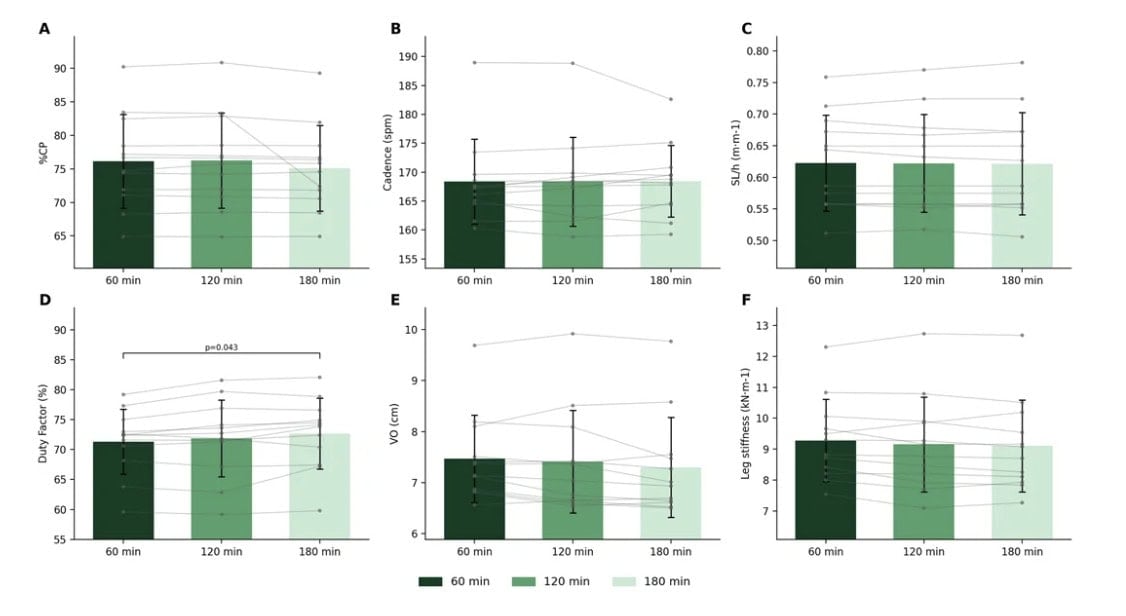
They ran three blocks, each consisting of an hour at a steady speed followed by a 12-minute uphilltime trial. A foot pod recorded their mechanics throughout. The repeated steady hours are what make this study interesting. Out on the trail, the obvious explanation for a change in stride is often that the grade or your speed just changed. Here, the researchers could compare runners at the same speed as the miles accumulated.
During the steady running, cadence, step length, estimated power, and the energy cost of running all held fairly steady. The one wearable measure that shifted significantly was duty factor, the share of time spent in contact with the ground. It rose from 71.3% at the first-hour measurement to 72.7% at the third. The runners could still hold the pace at a similar energy cost, but their feet were spending a slightly larger fraction of the run on the belt.
What this means for runners
If your foot pod reports duty factor, try comparing the same flat stretch early and late in a familiar long run, at roughly the same speed. Does that number drift on the days your stride starts to feel heavy? I’d want to see that pattern across several runs before drawing much from it. A 1.4-percentage-point shift in a dozen runners is interesting enough to look for. It’s a thin basis for changing your stride mid-run to make the number go back down.
References
- 1Cartón-Llorente, A., García-Pinillos, F., & Jaén-Carrillo, D. (2026). Power-based running durability in trained runners: Preliminary evidence of speed-adjusted mechanical drift as a marker of fatigue. European Journal of Sport Science, 26(11), e70275. PubMed Central. https://doi.org/10.1002/ejsc.70275↩︎
Join 300,000+ runners in RunClub
Free training plans for every distance, a daily running game, exclusive coaching content, and a real community of runners. Create your free account in 20 seconds — no card.
‘;
pfOverlay.addEventListener(‘click’, function(e){ if (e.target === pfOverlay || e.target.closest(‘.rc-news__pf-close’)) pfOverlay.style.display=’none’; });
document.body.appendChild(pfOverlay);
}
pfOverlay.querySelector(‘.rc-news__pf-body’).innerHTML = r.data.html;
pfOverlay.style.display = ‘flex’;
}).catch(function(){});
}
root.addEventListener(‘click’, function(e){
var a = e.target.closest(‘.rc-news__author’); if (!a) return;
e.preventDefault(); openProfile(a.getAttribute(‘data-user’));
});
// Reply targeting (composer lives outside the re-rendered box).
var pill = document.getElementById(‘rc-artc-reply-pill’);
var pillName = document.getElementById(‘rc-artc-reply-to’);
var input = document.getElementById(‘rc-artc-input’);
var formEl = document.getElementById(‘rc-artc-composer’);
function setReply(pid, name){ replyParent = parseInt(pid,10)||0; if (replyParent && pill){ if (pillName) pillName.textContent = name||’comment’; pill.style.display=”; } if (input) input.focus(); }
function clearReply(){ replyParent = 0; if (pill) pill.style.display=’none’; }
var rcx = document.getElementById(‘rc-artc-reply-cancel’); if (rcx) rcx.addEventListener(‘click’, clearReply);
box.addEventListener(‘click’, function(e){
var b = e.target.closest(‘.rc-news__reply-btn’); if (!b) return;
setReply(b.getAttribute(‘data-parent’), b.getAttribute(‘data-name’));
if (formEl) formEl.scrollIntoView({block:’nearest’});
});
// Show-all (load the full thread).
box.addEventListener(‘click’, function(e){
var s = e.target.closest(‘.rc-artc__showall’); if (!s) return;
s.disabled = true;
post(‘mh_artc_thread’, {post_id:postId, sort:currentSort, all:1}).then(function(r){ if (r.success && r.data.html) box.innerHTML = r.data.html; }).catch(function(){ s.disabled=false; });
});
// Sort tabs.
Array.prototype.forEach.call(document.querySelectorAll(‘#rc-artc .rc-news__sort’), function(tab){
tab.addEventListener(‘click’, function(){
var ss = tab.getAttribute(‘data-sort’); if (ss === currentSort) return;
currentSort = ss;
Array.prototype.forEach.call(document.querySelectorAll(‘#rc-artc .rc-news__sort’), function(t){ t.classList.toggle(‘is-active’, t===tab); });
post(‘mh_artc_thread’, {post_id:postId, sort:currentSort, all:1}).then(function(r){ if (r.success && r.data.html) box.innerHTML = r.data.html; }).catch(function(){});
});
});
// Composer: emoji (all) + member image upload + submit.
var msg = document.getElementById(‘rc-artc-composer-msg’);
var mediaIds = [];
if (formEl){
var emojiBtn = document.getElementById(‘rc-artc-emoji-btn’);
var emojiPop = document.getElementById(‘rc-artc-emoji-pop’);
var emojiLoaded = false;
if (emojiBtn) emojiBtn.addEventListener(‘click’, function(){
if (!emojiLoaded){ emojiLoaded = true;
var sc = document.createElement(‘script’); sc.type=’module’; sc.src=’https://cdn.jsdelivr.net/npm/emoji-picker-element@1/index.js’; document.head.appendChild(sc);
var picker = document.createElement(’emoji-picker’);
picker.addEventListener(’emoji-click’, function(ev){
var u = ev.detail && ev.detail.unicode; if (!u) return;
var s0 = input.selectionStart||0, s1 = input.selectionEnd||0;
input.value = input.value.slice(0,s0) + u + input.value.slice(s1);
input.focus(); input.selectionStart = input.selectionEnd = s0 + u.length;
});
emojiPop.appendChild(picker);
}
emojiPop.hidden = !emojiPop.hidden;
});
var preview = document.getElementById(‘rc-artc-media-preview’);
var attachBtn = document.getElementById(‘rc-artc-attach-btn’);
var fileInput = document.getElementById(‘rc-artc-file’);
function renderPreview(){ if (!preview) return; preview.innerHTML=”; mediaIds.forEach(function(m){ var d=document.createElement(‘div’); d.className=’rc-news__pv’; d.innerHTML=’
‘; preview.appendChild(d); }); }
if (attachBtn && fileInput){
attachBtn.addEventListener(‘click’, function(){ fileInput.click(); });
if (preview) preview.addEventListener(‘click’, function(e){ var x=e.target.closest(‘.rc-news__pv-x’); if (!x) return; mediaIds=mediaIds.filter(function(m){ return String(m.id)!==String(x.getAttribute(‘data-id’)); }); renderPreview(); });
fileInput.addEventListener(‘change’, function(){
var files = Array.prototype.slice.call(fileInput.files||[]); fileInput.value=”;
files.forEach(function(file){
if (mediaIds.length >= 4) return;
var ph = document.createElement(‘div’); ph.className=’rc-news__pv is-loading’; ph.textContent=’…’; preview.appendChild(ph);
var fd = new FormData(); fd.append(‘action’,’mh_newsroom_upload’); fd.append(‘nonce’,upnonce); fd.append(‘file’,file);
fetch(ajax,{method:’POST’,body:fd,credentials:’same-origin’}).then(function(r){return r.json();}).then(function(r){
ph.remove();
if (r.success){ mediaIds.push({id:r.data.id, url:r.data.url}); renderPreview(); }
else { msg.className=’rc-news__composer-msg is-err’; msg.textContent=(r.data||’Upload failed.’); }
}).catch(function(){ ph.remove(); });
});
});
}
var btn = formEl.querySelector(‘.rc-news__send’);
var authorEl = document.getElementById(‘rc-artc-author’);
var emailEl = document.getElementById(‘rc-artc-email’);
formEl.addEventListener(‘submit’, function(e){
e.preventDefault();
var content = (input.value||”).trim();
if (!content){ msg.className=’rc-news__composer-msg is-err’; msg.textContent=’Write something first.’; return; }
var payload = {post_id:postId, content:content, parent:replyParent, sort:currentSort, all:1};
if (authorEl) payload.author = authorEl.value;
if (emailEl) payload.email = emailEl.value;
if (mediaIds.length) payload.media = mediaIds.map(function(m){ return m.id; });
btn.disabled = true; msg.className=’rc-news__composer-msg’; msg.textContent=’Posting…’;
post(‘mh_artc_comment’, payload).then(function(r){
btn.disabled = false;
if (r.success){
input.value=”; clearReply(); mediaIds=[]; if (preview) preview.innerHTML=”;
box.innerHTML = r.data.html;
msg.className=’rc-news__composer-msg is-ok’; msg.textContent = r.data.approved ? ‘Posted.’ : ‘Posted — awaiting moderation.’;
setTimeout(function(){ msg.textContent=”; }, 5000);
} else {
msg.className=’rc-news__composer-msg is-err’; msg.textContent = (r.data || ‘Could not post.’);
}
}).catch(function(err){ btn.disabled=false; msg.className=’rc-news__composer-msg is-err’; msg.textContent=’Error: ‘+err.message; });
});
}
})();