Good morning! It’s Friday, November 6, 2026, and this is The Morning Shift, your daily roundup of the top automotive headlines from around the world, in one place. This is where you’ll find the most important stories that are shaping the way Americans drive and get around.
In this morning’s edition, Ferrari is making even more money than it expected as the rich continue to spend big, Audi could boost the size of its planned U.S. auto plant, battery electric vehicle market share just hit a new record in Europe and Mitsubishi looks to the Pajero to turn things around.
If you’d like a recap of the latest auto news sent to your inbox each weekday, you cansign up for Jalopnik’s free Morning Shift newsletter here.
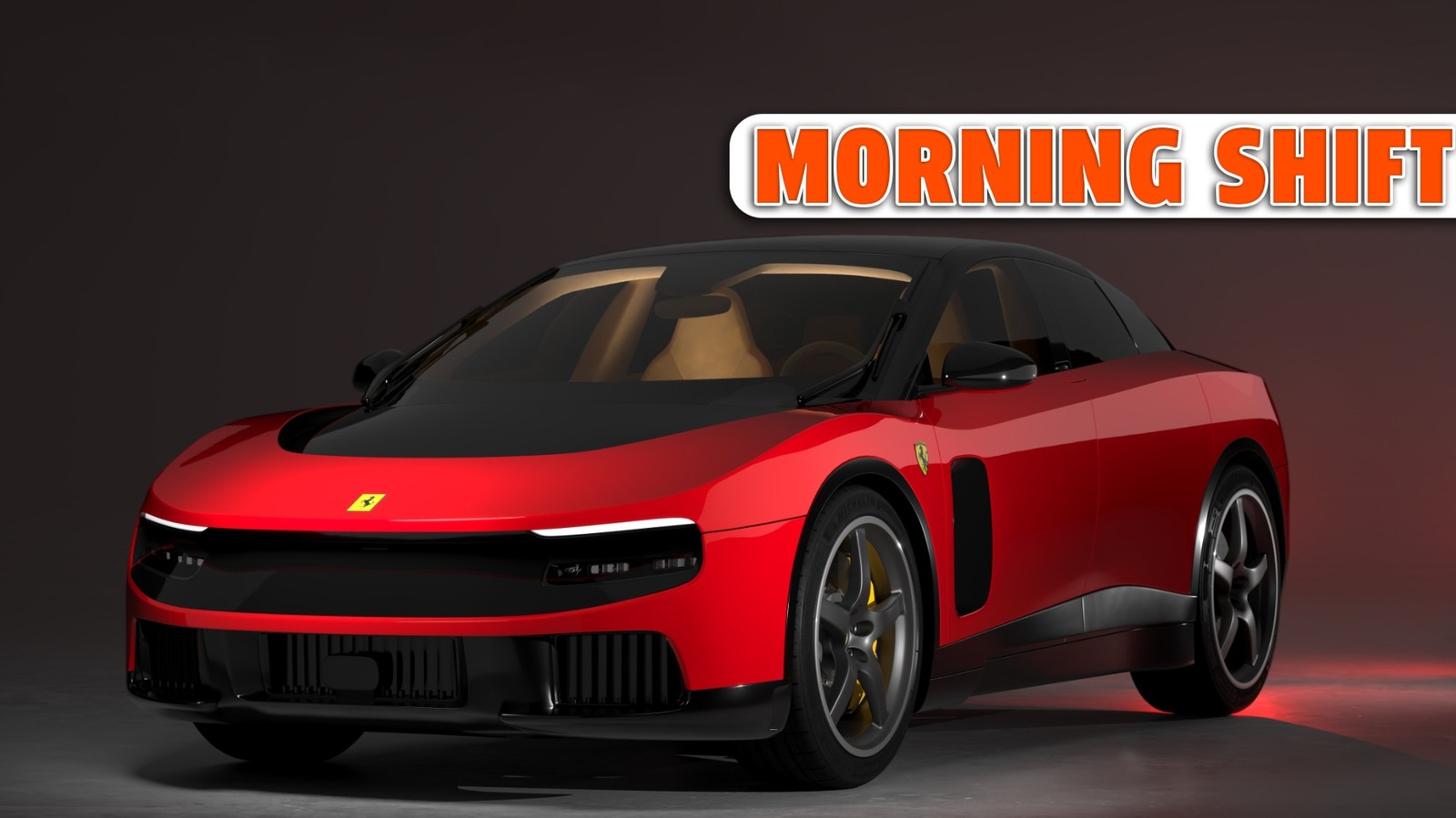
1st Gear: Mama mia, Ferrai is making a lot of money
It’s true that you and I don’t have any money, but do you know who does? Ferrari buyers. Lots of it, too. That’s why the Italian supercar maker raised its forecast for this year’s results after beating estimates on core profits and revenue in the third quarter. If only the F1 team could be as successful.
Ferrari pointed to sales of higher-margin vehicles and lucrative optional extras added to its vehicles as reasons for the company’s strong financial performance. Order books now reach into 2028, and as we reported earlier this week, the Luce EV is already sold out for all of 2027. From Reuters:
Ferrari guided for its adjusted earnings before interest, taxes, depreciation and amortisation (EBITDA) to rise to at least €3 billion ($3.36 billion) in 2026, versus a previous forecast for a result of at least €2.97 billion.
The company also nudged up its forecast for this year’s net revenue, while guiding for an industrial free cash flow generation of up to €1.65 billion in 2026.
Ferrari’s forecast upgrade was based on stronger-than-expected personalisations – those finishing touches customers request at extra cost to make their cars better suited to their individual tastes, led by the 296 Speciale model family – as well as softer currency headwinds and its current second place in the Formula 1 Championship.
In the third quarter, Ferrari’s adjusted EBITDA rose 12% to €753 million, topping a €739 million analyst consensus in a Reuters poll.
Sales of the €3.6 million limited-edition F80 supercar improved Ferrari’s product mix in the third quarter and its result in the period, the company said, despite another drop in overall car shipments, as it presses ahead with a planned model changeover.
Between July and September, Ferrari says it shipped 3,368 vehicles, which is actually 33 fewer than the same period last year, but it doesn’t seem that the slight discrepancy mattered much.
Ferrari CEO Benedetto Vigna added that Ferrari still has two more model launches coming this year, and he’s “sure” clients will be “super happy” about them. Of course, while clients seem to be happy about the Luce, folks who cannot afford one seemed to be very upset. It remains to be seen if that history will repeat itself.
2nd Gear: Audi could nearly double the size of its planned Georgia plant
Audi is gearing up to build a massive $4 billion assembly plant in Macon, Georgia, and even though it won’t open until the early 2030s, the German automaker is already considering a second phase that’ll add $3 billion in costs and an extra 3,000 workers when it’s completed in 3033, according to documents released by the Mid-Georgia Gateway Development Authority.
Georgia is giving Audi the 1,500-acre site, providing $458 million in tax incentives and over $120 million in grants for infrastructure, rail improvements, environmental sites, remediation and construction. That’s not all, there’s another $430 million coming Audi’s way for water, road improvements, utility issues and workforce training and recruitment. It’s a pretty sweet deal for Audi, I’ll tell you what. Of course, that’s all on top of the tariff relief President Trump promised Audi to help secure the plant’s future. From Reuters:
Two uce the 15% tariffs it pays on imports from the EU to 7.5%, but that the US Commerce Department was expected to agree to around 10%
The tariff relief program aims to prod automakers to add US production or other investments, the
Trump’s tariffs on autos, steel, aluminum and parts cost Audi around €1.2 billion ($1.4 billion) last year as it imports all its vehicles for the US market from Europe or Mexico.
Currently, Audi’s plan is for the plant to pump out 200,000 SUVs per year and employ 4,500 workers, so adding another 3,000 workers is no small chunk. There’s no word on how much capacity would be increased, but I’d have to assume it’s going to be sizable.
3rd Gear: BEVs hit 34% of the market in Europe
Battery-electric vehicles took 34% of new car registrations in 12 European markets in October, which, if you’re keeping track at home, is a record share. While that may sound like good news, it’s causing a bit of a headache for automakers as it strains supply and squeezes margins, as the surge came faster than some OEMs’ battery supply and cost structures could comfortably handle. In Germany, the country where the largest automaker is Europe’s are located, BEVs hit a record 37%. That’s sort of wild to think about. From Automotive News:
BEV sales in the 12 markets rose 57 percent during the month to reach a 34 percent market share, up from 22.4 percent in October 2025, according to an Automotive News Europe analysis. BEV penetration averaged 21 percent in the first half of 2026 before steadily increasing through the third quarter and reaching 33 percent in September.
In the first 10 months of 2026, BEV sales increased 44 percent to 2.63 million vehicles, while the overall market grew 6 percent. As a result, BEV market share rose to 27 percent from 20 percent a year earlier.
Germany was among the fastest-growing EV markets in October. BEV registrations rose 79 percent to 94,086 vehicles, accounting for a record 37 percent of monthly sales. Through October, battery-electric vehicles represented 28.2 percent of the German market, up nearly 10 percentage points from 2025.
In the U.K., BEVs captured 32.7 percent of registrations in October, up 6.5 percentage points from the same month in 2025. Through October, BEVs held a 27 percent share of the market, compared with 22 percent a year earlier.
France also remained a strong BEV market. Battery-electric registrations totaled 61,958 in October, giving BEVs a 41.5 percent market share, only slightly below September’s record 41.7 percent. Through October, BEVs accounted for 32 percent of French registrations, compared with 20 percent in 2025.
Several smaller markets continued to post some of Europe’s highest EV penetration rates. BEVs accounted for 55 percent of registrations in the Netherlands, 51 percent in Sweden and 49 percent in Belgium.
There are bottlenecks to deal with for some automakers, though.
Mercedes-Benz said its electric GLC midsize SUV is sold out in Europe for the remainder of 2026 because of exceptionally strong demand. For some configurations, customers placing orders now may have to wait until the third or fourth quarter of 2027 for delivery.
Volkswagen Group has also reported stronger-than-expected demand for its new entry-level EVs. Orders for the ID Polo exceeded 30,000 by early September, while the Cupra Raval accumulated more than 51,000 reservations. The automaker said demand could lead to extended waiting times for some versions.
Automakers are also grappling with the financial consequences of the accelerating shift to BEVs.
During VW Group’s third-quarter earnings call on Oct. 29, CFO Arno Antlitz said the company’s BEV transition is occurring faster than anticipated. The group’s order book now consists of about 40 percent BEVs, a level it had originally expected to reach only in 2029.
Till Conrad, head of marketing at Toyota Europe, said battery-electric vehicles still generate lower margins than hybrids and conventional vehicles, although falling battery costs should help close the gap.
This seems like a real “damned if you do, damned if you don’t” situation. I’m not really sure what the solution is, because I’m a goofus, but I can certainly understand why automakers have fought so vehemently against the transition to EVs.
4th Gear: Mitsubishi needs the Pajero to be a hit
Mitsubishi cut its full-year profit forecast, saying the war in the Middle East is hurting sales and driving up costs. Now, the Japanese automaker says it expects its operating profit to decline 7.3% — a reversal from a previously predicted expansion. From Automotive News:
Mitsubishi’s revision has operating profit declining to ¥70 billion ($444.8 million) in the current fiscal year ending March 31, from ¥75.5 billion ($479.8 million) the year before.
In August, the company predicted profit would grow 19 percent to ¥90 billion ($571.9 million).
Mitsubishi also downgraded its net income outlook to be flat with the previous year. It had earlier expected net income to more than double in the current fiscal year.
In announcing financial results, COO Keisuke Kishiura said Middle East disruption will dent full-year operating profit by ¥45 billion ($285.9 million), including lost sales and higher transportation and raw material costs. The reversal shows how the lingering conflict continues to affect auto industry costs and demand, while Mitsubishi lags rivals in hybrids and electric vehicles.
Mitsubishi dialed back its outlook despite announcing a 75 percent surge in operating profit and narrower net loss for the fiscal second quarter ended Sept. 30.
The automaker lowered its global sales forecast to 764,000 vehicles for its current fiscal year due to declining volume in Southeast Asia, Australia, North America and Europe.
The new guidance represents a 4.1 percent decline from the previous year.
Mitsubishi had earlier forecast global sales to increase 7.5 percent to 857,000 vehicles.
Mitsubishi expects North American deliveries to fall 7 percent to 154,000 vehicles, European sales to decline 5 percent to 40,000 and Southeast Asia to lose 12 percent to 216,000.
Mitsubishi sees Japan sales increasing 11 percent to 136,000 vehicles.
Mitsubishi is hoping the newly reintroduced Pajero will boost sales. The automaker has already taken 9,000 orders worldwide for its new off-road SUV, meant to take on the Toyota Land Cruiser. Its goal is to sell 10,000 of them by the end of the current fiscal year, which ends on March 31, 2027. It’s already on sale in Thailand — where it’s built — and will hit dealerships in Japan and Australia in December. There’s still no word on whether or not it’ll come Stateside, but we can keep our fingers crossed.
Reverse: Big mistake

I do thank Rutgers for being the birthplace of college football, especially because it really hasn’t worked out for the Scarlet Knights since then. Over 112 seasons of play, the team is 686–710. It also has 42 ties for good measure. Not exactly stellar, and this season, it’s off to a 2-6 start. Ouch. It’s not like my Penn State Nittany Lions have fared much better of late. Anyway, if you want to learn more about the first college football game, head over to History.com.
The Fuel Up
Friends, I’ve got some great news to cap off a pretty solid week, all things considered. Fuel prices are continuing their downward trajectory, and they’re even picking up a little bit of steam on the way. Helping matters is the fact that WTI Crude Oil futures and Brent Crude prices are both down, sitting at $91 and $98, respectively, at the time of publication.
Here’s where national average prices stand right now, according to AAA:
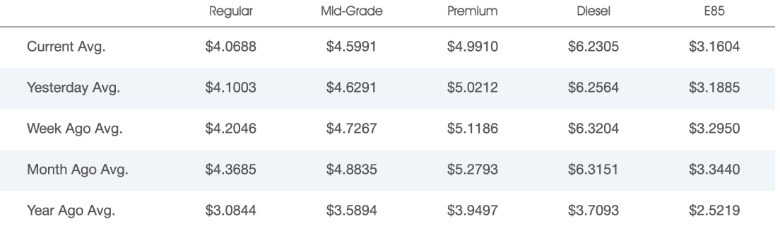
This all means the average price of a gallon of gas dropped another 3 cents overnight to $4.07 Diesel saw a similar 3-cent drop to $6.23. I’ll give President Trump credit. He said fuel prices would be coming down after the midterms, and would ya look at what they’re doing. I’m sure he doesn’t much care at this point, though
On the radio: Oli
Everybody has to stop what they’re doing, because Olien right now, and no, I’m not interested in hearing you say “it’s too early to listen to Christmas music.” Keep that to yourself, Grinch