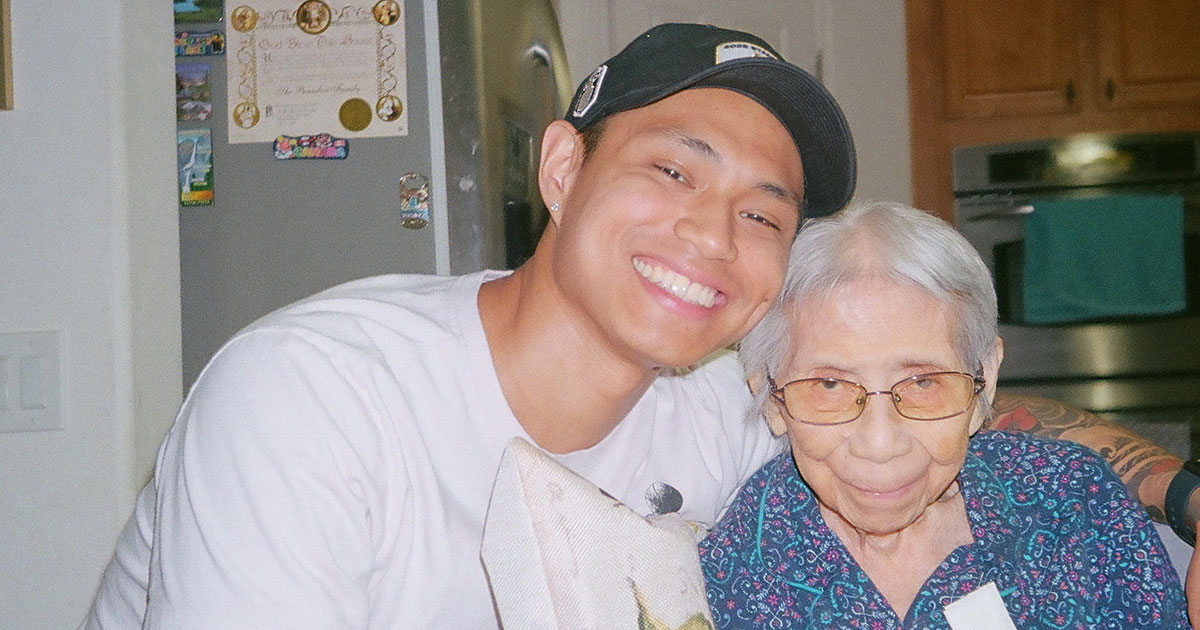
Content creatorChris Punsalanopens up about caring for his grandmother and the guilt caregivers rarely admit to.
Estimated reading time:5minutes
Were there any circumstances that influenced your decision to become a caregiver?
My grandmother raised me, so there was a part of me that felt like this was my way of repaying her for the time that she spent helping me. It made complete sense for me to do it because of the circumstances I was in.
Is there anything you would say to yourself about that experience, or about what’s to come?
I wouldn’t want to change anything
I wouldn’t want to change anything for the world. I learned so many valuable lessons that have contributed to the person that I am today. All I would say is it’s going to be OK.
There was so much resentment and uncertainty. I would just tell myself that it’s going to be fine.
Were there any reew about?
There was a program that I applied to, and I was able to receive income for being my grandmother’s full-time caregiver. Once a year, my grandmother would be evaluated by a social worker, and they would come in and see how many hours she would be approved for. Obviously, as many caregivers know, it’s not enough hours; you never get approved for the hours that you actually spend with your loved one. But I wish more people knew that there are these programs statewide that allow you to get paid to care for your loved one.
What is your perspective on mental healthcare for caregivers, and how important is it?
I can’t state enough how important
I can’t state enough how important it is. I did everything that I possibly could during that time to mitigate the anxiety I would feel. There wasn’t any amount of meditation or physical exercise or even being plugged into the community that worked. In the later years of my caregiving journey, I was very plugged into the caregiver community, yet I found that there wasn’t a solution to getting rid of this constant fear and anxiety of thinking about whether my person is still alive or not. There is just this knocking on your door of wondering if the people that you care for are still OK.
Did caregiving change your view of who gives care and who receives it?
I’ve realized that people can have different capacities for care. For myself, I have seen the depths that I can personally go to to care for not just a loved one, but for people in my life in general. If you are put in a situation where it is pushing your boundaries of how much you think you can actually care for somebody — not just physically, but emotionally and spiritually — you would be so surprised at how far you can go in service of other people. It doesn’t have to be the typical adult children that usually care for their parents. Anybody can step into that role. I was the youngest grandson among my grandmother’s grandchildren to step in and care for her, and a young male. That’s super uncommon, especially in America, for young males to step up and be a full-time caregiver for their loved one.
I can’t say that I did it all on my own. I was handling a majority of the care for my grandmother, but there were other family members stepping up. I also realized at the same time that if I were to go, that a huge piece of this whole routine would be gone. I imagine that it’s even more extreme for millions of caregivers out there who are the sole caregiver for a spouse or for a parent. If they were to ever go, they are taking that information and the medication list and the doctor’s list with them, and they will leave their loved one high and dry. I definitely had that realization.
What inspired you to join tendercare?
Tendercare is a company founded by Shauna Sweeney
tendercare is a company founded by Shauna Sweeney. We met last year, and we immediately hit it off. I filmed a documentary for her, and shortly after, she asked me to join her team as the content director.
We just try to make the caregiving journey for the family caregiver a little bit simpler, whether it’s tools to help them organize their medication list or their doctor’s list, or even pointing them to resources that they’re eligible for that they didn’t even know about. One that we’re pushing right now is the GUIDE program, and it’s for Alzheimer’s and dementia patients. If you qualify, you get up to $2,600 in respite care a year. Surfacing all these programs that people have no idea about — where all you have to do is put in a couple of bits of info about you, and you get access to these services — that’s what tendercare’s mission is, and that’s what we’re trying to spread the word about. I couldn’t imagine any other path for myself post-caregiving than to be of service to those who are in the shoes that I was in.
Is there anything else you want to say to caregivers?
I have found so many people harboring this guilt for the resentment they feel for their loved one. I would just like to encourage caregivers who are feeling that that you’re not alone in feeling that. Just know that there are millions of others who are feeling the same thing. I felt the same way in the eight years of caring for my grandmother. I can look back and say that it was honorable for a grandson to be his grandmother’s caregiver. But I also was really angry at the world and my grandma and myself. I can’t state that enough: You aren’t alone in that feeling, and you share that with the millions of others who are also going through it.