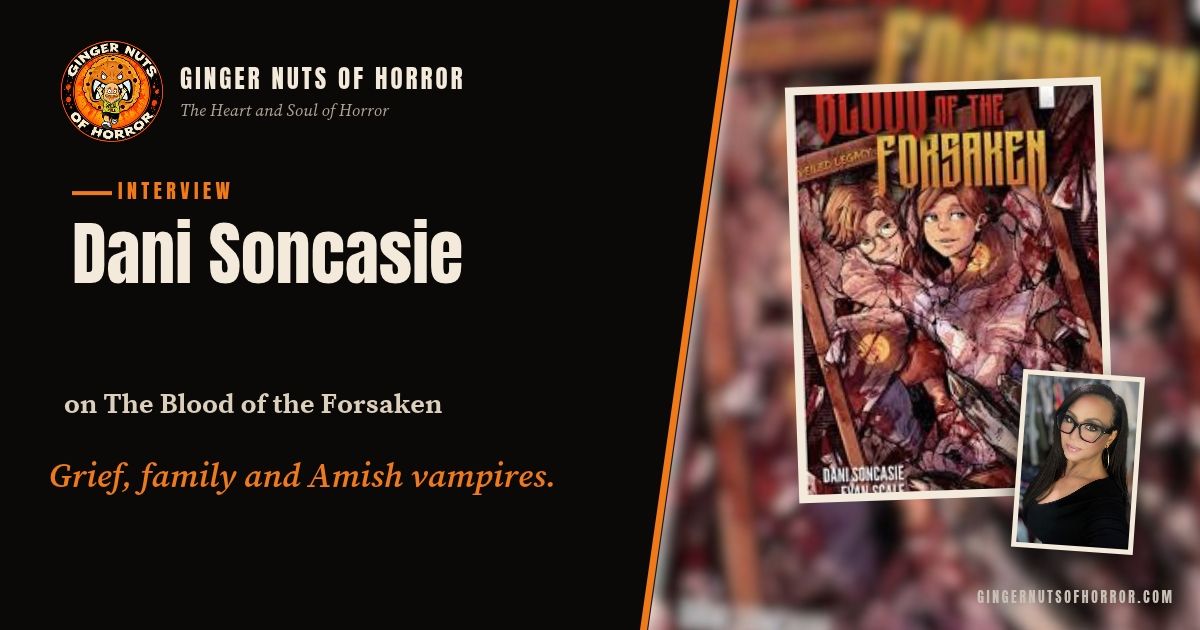
Amish vampires, a trapped twin and a story twenty years in the making.
Blood of the Forsaken | Dani Soncasie | Independent | In production |
- Author Dani Soncasie
- Editor Carrow Brown
- Art Evan Scale
- Format Graphic novel
- Setting Small-town Midwest
- Subgenre Supernatural thriller, vampire fiction
When vampires descend on the Hogan family home, Emma is trapped inside the one place she should be safe. Her twin brother Jimmy, miles away and certain something has gone badly wrong, races home to find her.
Blood of the Forsaken is the vampire graphic novel from Dani Soncasie, built from the world of her earlier novel One Foot in Darkness. In this Dani Soncasie interview, she explains how two pages of flashback grew into a 42 page first issue. She also reveals why the vampires at the Hogan family’s door became two Amish men. On the surface it is a story about twins, with Emma trapped at home and Jimmy racing across town to reach her.
The real weight sits deeper. Soncasie lost her younger brother in 2013, and that loss changed the book and the people in it. She is also a passionate advocate for disabled patients, and she talks about it with the same bluntness she brings to the page. Regular readers have already met her talking about the horror that made her and finding herself stuck in a horror franchise. Here she gets into the craft: her editor’s best questions, her silent mentors, and why she puts a well told story ahead of subverting anyone’s expectations.
The Dani Soncasie Interview: Twenty Years Back to the Basement
Let’s start at the very beginning. For our readers, please introduce yourself. Beyond the author bio, tell us a little about who you are when you’re not writing, what you love doing, what fascinates you, and what fuels your creativity.
My name is Dani Soncasie. I have four adult children. I live out in the country with my husband and youngest daughter (who’s technically a legal adult but still a senior in high school) our two dogs, cat and some chickens. I love to read comic books, some very light video gaming, special effects, watching anything sci-fi, fantasy, action, superhero, or supernatural horror on tv. Though I haven’t found the time in ages, I do enjoy playing music. I used to play guitar and sing quite a bit. I like to consider myself a holistic artist or a nondenominational creative.
Another past time of mine is that I am a huge advocate for disabled Americans. Especially women, with even more focus on amputee women. Women already have an uphill battle when going to the doctor for a lot of issues. We are more likely to be prescribed antidepressants for whatever it is we have gone in for, rather than actually having our concerns genuinely investigated with interest and curiosity. Millions of women go undiagnosed from severe debilitating physical diseases every year because of this.
When you couple that with orthopedic disabilities, especially lower limb amputation, secondary conditions and other unrelated entirely, get dismissed, ignored, or written off entirely as just “‘art of life as being disabled”. I was one of them for almost twenty years, and almost died. There seems to be an education gap when it comes to many primary care or general practice physicians when it comes to those who deal with congenital defects, and amputee life. Not to mention the absolute crock of horse dookie that is the insurance/prosthetics industry. It is set up to let amputees down with zero regard to woman amputee’s mental health, or physical health for that matter. I could go on for hours!
I use my experience, and my very big mouth, to advocate for better communication, practices, and specialization for disabled patients. My first published piece, Curiosity Cures, will come out this spring in the Narrative in Bioethics Journal, regarding medically supervised weight loss, in Johns Hopkins University Press. I’m Dani Soncasie. I am a mother of 4, I have chickens, dogs, a cat. I am a huge science fiction, comic book, fantasy, and horror nerd! I was born physically disabled, and being an advocate for better education, medical care, and treatment of disabled people is a passion of mine.
In the early stages of a new project, what tends to come to you first: a compelling character voice, a central thematic question, or a vivid image/scenario? How does that initial spark then guide you in building the rest of the story?
It usually starts with a line I cannot get out of my head. It replays in the forefront and back of my mind like a song I can’t get rid of. It starts like that. This tiny seed, consuming and growing as time goes by. At the risk of mixing my metaphors, I just follow that thread to see where it leads me! I’m a huge fan of meditating with ambient music. The creepier the better! And allowing my mind to wander and be creative on its own.
Every book has its own unique set of problems to solve. What was the most difficult ‘puzzle’ you had to crack while writing this book? Was it a plot hole, a character’s motivation, the structure, or something else entirely?
This comic is adapted from a book I published 20 years ago. Finding the right way to “open the door” so to speak and bring new readers into my world was the first challenge. The section that was chosen also needed to be fleshed out. At first that was a bit daunting, but if you have the right editor, or collaborators, then it just ends up being a lot of fun! Which it was! Honestly, the hardest part was finding a place to end it, because I just wanted to keep going!
The journey from a finished manuscript to a book in a reader’s hands can be a surprising one. What was the most significant way your book evolved during the editing and publishing process, something you didn’t anticipate when you typed ‘The End’?
Discovering what I was capable of. I had a really awful experience the first time I published 20 years ago. Their version of an editor was to hold on to my manuscript for 9 months, only running spell check. There was no one to talk to or collaborate with. They had no suggestions or pushed my creative boundaries.
When I got it back there were so many errors. They just ran spell check here and there, and formatted it for printing. I spent three weeks pouring over that manuscript before I sent it back for them to fix. Even then, when I received my first Author Copy, there were errors. There still are! What has been published is essentially my first draft.
Adapting this version of it as the graphic novel it was always intended to be, I lucked into the most talented and thorough editor! She knew exactly right away which buttons in my brain to push to get the most out of me and my story. Without Carrow pushing me and asking the right questions, it would not be what it is today.
Once a book is published, it no longer entirely belongs to the author; it belongs to the readers and their interpretations. Has a reader’s reaction or analysis ever revealed something about your own work that surprised you?
There were a couple of professional comic creators who read the script and told me they were just blown away by how good it was. My jaw hit the floor. I wanted to cry but I was live on camera!
Aaron Sparrow, Creator of Kneel before Doomface, and previously writer of the Darkwing Duck comics, called it a “Triumph!” I absolutely wanted to faint! I’m still shocked when people say nice things about it!
Writing is a demanding, often solitary pursuit. Beyond the apparent goal of ‘telling a story,’ what is the specific, personal fuel that keeps you going through the difficult stretches? Is it the joy of discovery, the need to understand something yourself, the connection with a future reader, or something else?
Writing is fulfilling for me. It feeds something in my soul. It’s very satisfying. When I’m writing a story, I will keep writing just to find out what happens next!
We often hear about authors being influenced by other books. What are some non-literary influences on your work, such as a specific piece of music, a historical event, a scientific theory, or even a landscape, that have profoundly shaped your storytelling?
There are events in my own life that have inspired much of this book and its characters. Some of these events I can’t really discuss, because I don’t want to give too much away!
I moved to the area I live in just before I started high school. The town the book takes place in is inspired by it. For the character of Jimmy, I initially took inspiration from my late younger brother, Stephen and named him for my oldest child, Ashton James, who was still very young at the time.
My baby brother passed away in 2013. He was 6 years younger than me. It affected me so very strongly. Hit me like a building falling down on top of me, if I’m being honest. I was irrevocably changed. That evolved the story and characters quite a lot.
As the years progressed and my oldest grew up, Jimmy took on more of Ashton’s personality as well. There are pictures on the wall in some of the early pages that are taken directly from actual pictures of my children when they were little. Speaking of which, there are several Easter Eggs in the basement as well for my late brother, my other siblings, Brett and Ellie, my husband David, and my four children, Emma, Ashton, Kessler and Amelia. Speaking of Emma, yes. Obviously I did name my main character for her! I had just given birth to her when I started writing the first version of the book, One Foot In Darkness, in 2004.
As for the vampires, the inspiration for their specific look came from a mix of The Goonies and Buffy The Vampire Slayer. I told Evan, the artist, that I wanted them to be snowflakes; each one to be slightly different And that I saw them as a cross between Sloth from The Goonies and a vampire from Buffy The Vampire Slayer.
Is there an author, living or dead, whom you consider a ‘silent mentor’? Not necessarily someone you try to imitate, but whose approach to the craft made you feel permission to write in your own way?
Christopher Pike and Anne Rice. That wasn’t even a thinker. Pike really introduced me, at a young age, to vivid storytelling. I had such a visceral reaction to one of his scenes that all I could think of was, “I want to do that to someone!” The greatest compliments I get are when I am told how descriptive I am, or how vivid my action scenes are written. That’s my favorite!
Rice was just damn elegant and horrifying at the same time. She wove these intricate, and ever expanding worlds into beautiful tapestries of prose! Yes, she could go on for fifteen pages about a side screened in porch. But, it was always worth it in the end! Her characters were all so very distinct, three dimensional, and alive. Her worlds felt truly lived in. The lore she created is something to marvel at.
My world, my universe, has a very deep lore. The iceberg is already intact and it continues to grow!
Who was the first person to see your early drafts, and why did you trust them with your unpolished work? What is the most valuable piece of feedback they gave you?
Carrow, my editor and best friend. She gave me so much amazing feedback, it’s really difficult to just narrow it down to just ONE. I’ll do the top three.
“Who is this for?” It is a question everyone should ask about everything. Market research is somewhat tedious and exhausting. But, in the long run, it is absolutely worth it! Find out who your audience is, where they are, what they like, what they respond to, and how they like to be spoken to.
“Why are you starting with a flashback?” My 2006 One Foot in Darkness starts pretty different from Blood of the Forsaken. It’s difficult to say without giving spoilers to future issues, but Issue 1 of this adaptation is basically from 2 pages of a flashback in Chapter 1 called, Sweet Dreams.
My first draft of this first issue started off similar, with the “present day Emma” before entering into the flashback. Carrow questioned that tactic. What ended up happening was me taking those 2 flashback pages and developing them into a 42 page graphic novel! It was by far the best writing I had ever done in my entire life!
This seemingly simple question had one hell of an unexpected result! Instead of amateurishly glossing over the origin of my characters, I began revisiting that entire point in their history and bringing it to life. Finally!
“What if they were Amish?” I initially wrote One Foot In Darkness in 2004. There were vampires who arrived at the Hogan’s house, who needed a phone. Back then they were just a couple of douchey, preppy guys in khakis whose car broke down. In 2004, it wouldn’t have been that surprising for a couple of guys to not have a cell phone on them. However, today, that would be a plot hole.
Carrow made the suggestion of changing them to two Amish men. Immediately, lightbulbs exploded in my mind! The area that this is inspired by has a good sized Amish and Mennonite community. It made perfect sense and opened the story up to other possibilities!
These two Amish men turned vampires have become one of the most unique aspects of the entire book, and certainly one of the facets I get asked about the most!
Horror is often most potent when it’s internal. Beyond external monsters, how do you explore the slow unravelling of a character’s sanity or the horror of their own mind?
The choices we make stay with us, and they can haunt us. So can who raised us, how they raised us, where, what they told us, and what they chose not to. Those things become the building blocks of who we are and how we make choices.
Setting in horror is often described as a character in its own right. How do you approach transforming a location, whether a house, a town, or a landscape, into a
For me, the scariest place was all too often the one place that should have been the safest. So, I made that a central question. What if the one place you run to when you need to get away, becomes the one place you can’t escape? What happens then? Not just physically. But mentally and emotionally. You’re already in your “safe place”. You are home, and now, you can’t get out! Furthermore, your twin brother is miles away, on the other side of town trying to get to you.
Every family has problems, arguments, secrets, drama, differences, and some have skeletons in the closet. Some families can never really figure out what truly matters. Some fight monsters, some have monsters. But, at the end of the day, you are the only one that you have to live with for the rest of your life. Your siblings are kinda like partners, sharing life’s journey with you.
But, it’s honestly just you up there in your head, no one else. You are the only one who is obligated, forced, required, however you like to put it, to live with every choice you make day in and day out. So, it’s up to you to decide who and what is important. You decide how far would go for your family if and when the time comes, and whether or not you’re willing to live with those consequences for the rest of your life. However long that may be.
Writing a terrifying buildup is one skill; delivering a satisfying payoff is another. How do you decide when to finally show the monster or reveal the
The horror genre is rich with established tropes and archetypes. How do you engage with these familiar elements, the haunted house, the ancient curse, the final girl, in a way that feels fresh and surprising? Do you consciously seek to subvert a trope, or do you focus on executing it with such depth and authenticity that it becomes new again?
As someone who has been a critic, film reviewer, and online pop culture pundit for some years now, the phrase “subvert expectations” has almost become a trigger! Many times we hear that and think, “Oh no. Here we go again.”
My focus is always just to tell a damn good story. To write the best I possibly can and hopefully entertain you. Tropes and archetypes became and are tropes and archetypes for reasons. Used properly, used well, and by making them your own you can most definitely enhance your premise and take it to a whole new level!
Depth and authenticity, I personally feel, should come before “subverting expectations”. Especially as a newer, unknown author. Readers don’t know you yet. They don’t really have expectations for you to subvert. Everything has already been done to death already, anyway. So why not do the really crazy unexpected thing and just blow their minds with a superbly well written story that engrosses them completely?
How do you approach writing scenes of intense terror or violence to make them feel physically impactful without tipping into gratuitousness?
For the antagonist, I imagine what would absolutely terrify me. Even though I do operate in urban, dark, and history fiction fantasies, writing characters fighting and being hunted by supernatural monsters and otherworldly forces, I still want the movements, emotions, and the physicality to feel real or plausible. That’s your verisimilitude.
If you don’t have characters reacting with human emotions, and you have antagonists who are just slaughtering left and right just for funsies with no real motive, what exactly is there for your reader to relate to or invest in?
Do you have a favourite line or passage from your work, and would you like to share it with us?
Oh yes! I love it so much! It’s such an inversion; it’s so eerie and unsettling.
One of the vampires takes a cellphone away from a household member and says:
“These devices are a distraction from God’s word. Such things lead to pride and vanity. Shameful behavior requires punishment and correction.”
What is the specific, core truth you are trying to expose or explore through your horror?
Sometimes in life there are situations we are put in, where no matter what happens, what decision we make, someone will get hurt. All you can do is your best. You cannot control other people. You can advise them, you can love them. But in the end, you are not responsible for what they choose to do. Whether it is to themself, to others, or to you. You can only be held accountable for the choices that you make. So, make some good ones!
You have precisely two minutes in a crowded bookstore to hook a reader who is sceptical of the entire horror genre. They look at your book’s cover and ask, ‘Convince me. Why should I read this? I don’t even like being scared.’
Have you ever made a mistake? Or rather, have you ever watched someone you loved make a terrible mistake, one they could never take back? And you felt deep down that if you had just held on a little tighter, a little longer, everything would be different today? Rationally, you know that it can’t honestly be your fault. But, you can’t shake that there could have been something you could have done, and you’ve never stopped beating yourself up about it?
That’s what Blood of the Forsaken is about. It’s loss, grief, family, and what we are willing to do, and not do, for the people we love most. And ultimately, how we carry that, and them, with us as we continue on without them.
Blood of the Forsaken by Dani Soncasie, with art by Evan Scale, is in production and crowdfunding now on FundMyComic.
The chief lesson of this Dani Soncasie interview: if two polite Amish gentlemen turn up asking to borrow a phone, keep the door shut and your mobile out of sight. They have strong views on vanity.
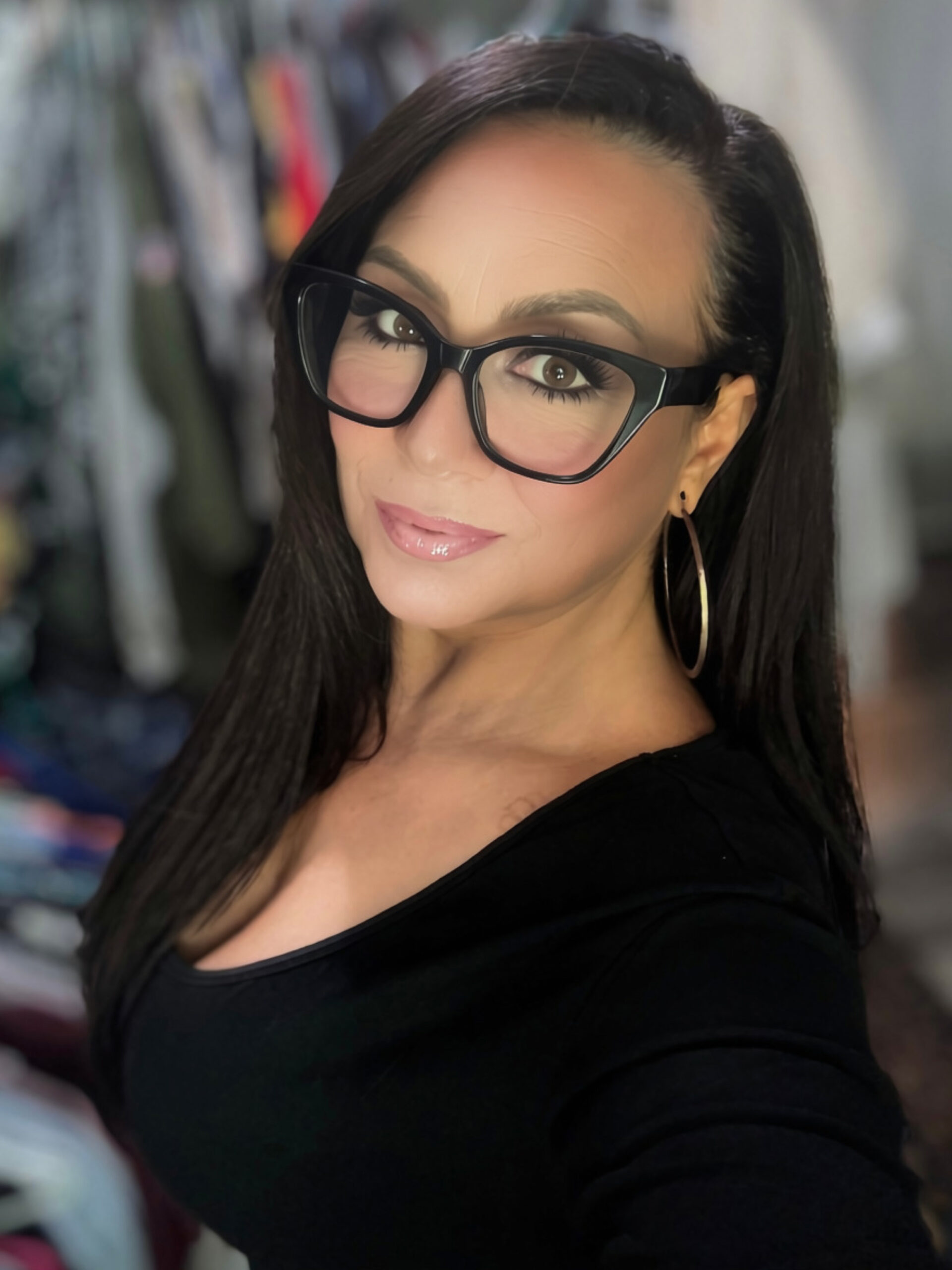
Dani Soncasie is an indie comic creator, horror author, and longtime content creator from Missouri with a particular affection for monsters, complicated families, mythology, and stories about ordinary people dropped into extraordinary circumstances. She is the writer and creator of Blood of the Forsaken, an original vampire graphic novel adapted from the fictional world she first created in her 2006 novel One Foot in Darkness. After years spent discussing comics, movies, characters, storytelling, and pop culture through her online work, Soncasie has moved from talking about fictional worlds to building her own.
Keep reading on Ginger Nuts of Horror
Dani Soncasie on Horror: The Good, the Bad and the Ugly
Dani Soncasie: The Horror That Made Her
Dani Soncasie Is Stuck in a Horror Franchise
Ginger Nuts of Horror is an independent horror review and culture site based in Edinburgh, Scotland. Edited by British Fantasy Award nominee Jim McLeod, it publishes horror book reviews, film reviews, author interviews, features and cover reveals. Ginger Nuts of Horror won Best Inclusive Film & Book Review Platform at the SME News UK Enterprise Awards 2026.