OutdoorHub Staff 07.29.26

For many fishermen, the biggest concern during a weekend on the water isn’t where the fish are – it’s how long the batteries will last. Traditional lead-acid batteries have long been relied upon to power a variety of equipment – including trolling motors, fish finders, GPS units, lights, and livewell pumps – but their bulky size and limited usable capacity often turn a pleasant fishing trip into a frustrating race against time to recharge and make it back to shore.
In contrast, LiFePO4 batteries offer clear advantages in marine applications. They can provide up to 100% usable depth of discharge, whereas lead-acid batteries are generally recommended to be used only at about 50% of their rated capacity. At comparable voltage and capacity, lithium batteries can weigh about one third that of their lead-acid counterparts.
Designed around these real-world challenges Radodo 12V 120Ah Group 24 Trolling Motor Bluetooth Battery Provides 120Ah capacity and 1536Wh energy within a compact bci group 24 size. Weighing only 23.81 pounds and equipped with Bluetooth 5.0 monitoring, it offers fishermen a marine power upgrade built around three practical benefits: long runtime, light weight, and clean battery management.
Long runtime: 1,536Wh supports more than three days of fishing
For the angler who goes out on consecutive days, having to locate a charging point at the end of every trip can be a familiar frustration. This takes time and effort, plus the fishing plan is forced to revolve around the battery’s remaining charge.
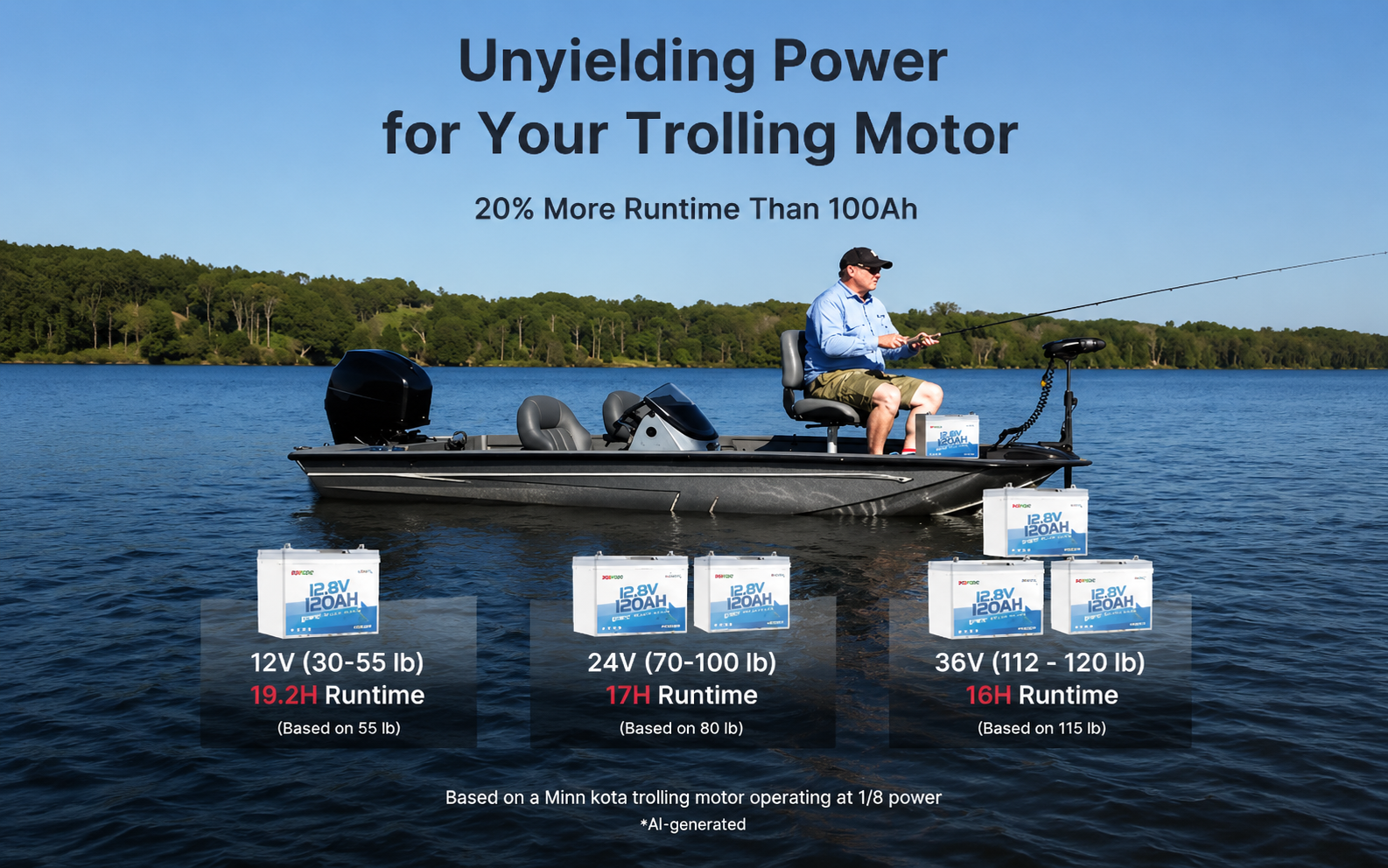
Radodo 12V 120Ah Group 24 battery provides enough energy 3+ days trolling power For a weekend on the water. When paired with a normal 55 lb trolling motor running at one-eighth power under the specified test conditions, the estimated runtime can reach 19.2 hours. Based on six hours of daily use, this is enough to last more than three days on the water.
This performance reflects not only its 120Ah rated capacity, but also the greater utility potential of the LiFePO4 chemistry. To help preserve service life, lead-acid batteries are typically limited to about 50% depth of discharge. So two 12V 100Ah AGM batteries will provide a typical useful capacity of about 100Ah, while a Redodo 120Ah LiFePO4 battery can provide much more capacity than its full 120Ah capacity.
For fishermen, more usable energy means less pressure to recharge every day and less need to end a fishing session early to reserve power for the return trip. From launching at dawn and running the trolling motor and onboard electronics all day to returning at dusk, the battery provides greater confidence throughout the weekend.
Lighter weight: 63% less weight capacity and frees up space
On a boat, battery weight affects more than operation. It also affects the total weight, onboard space, weight distribution and overall performance. The Radodo 12V 120Ah Group 24 battery weighs just 23.81 pounds – which is approximately 63% lighter than a 12V 100Ah Group 31 AGM battery. The low weight makes installation, removal, shore charging and seasonal storage easier, while also reducing weight concentrated in the battery compartment or stern.
For kayaks, jon boats, bass boats and other small to medium-sized fishing vessels, the benefits are especially practical. The battery’s low weight allows for greater carrying capacity for fishing gear, anchors, electronics and other equipment. Its compact Group 24 dimensions allow it to fit into standard battery boxes and trays without modifying the original installation area.
According to user testing, replacing the heavy battery with a lighter lithium model helped the test boat 0.5 mph gain Under comparable operating conditions. This provides a practical example of how reducing battery weight can improve water performance. Actual results may vary depending on boat type, motor configuration, gross weight, wind, current and water conditions.

Clear monitoring: Bluetooth replaces guesswork with real-time data
A higher capacity battery provides more value when users can clearly understand how much power is left. Electricity consumption on water is rarely constant. Headwinds, current, trolling motor speed, and simultaneous use of multiple electronic devices can all affect runtime. With conventional lead-acid batteries, users often rely on voltage readings or experience-based estimates, which may not accurately reflect the remaining usable capacity.
Features of Redodo Battery smart bluetooth 5.0 monitoring allows fishermen to view charge, voltage, current, temperature and charging or discharging status through a smartphone app. With real-time battery data, users can adjust equipment usage, manage their fishing schedule, and make more informed decisions about whether to continue exploring or begin a return trip.
The battery also features a 120A smart BMS with protection against overcharging, over-discharging, overcurrent, short circuit, and high or low temperature. Its IP65-rated housing helps protect the inside of the boat from moisture, splashes and dust, supporting reliable long-term deep-cycle use in marine environments.

move towards the light, move forward
Lightening the load can start from a single battery. The Radodo 12V 120Ah Group 24 LiFePO4 battery offers a capacity upgrade. Its 1,536Wh energy capacity extends time on the water, its 23.81 lb design minimizes handling and boat-weight demands, and Bluetooth monitoring makes it easy to understand battery status. Smaller batteries, simpler wiring and more transparent power management help remove unnecessary complexity from each fishing trip.
This approach reflects Redodo’s brand philosophy, “move towards the light, move forward“ Going light doesn’t just mean reducing battery weight. It also means reducing the burden of frequent charging, complex installation and uncertain power estimates. When onboard power becomes lighter, longer lasting and easier to manage, fishermen can spend less time worrying about energy – and more time exploring distant waters.

OutdoorHub Staff
The Outdoor Hub staff is here to bring you relevant content about the industry.