“I was struck by the thought that perhaps I had always missed the very thing that made poetry poetry.”
This first appeared in Lit Hub literary history Newsletter-Sign up here.
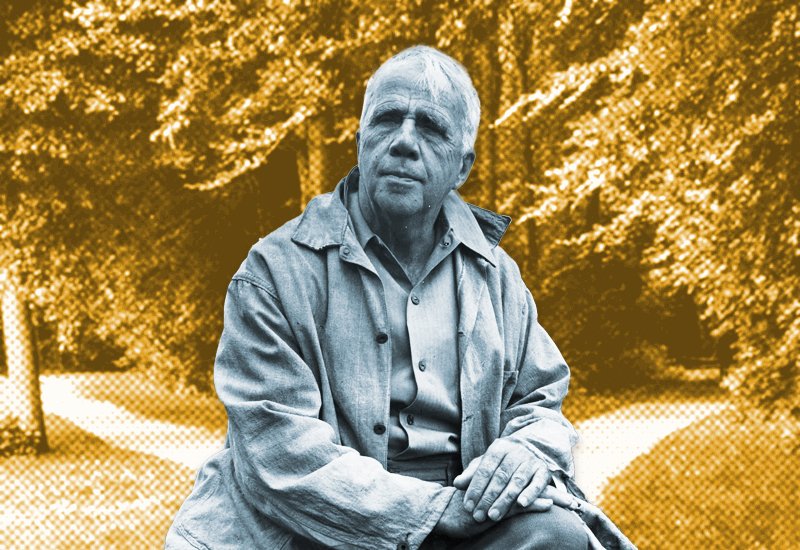
Robert Frost’s most famous poem, “The Road Not Taken,” “has confused audiences from the beginning,” has written David Orr.
In the spring of 1915, Frost sent Edward Thomas an envelope containing only one item: a draft of “The Road Not Taken” under the title “Two Roads”. According to Lawrence Thompson, Frost was inspired by Thomas’s habit of writing poetry to regret whatever path the pair took during their long walks in the countryside – an impulse which Frost associated with the Romantic tendency to “weep over what might have been”. Thompson writes, Frost believed that his friend “would take the poem as a gentle joke and protest, ‘Stop teasing me.'”
This did not happen. Instead, Thomas sent Frost an appreciative note in which it was clear that he had assumed that the poem’s speaker was a version of Frost, and was to read the last line as generations of high school valedictorians have believed. The sequence of their correspondence on the poem is a miniature version of the confusion that “The Road Not Taken” would provoke in millions of later readers:
1. Frost sent the poem to Thomas, without any explicit text, in March or April 1915.
2. Thomas responded shortly thereafter in a letter now apparently lost but referenced in later correspondence, calling the poem “shocking” but missing Frost’s intentions.
3. Frost responded in a letter (the date is unclear) asking Thomas for further comment on the poem, hoping to hear that Thomas understood that it was at least partly addressing his own behavior.
4. Thomas responded in a letter dated June 13, 1915, explaining that “Simple words and inoffensive rhythms were not from which I was accustomed to expect great things, the things I love. It made me think that perhaps I had always missed the thing that makes a poem poetry.” It is still clear that Thomas does not properly understand the poem’s stance or Frost’s “joke” at his expense.
5. Frost writes on June 26, 1915: “I think you attack too strongly a matter so small. A tap would have disposed of my poem. I wonder if you were trying too hard to show respect to me, you failed to see that the sigh (in line 16) was a false sigh, hypocritical for the sake of amusement. I don’t think I ever expressed regret for anything, Except to see how it would feel.”
6. Thomas responded on July 11, 1915: “You have put me on that path again without any fault of my own… I doubt whether you can show anyone the fun of that thing without showing them and advising them what kind of laugh to start with.”
The poem was published in August 1915 edition of atlantic monthlyWith “Birches” and “The Sound of Trees”. If you, like Thomas, find yourself confused, and want to better understand this American classic, you can read Orr’s full unpacking here.