The oft-told origin story of Hobby Lobby is that one day in 1970, twenty-eight-year-old David Greene was sitting at a lunch counter in Oklahoma City and sharing frustrations with fellow managers. When they imagined what kind of enterprise they could create on their own, one suggested they make watches. David said, “I have a better idea.” “Small miniature frames.” The trend of hanging picture frames in clusters in home decor had emerged, each displaying a painting of a subject such as a sunflower or a lighthouse. Customers kept asking about smaller frames and David had difficulty finding them.
Article continues after ad
One of them said, “Looks like it might work.” The next day, he found a professional frame chopper through an equipment supplier with a hefty price tag of $450, and signed a twelve-month loan for $600 to cover the cutter, wooden sticks, canvas, and other materials. The $600 loan recurs in Hobby Lobby’s founding myth—a symbol of the big-box giant’s humble roots. Setting up in a garage, the partners created samples and sent them out with a traveling salesman. He came back with a massive order of $3,500. The partners begged their supplier for more material on credit and began rapidly building frames, ultimately making a profit of $300.
While looking for a snappy name, he noticed a client in Houston calling itself “Hobby Lobby.” Without the slightest thought about trademark infringement, he kept the name of his store.
As orders started coming in from Oklahoma and Texas, the partners would cut at night while David’s wife Barbara and their sons, Mart and Steve – ages nine and seven – would glue frames on the kitchen table during the day. “What a sight!” David later rhapsodized. “I sure wish we had a picture of all of us working together around the kitchen table.” They paid Mart and Steve seven cents per frame, while Barbara worked for no fee, leading David to later joke that the business was built on “child labor and slave labor.”
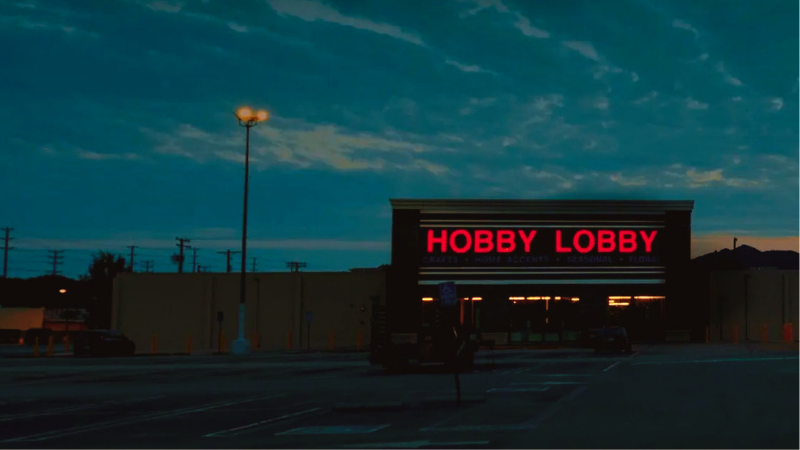
In the summer of 1972, they opened their first retail store in a three hundred square foot space in downtown Oklahoma City. While looking for a snappy name, he noticed a client in Houston calling itself “Hobby Lobby.” Without the slightest thought about trademark infringement, he kept the name of his store. “There was a good thing about it,” David later recalled, he thought, “our little operation in Oklahoma City was no threat to them.” (By the time they expanded into Texas, the original Hobby Lobby had gone out of business.)
The store had only a small inventory of sequins, beads, and painting supplies in addition to frames. Business was so slow in the first month that her daughter Darcy, who was in kindergarten at the time, would sit on the floor for hours without interruption, playing with beads. But traffic increased during the Christmas season, and the company grossed $3,200 in its first year, while David continued his day job, working sixty-hour days as a manager at the department store TG&Y.
David, who was thirty-one at the time, attributed its success to an unexpected source: the flower children of the Aquarius era, who were eager for materials for home crafts. “The long-haired hippies of that era used to come into our store and sit on the carpet and string together beads of different colors,” David recalls. “Thank God for them.” Eventually, business flourished so much that they were able to open a second store on the west side of town. In 1974, the company generated gross revenues of $150,000, and a profit of $36,000.
This was enough for David to consider quitting his job at TG&Y and leaving his $26,000 annual salary to work full-time for Hobby Lobby. He prayed to Barbara about the judgment with the Bible verse from Ecclesiastes as his inspiration: “Whatever your hand does, do it with all your might, for in the grave, where you are going, there is neither work, nor planning, nor knowledge, nor wisdom.” Both of them together decided to take this step. “It was God’s feeling,” he said. “This is what God wanted us to do.”
The bet was successful, as the company increased its revenue nearly fivefold the following year, to approximately $750,000. Sadly for David, his mother did not live to see it. In April, Mary Green died in Midland, Texas, at the age of seventy, with one of David’s sisters holding her in her arms. Just before she died, Mary sat up and cried out, “Do you see them? Do you see them?” David’s sister asked what he meant. “Angels,” Mary said. David was happy to hear this. “At the end of my mother’s life, God himself sent a company of angels to welcome her into his kingdom,” he concluded. However, David was disappointed that he never got to see the commercial success of Hobby Lobby. “I regret that he never saw it,” he said, “but I do not regret that he constantly urged me to do great things for God.”
Until now, Christian life was dominated by evangelicals. The godless ’60s had radicalized many Christians, who saw the toxic mix of drugs, rock ‘n’ roll and shallow commercialism as a sign of the end times and vowed to reverse the demonic tide. “Street Ministers” entered the counterculture with coffee-shop ministries to persuade bead-buying hippies to “get over Jesus”, and self-described “Jesus Freaks” combined Pentecostal worship with exuberant folk rock. At the same time, the number of Christian broadcasters grew like the proverbial loaves and fishes, with worldwide audiences increasing tenfold between 1970 and 1975 – from 10 to 110 million people.
He taught that children should be exposed to the Bible at an early age, setting an example for the rest of their lives, and that spanking and other forms of physical punishment should be used to maintain discipline.
The new wave of televangelists blended charismatic sermons with calls for charity as well as increasing calls for political action. Most prominent among them was Pat Robertson, a soft-spoken Southern Baptist minister who transformed a failing Virginia television station into a rising media empire, the Christian Broadcasting Network. his signature 700 club A true political salon mixing evangelical and charismatic elements, hosting guests to talk about the political issues of the day. Robertson helped launch the Assemblies of God, the largest Pentecostal denomination, with minister Jim Baker and his wife Tammy Faye, who eventually co-founded the rival Trinity Broadcasting Network with his program. PTL Club. The radical Louisiana Pentecostal preacher Jimmy Swaggart launched his own national program, which railed against the forces of “secular humanism” that had settled in schools and the halls of government, turning people toward false idols of sensuality and selfishness.
No Christian warrior championed “family values” more than James Dobson, who created a nationwide radio network to spread conservative Christian ideals and mobilize voters. In 1970 he published dare to disciplineA jeremiad against the liberal parenting philosophy of Dr. Benjamin Spock. He taught that children should be exposed to the Bible at an early age, setting an example for the rest of their lives, and that spanking and other forms of physical punishment should be used to maintain discipline.
As he wrote book after book, Dobson became more troubled by the acceptance of homosexuals, who had entered American political life after the Stonewall riots of 1969 and were now demanding social and political acceptance. Scripture, he said, teaches that “homosexual criminals” will never “inherit the kingdom of God.” Dobson resigned from the American Psychological Association in 1973 over the removal of homosexuality from the list of psychological disorders. In 1977, he launched the Christian ministry Focus on the Family, a weekly radio program broadcast on forty stations that warned his Southerners about a “crisis” for the American family in which traditional gender roles were being undermined by homosexual and feminist propaganda.
Amidst this heated political rhetoric, David Green felt inspired for the first time to put his wallet where his convictions were, showing that his business was more than just a money-making venture. In September 1979, he went to Cleveland, Tennessee, for the annual meeting of the Church of God of Prophecy, just as his father had gone decades earlier. David entered the church’s brutalist concrete tent with other congregants to hear speaker after speaker extolling the virtues of Christ and detailing the coming battle of Armageddon, when the Antichrist will fight Jesus for control of his kingdom. The church leader in charge of translating and distributing Biblical literature around the world made an impassioned appeal for funds, comparing the scriptures to life-giving rain. He said, “Our church’s money is generating more souls in remote places that are very dry, thirsty and hungry for living water.”
David sat in his seat and thought about the dollies his mother sold at church markets when she was a child, so they could support missionaries overseas. Until now, David had always given his 10 percent tithes to the church. What else could he offer? Certainly he could not risk any of the money needed to expand Hobby Lobby. maybe later, he said to himself. I need to use every dollar I have now to grow this business. The next morning, after taking an oath of allegiance to the Bible, church supervisor M.A. Tomlinson announced a new crusade focused on maintaining family values as the heart of the church—reiterating the broader message of evangelicals like Robertson, Swaggart, and Dobson. “We are all aware that Satan is attacking the entire family structure,” he said. “Our concern requires that we rise up and fight back.” Everyone in the audience, he said, must work to spread God’s word, “not just when everything is pleasant, not just when we have no opposition – we must work even when it’s day, while we have the opportunity!”
From then on, Hobby Lobby would be a “giving company,” David vowed.
David thought about the message later as he looked out the airplane window on the way home. At that very moment, he heard a quiet voice from inside, You have to give $30,000 for Bible literature. They recognized it as God, but they pushed it away. it’s impossibleHe prayed. God, I don’t have $30,000. But the voice insisted. You are serious about this, right? He thought. Maybe there was a way. If he divides the amount into four payments of $7,500, he can make one payment per month for the rest of the year. When he got home, he prayed to Barbara, and they agreed it could work, so they sent four postdated checks in the mail to Tennessee.
A few days later, David received a call from a church official who told him that four missionaries in Africa had held a prayer meeting for the literature fund on the same day that the Greens had sent the checks. “Looks like God heard their prayers!” He said. When David heard this, “something inside me shook.” All his guilt about not living up to his mother’s appeal to “do something for the Lord” disappeared, and for the first time, David felt at peace. He said, “It became permanently ingrained in me that God had a purpose for a businessman.” “He called me. He blessed me. People like me should have a role in the work of the kingdom of God.”
From then on, Hobby Lobby would be a “giving company,” David vowed. “Since I believe there is a real heaven and a real hell, I want to direct as many people as possible toward heaven and away from hell.” That gift was more precious and more generous than any other purpose he could have imagined, potentially influencing the world thousands of years into the future. “It’s exciting to give back like we do,” David said. “It’s an adventure.”
In the years to come, David and his family would devote more of their money and time to that adventure, to ensure that Jesus’ message of salvation would reach the world.
__________________________________
From The gospel according to hobby lobby. Used with permission of the publisher, PublicAffairs. Copyright © 2026 by Michael Blanding