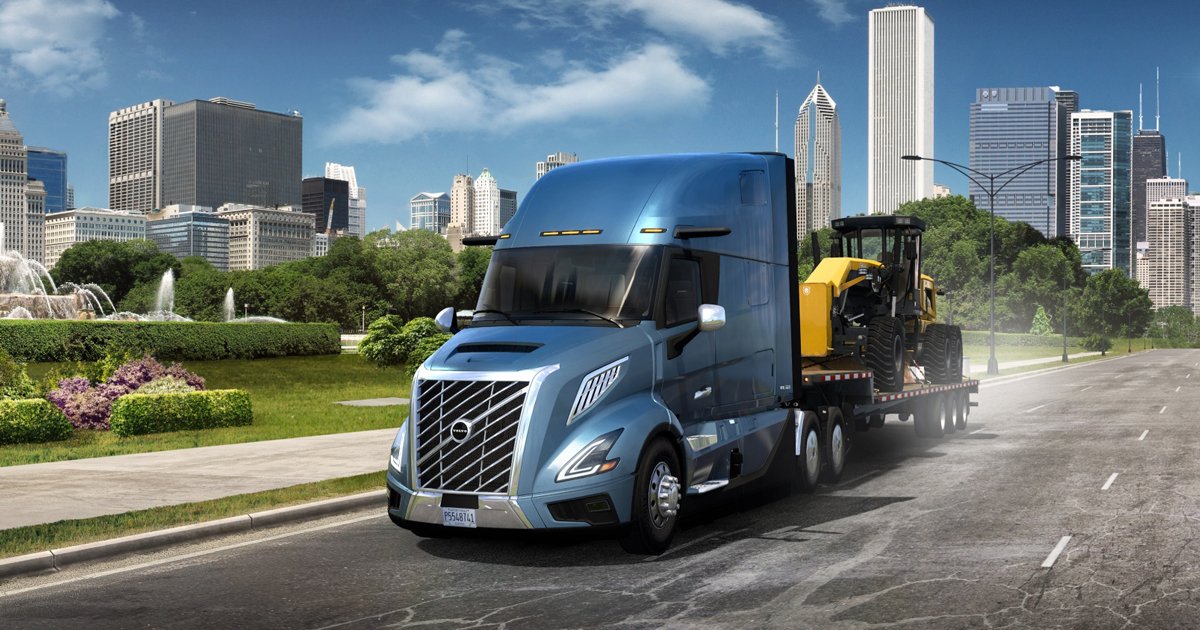
The latest version of the Volvo VNL is now a playable model in American Truck Simulator. (American Truck Simulator via Volvo Trucks North America)
key takeaways:
- Volvo Trucks North America added its new VNL and VNR electric models to American Truck Simulator on July 8 through an expanded partnership with the game’s developers.
- Volvo said the simulation uses design data and real-world testing to accurately recreate the truck’s performance and can help onboard future drivers and technicians.
- Volvo executives said the game complements industry training and envisions future truck launches including digital versions that customers can test immediately.
Volvo Trucks North America is adopting video games as a way to promote and educate, with the company recently announcing the addition of its VNL line to American Truck Simulator.
In American Truck Simulator, players transport freight, manage fleets and create virtual trucking companies. Now they can do it behind the wheel of Volvo’s latest trucks.
VTNA expanded Its nearly decade-long partnership with game developers sees the addition of new VNL and VNR electric trucks to the list of vehicles that players can use until July 8.
“This is a very exciting way to introduce our trucks,” said VTNA President Peter Voorhoeve. “American Truck Simulator has built an incredibly passionate community that appreciates great trucks and authentic driving experiences.”
(SCS Software via YouTube)
Brian Balicki, head of design for the Truck Technology and Industrial Division at VTNA, said many techies start out playing games that later inspire their careers. He said that a major goal of bringing the truck into the game was to ensure that the brand was accurately represented. Balicki said he hopes it will help aspiring truck drivers and gamers get involved with trucking.
“I see convergence of this platform with the trucking industry,” Balicki said. “There’s a lot of what we call gamification in our industry, when drivers are doing a good job on the road, when they’re using fuel appropriately and responsibly, they’re rewarded, and the game system itself is similar to that, and they’ve introduced a safety curriculum.”
Volvo’s focus on authenticity dictated how the truck was recreated in the game. (American Truck Simulator via Volvo Trucks North America)
Volvo’s focus on authenticity dictated how the truck was recreated in the game. Balicki recalled that gamers had asked when the model would be added to the game, shortly after the launch of the physical truck in January 2024. VTNA already had a working relationship with the game developers, so older models were included. The game developers worked from the same digital data used to design the physical truck.
“A lot of the surfaces, features and functions were developed here in Greensboro, North Carolina,” Balicki said. “We create (computer-aided design) data assemblies, and then those assemblies are cleaned and organized so that SCS can potentially use them.”
Connected:Volvo says EPA NOx proposal is clouding truck sales outlook
The developers based the truck’s virtual driving characteristics on real-world testing in Dublin, Virginia. It took about a day and a half of test riding for VNL to get everything the developers needed, including how the truck felt, as well as lots of audio recordings and photos.
“There’s definitely a little bit of translation because they use polygons and we use NURBS (non-uniform rational B-splines),” Balicki said. “But in the grand scheme of things, representation and loyalty to customers still exists.”
The Volvo VNR Electric is the first battery-electric truck available in American Truck Simulator. (American Truck Simulator via Volvo Trucks North America)
Balicki said testing took more than a day because the developers needed to capture multiple truck variants, including different sleeper configurations. The developers wanted each configuration to have its own driving characteristics and sound profile, rather than using a single setup across the entire VNL lineup. They also focused on getting the physics right, including various powertrain features.
“A lot of translation of textures, patterns, materials, sound, ambient lighting, whatever comes virtually,” Balicki said. “They can simulate aerodynamics and fuel economy within the game.”
Balicki pointed out that simulations do not replace physical instruction in the real world. But he considers it a good step into the virtual industry at a time when it is becoming more like a video game. He envisions a future in which digital versions of trucks will be introduced when the physical versions are introduced, allowing customers to test them immediately.