Every sports bike sells you a compromise designed as a decision. Buy the Hypersport machine, and you’ll get a chassis that demands to be whipped on the racetrack and a riding position that turns a two-hour highway slog into a physical therapy session. Buy a sport-tourer instead, and the discomfort disappears, but much of the excitement also disappears; The engine goes soft, the geometry goes slack, and the bike starts to feel like it’s apologizing for existing. The industry has for decades treated comfort and performance as opposite ends of a dial that you can’t maximize simultaneously.
The old rule of sport bikes – choose one, not both
Motorcycle design has traditionally followed a simple rule: aggressive ergonomics create better performance, while relaxed ergonomics improve comfort. Each manufacturer must decide where its motorcycle should sit on that scale. Take on a modern superbike like the Ninja ZX-10R or the Honda CBR1000RR-R Fireblade.
Their low clip-ons, high rear-set footpegs and forward-slung riding position maximize front-end feedback and aerodynamic efficiency. They’re wonderful on the racetrack, but after a few hours on public roads, even experienced riders start to feel strain on their wrists, shoulders and knees. At the opposite end sits a full-dress touring motorcycle.

Bikes like the Honda Gold Wing prioritize comfortable ergonomics over luxurious seating space, wind protection, luggage capacity and outright acceleration. They’re fantastic for traversing the states in complete comfort, but they don’t provide the urgency or emotional jolt that riders expect from a true high-performance machine. The obvious question then: What if a motorcycle could actually combine both personalities without overwhelming either one?
The Kawasaki Ninja H2 SX SE gets the comfort-to-performance formula just right
Base price: $29,999

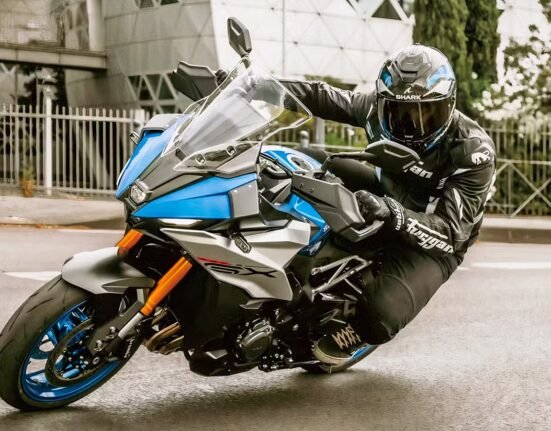
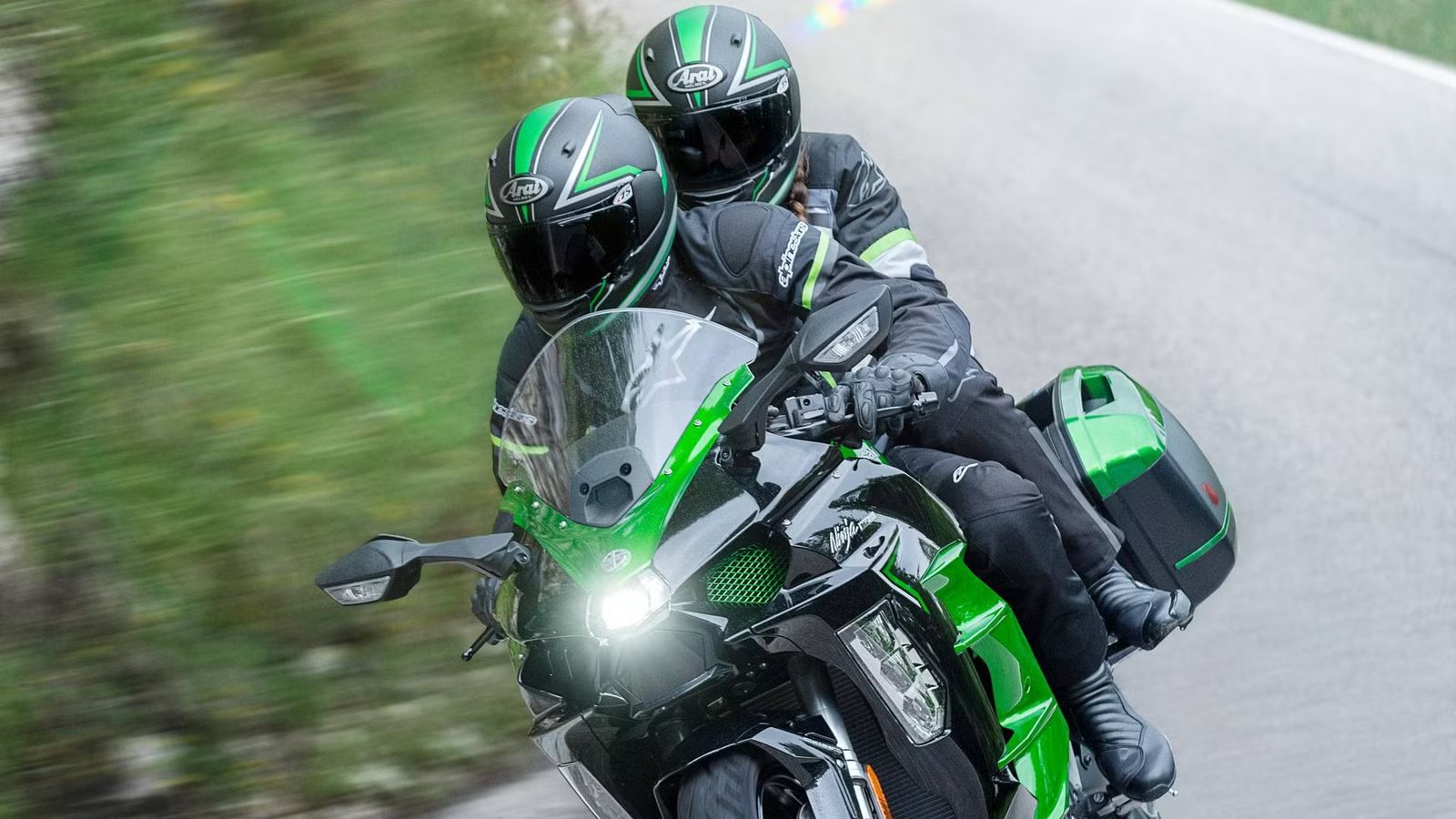
Kawasaki answered that question with the Ninja H2 SX SE. It’s a supercharged hypersport-tourer that borrows its engine architecture from the wild H2 hyperbike family, then re-tunes almost everything around real-world utility. This isn’t a detuned H2 with a big windscreen, and it’s not a sports-tourer with a supercharger for the sake of the brochure.
It’s a true synthesis engineered to carry H2’s track-bred DNA across state lines, which is what makes that platform so special in the first place. Kawasaki’s tagline for this is “Engineered to be free.” A more accurate description might be: Engineered to prevent you from choosing.
At an MSRP of $29,999, the Ninja H2 SX SE stands firmly in premium territory. Yet this is not just an expensive sport-tourer loaded with electronics. It occupies a niche that very few motorcycles attempt to enter – a true supercharged hypersport-tourer capable of crossing multiple states with ease and easily reaching speeds that most touring bikes can only dream about.
A supercharged engine built for utility, not just numbers

At the heart of the H2 SX SE is a 998cc supercharged inline-four, which is claimed to produce 207 horsepower at 10,000 rpm and 101 lb-ft of torque at 8,500 rpm. Those numbers will be the headlines. What matters in the workday commute is where that torque appears. Kawasaki has tuned this engine to remain flat through the midrange rather than underloading and saving its punch for a screaming top end.
This is the real advantage of forced induction over naturally aspirated liter bikes. The Ducati Panigale V4 needs revs to make its mark – you chase the tach towards five figures to get to the good stuff. The supercharger on the H2 SX SE compresses the intake air regardless of engine speed, so third gear at 3,500 rpm already has real pressure behind it.
Quick-shifter grunt work

The Ninja H2 SX SE comes standard with Kawasaki’s KQS bi-directional quick-shifter, which allows clutchless upshifts and downshifts while riding. Combined with Kawasaki’s assist and slipper clutch, the system dramatically reduces the physical effort involved in changing gears. On short trips, that convenience may seem like a luxury. However, after spending a whole day in the saddle, this becomes one of the biggest comfort benefits of the motorcycle.
Repeated clutch operation in stop-and-go traffic, mountain switchbacks, or urban commuting gradually leads to fatigue. The quick-shifter reduces that effort while keeping acceleration smooth and seamless. With a slipper clutch, downshifts are equally refined, helping to maintain chassis stability during aggressive deceleration. The end result is a motorcycle that feels extremely easy to ride despite its immense power. Rather than demanding constant physical input from the rider, the H2 SX SE quietly handles many of the small tasks that contribute to fatigue over long distances.
Long range cockpit

Sit the H2 SX SE next to its H2 sibling, and the difference is immediate. Seat height is 32.9 inches with 5.1 inches of ground clearance. The footpegs have also been lowered, opening up the knee angle so that a six-footer isn’t crouching every time the bike stops for fuel. Curb weight is approximately 589 pounds. It feels heavy. However, one should note that living with an established, adequate-feeling machine at highway speeds is often easier than a featherweight bike tossed around by every crosswind gust.

The trellis frame below was specifically re-engineered to handle two-up riding and tough stuff without affecting the way the bike moves. Loading a passenger and 40 pounds of gear onto a chassis borrowed from a single hyperbike can easily turn high-speed stability into a guessing game. Kawasaki built the H2 SX SE’s frame to carry that extra mass without obscuring the rear end or lighting up the front on sweeping on-ramps.
Suspension and brakes disappeared
The SE badge brings Kawasaki’s semi-active Kawasaki Electronic Control Suspension (KECS), built around Showa’s Skyhook eERA technology. In simple terms, the Skyhook tries to keep the bike’s protruding mass – frame, engine, rider – stable in space, much like a camera gimbal keeps footage smooth while everything beneath it keeps moving.
Sensors read wheel speed, stroke and chassis motion dozens of times per second, and the suspension adjusts damping on the fly to soak up potholes or heavy slabs of interstate concrete before they reach your spine. The rider still chooses the overall character, toggling between comfort-leaning and sport-leaning settings, but the system fine-tunes that choice in real time.
Brembo Stylema brakes without hard edge
Stopping a motorcycle capable of producing over 200 horsepower requires equally serious braking hardware. That’s why Kawasaki has equipped the H2 SX SE with dual 320 mm semi-floating front discs gripped by Brembo Stylema radial monoblock four-piston calipers, complemented by Kawasaki Intelligent ABS. These are the same family of premium calipers found on some of the world’s best performance motorcycles.
Electronics that manage exposure as well as fatigue

The H2 SX SE runs a Bosch-based radar sensor as part of Kawasaki’s Advanced Rider-Assistance System (ARAS), which brings adaptive cruise control and blind spot detection to a bike with hypersport bodywork – still a rarity in this class. Adaptive Cruise silently manages following distance in highway traffic, and Blind Spot Alert sounds a warning before a lane change turns into a near-miss. Any feature is not just about the safety margin; Both reduce the mental workload of constantly checking mirrors, which has its own kind of fatigue on long journeys.
Heated grips also come standard. Fingers that don’t go numb at first glance remain sharp for everything else the ride demands. All of this is routed through a 6.5-inch TFT dash running Kawasaki’s Spin smartphone connectivity, which handles turn-by-turn navigation and call alerts without forcing the rider to find the phone at a stoplight. Less glances at the mounted phone means more attention spent on the road – a small tradeoff that adds up on a full tank of gas.
night-riding safety

Kawasaki has also fitted lean-angle-sensitive LED cornering lights, which activate gradually when the bike leans into a corner, and throw light at the apex of the turn before catching the headlight beam. On a canyon road after dark where a standard headlight aims straight ahead and leaves shadows on the inside of every turn, that extra pulse of visibility is the difference between seeing a decreasing-radius turn and seeing it mid-bend.
None of this makes the Ninja H2 SX SE the fastest bike in Kawasaki’s lineup, and it won’t outrun a full-dress tourer on a cross-country slab run. What it does do is bridge the gap between those two extremes more than almost anything else on sale in the US right now. This is a bike that can chase a canyon road on a Saturday and cover 400 miles on a Sunday without any compromise.
Source: Kawasaki