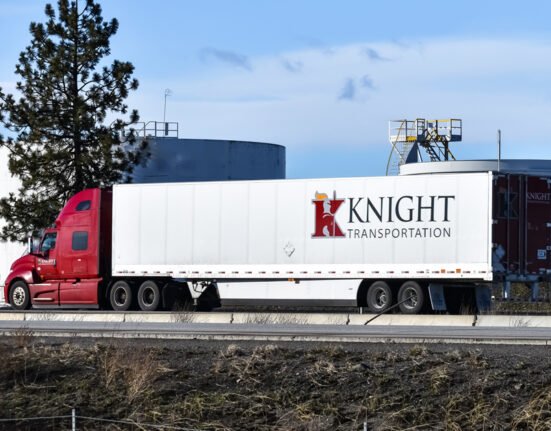
“It’s going to be extremely busy,” says Tenney. (Adamkaz/Getty Images)
key takeaways:
- Trucking M&A activity improved in the first half of 2026 as freight market conditions recovered and sellers who had delayed exits returned to the market.
- Capacity cuts, rising freight rates and strong investor confidence supported dealmaking, although buyers remained selective and trucking valuations varied by segment.
- Advisors expect more transactions in the second half as the market stabilizes, with buyers prioritizing differentiated capabilities and flexible businesses over excess capacity.
The freight forwarder market as well as trucking mergers and acquisitions have been gaining momentum this year, increasing experts’ optimism about a coming boom in deals.
“It’s going to be extremely busy,” said Spencer Tenney, CEO of Tenney Group. “We have a significant segment of the trucking industry that wants to exit, that has made plans to exit, but doesn’t have the right conditions to go to market.”
Tenney Group 2026 Mid-Year M&A Report found that capacity cuts, along with other key factors such as rising freight rates, inflationary pressures, aging business owners, artificial intelligence and increasingly interested buyers, have begun to drive industry consolidation. This comes after a slow few years for dealmaking that coincided with a slowdown in the freight market.
“We are waiting for the right conditions to unlock many of the M&A activities that have been locked in over the last three and a half years,” Tenney said. “So I’m very excited about the opportunities that lie ahead and the activity that has occurred in the first half.”
Tenney said the problem in the past was that conditions were too good, so many potential sellers were put off. But then the freight market changed rapidly and interest rates rose, leaving them with low valuations and few interested buyers.
“I expect we’ll see an even better market in the second half,” said Jonathan Brittva, managing director of Republic Partners. “The first half has been spent seeing better numbers and bringing it all together. But I think in the second half, we’ll start to see more activity.”
PMCF Investment Banking found that overall deal activity for transportation and logistics has stagnated this year. It tracked 121 transactions that closed over a 12-month period during the first half. The total was in line with last year but down from the 168 deals reported in 2024. The company is nevertheless keeping an eye on market trends that may favor greater bargains.
“Commercial trucking has had an exceptional year in the public markets, with the PMCF T&L Index showing a 35.2% share price increase within the subsector in the second quarter,” said Eddie Zukowski, a director of PMCF. “This growth was primarily driven by a number of expansions indicating increased investor confidence in the sector.”
freight market upside
BMO Transportation Finance is tracking the improvement in the broader transportation market which is primarily driven by the asset-light segment. While the asset-heavy side was low until recently, M&A activity is picking up as trucking also looks to be improving.
“I believe the banking market has recently begun to believe that the boom in the trucking industry is sustainable,” said Ken Kramer, director of corporate banking at BMO. “Capital markets have been more supportive. I expect M&A activity to be stronger in the second half of the year.”
The Department of Transportation accelerated the ongoing decline in capacity by tightening enforcement of non-domiciled commercial driver licenses and English language proficiency standards late last year. Britva said this rebalancing of the freight market has improved the performance of many transport companies, which is also helping to push deals forward.
Connected:DOT issues final non-domiciled CDL rule
“The question will be how long this will last and what kind of structural changes we are going to see,” Brittva said. “But at this point, the market, I would definitely describe as good.”
Zhukovskyy is optimistic that industry players are becoming more accustomed to all the noise and uncertainty. He also said that private equity firms have cash that they are eager to deploy. Their main conclusion is that volumes finally seem to be stabilizing after a multi-year correction and the underlying fundamentals, particularly in trucking, are changing in favor of dealmaking.
“The macroeconomic outlook appears to be stabilizing, but geopolitical risks remain across the region,” Zhukovsky said. “The continued conflict between global powers is eroding and impacting unit-level economics on the non-discretionary costs of doing business.”
not uniform across the board
“There’s still reason to be cautiously optimistic,” Tenney said. “It’s really important, as we see these numbers come in, to understand that the impact is not spread equally across every area of the transportation and logistics sector.”
Tenney recalled that deal discussions began to come together during the first half of the year as market conditions had stabilized enough to free up capital. He expects that by 2027, buyers and sellers will increasingly converge and conditions will continue to improve.

Alex Fraser from Cox Fleet discusses how fleets should respond when a roadside breakdown occurs, testing their safety, compliance and customer service systems simultaneously. Tune in by going above or RoadSigns.ttnews.com.
“Transportation M&A improved during the first half of 2026, but it was not a broad-based recovery,” said Gaurang Shastri, managing director of Lincoln International. “Activity remained highly selective, with buyers gravitating toward businesses that offer differentiated capabilities and defensible market positions rather than simply adding more capacity.”
Shastri said trucking companies face challenging valuations due to commodity freight rates, spot markets or undefined truckload capacity. He said buyers instead focus on businesses with competitive advantages, differentiated service offerings and leadership positions.
“The simplest way to describe today’s market is that buyers are pursuing capabilities rather than capabilities,” Shastri said. “They are looking for platforms that expand their service offerings, deepen customer relationships and provide access to attractive, flexible end markets.”