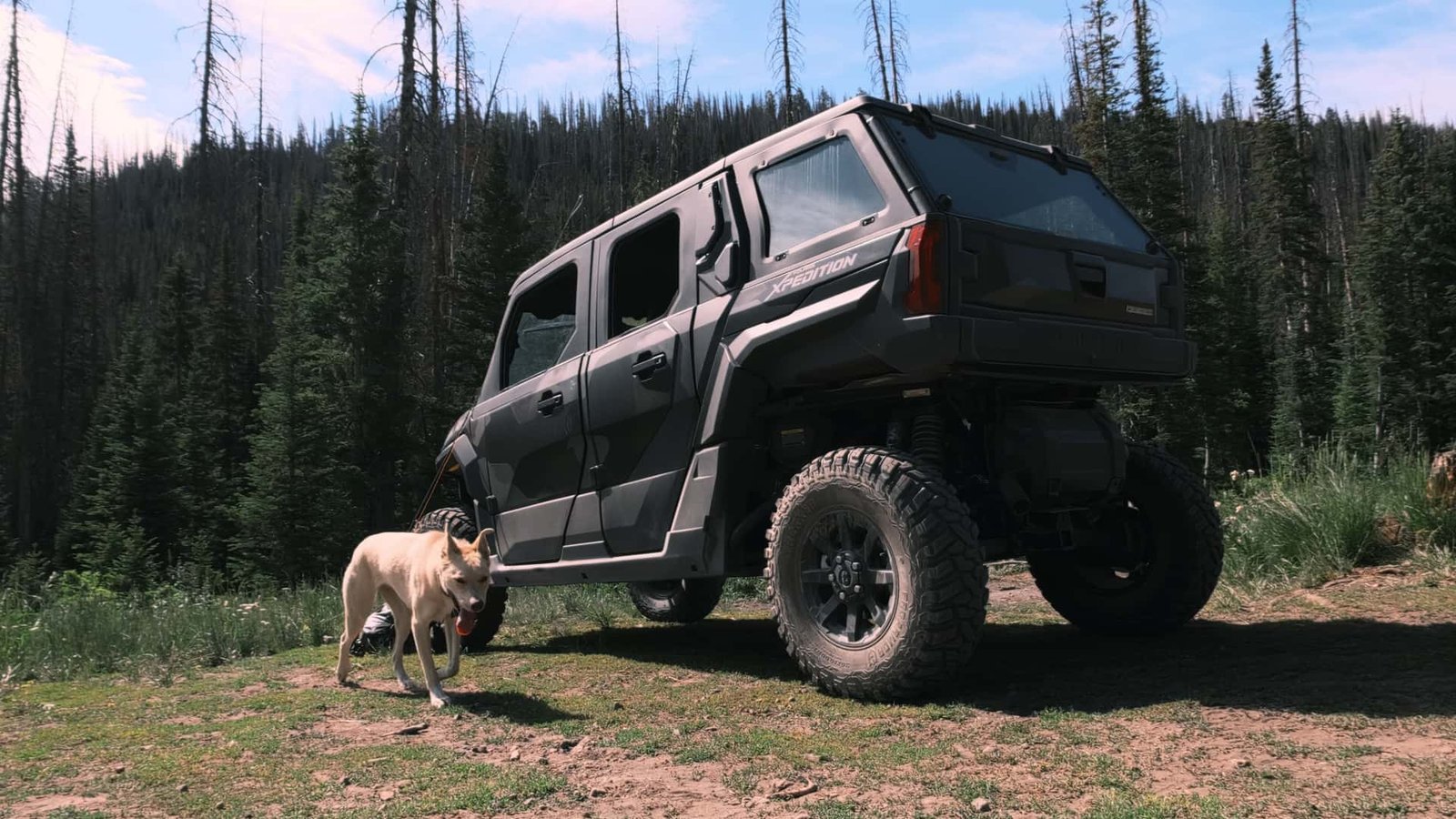
I’ve been looking forward to riding the Polaris Expedition side-by-side for years, because when it first launched with a rooftop tent, it beat me to it with my own Can-Am X3 overlanding build by about two weeks. Still, whereas my rig was slapped together with a pile of parts, the Expedition was something that had the seal of approval put on it by the factory, and it came complete with a warranty and the kind of engineering you’d expect from an OEM.
Although several years have passed since the Expedition’s original launch, I was still eager to drive a Polaris rig. And supposedly the spec sheet got better and better every year. More creature comforts, more capacity, more of everything. Everyone I met kept saying how great a UTV is, and how it can “replace your truck!” This was the first true side-by-side overlanding. And you can even get a rooftop tent!
Originally, I wanted to hunt bears in the Polaris Expedition Northstar this spring, because the HVAC, doors, five seats, and windows would make that endeavor a truly wonderful test, as spring snowfall, storms, and the Uinta Mountains make perfect testing conditions. But transportation problems caused delays and the bear was not hunted—at least not yet.
So when the Expedition arrived, I decided to take it to the mountains in search of some epic high country trout fishing. But instead of coming up with a plan to sell my truck in favor of a Polaris, I’m actually thinking about what everyone was saying when they talked about how amazing the Expedition is. it’s not bad; It’s just…a UTV with HVAC, and it doesn’t seem to live up to the price or the respect I get from owners.
Utah’s towering Uinta Mountains are some of the highest pieces of public land around, as they offer a range of ecosystems, flora and fauna, and ample room for everyone to enjoy whatever they like to do in those places. The snow-capped peaks (even in this year’s extreme heat and drought-stricken summer) show evidence of rock slides and avalanches, with logs and rocks scattered everywhere. Deer and elk graze in the lower forest, hiding themselves and finding shelter from the sun and people. And rivers and fish-filled reservoirs extend across the landscape, some of which are easy and difficult to access depending on location.
I’ve been wanting to take the bike to go fishing for a while, but the Expedition gave me a better excuse to escape from work, grab my fly rod, and see if I could find a new honey hole. I also took my dog with me, because he’s not only an excellent adventure companion; She’s also a good bear and lion deterrent, and the locations I had in mind certainly had the potential for both. And Polaris made prepping easy, as there’s ample space in both the enclosed rear deck as well as the fold-down rear seats and even the passenger seat.
This included my fishing backpack, my grays rod setup, lots of flies, and a cheap net, as well as water and snacks for both of us. I removed the windows and opened the windshield so we both could get some fresh air and the cool morning breeze. But almost immediately, I discovered one of the Expedition’s flaws: It has no power.

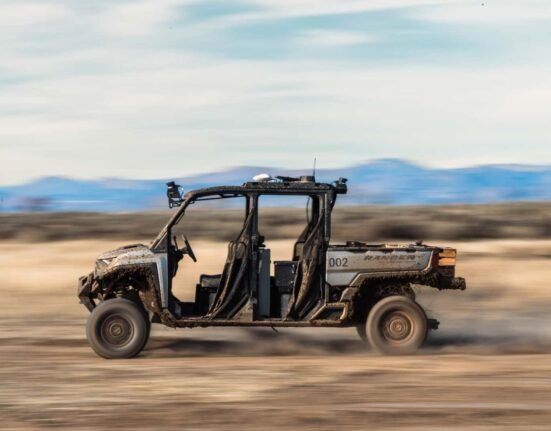
2026 Polaris Expedition ADV 5 Northstar
Photo by: Jonathan Klein
According to Polaris, the Xpedition’s 999cc twin-cylinder engine produces 114 horsepower and a modest amount of torque. I say this because Polaris doesn’t publish the Expedition’s torque, and I’m beginning to see why. Additionally, Polaris also publishes dry weight as standard, which is completely useless, as nothing moves if there is a lack of fluids like fuel, oil, and coolant, as well as every other fluid that goes into a gasoline-powered vehicle. However, Polaris did publish a curb weight for the 2024 Polaris Expedition ADV 5 Northstar, stating that it weighs 2,916 pounds when all the accessories are fully equipped to drive it. That weight, in combination with its moderate horsepower, and Some? It is extremely slow due to the amount of torque, while at the same time it is not good on gas.
Let me elaborate on that.
While directing the expedition to its first stop, I had to climb to a great height. Something around a few thousand feet, let’s say, a few miles away. However, this is backcountry, and there are ups and downs, so while some parts are flat, other parts are steep and steep. While going up those steep grades, I was flat-footed with the throttle but barely budging, topping out at about 35 mph. It consumed fuel. In big sips. So much so that, even though I drove about 75 miles total that day, I only had 1/8 tank left after filling up in the morning.
Far from the advertised 200+ miles. Then again, I wasn’t walking the trails at an ungodly pace. I was just dancing. But the small-displacement, naturally aspirated motor, a heavy overall weight, and high mountains, many of which are above 9,000 feet, prove to be poor companions in terms of fuel economy.
I get that people bring extra fuel with them on long trips, and not everyone lives at or above 8,000 feet, but the idea of an adventure-spec overlander with such limited range and weak power made me frown at the whole endeavor. My own Can-Am overlanding build in particular, which is based on the more sport-oriented X3 platform, can easily go over 150 miles on a tank, which I proved during my elk hunt last year. To be honest, I was expecting more. Both from its power and fuel mileage.
Where the rig shown was capable of dealing with obstacles both small and large, rough paths, boulder fields, small streams and pools and fallen timber were all unable to stop the expedition’s progress. It can even climb really steep slopes, which I tested in my backyard. And when it started raining in the middle of a particular mountain, the ability to close the windows and windshield and seal everything was great for keeping me out and heading toward a reservoir I wanted to explore — however, once I got there, I had the eerie feeling of being watched, and at least at one point during my short walk within its confines, I thought a print looked very much like a mountain lion.
Did he hear something in the forest or is it just my hallucination?
Photo by: Jonathan Klein
As far as side-by-side driving goes, the steering system is well weighted, neither too heavy nor too soft, and the controls and seating position are solid. With space for five people plus a covered bed, I fit myself, my wife and my three children, as well as my dog for a separate walk before our fishing excursion, and everyone had plenty of room. Our dog wanted to be in the front seat, but she always wants to be in the front seat.
We also checked out the JBL sound system, which provides a solid base for trail jams. NVH, especially at wide-open-throttle, which I had to use again whenever there was a hill, turned off the music, because there could have been a little better sound barrier right near the engine compartment. But otherwise, I wish my season had been worse.
I know it sounds strange, but during my tests, I had neither a really hot day, nor a really cold day, so I couldn’t test the Expedition’s HVAC system. If it had come sooner, the bear hunt would have been exactly the same. Some of my friends were sending me pictures from snowy days, while some friends were sending me pictures from the 80s. I only had to test the windshield wipers, which performed just as you’d expect from a windshield wiper.
The day ended with me finding a new stream and catching some brook trout barely the size of my hand. They’re fun, but a far cry from what I had envisioned catching that morning. I probably picked the wrong flies, and should have gone to another spot that I had saved. However, I did find some elk rubs from last season as well as a well-used game trail. So maybe a few more OnX waypoints could have been added, and the trek wasn’t a complete waste. But let’s be honest, fishing and being in the backcountry is better than sitting at your desk in front of your computer any day.
However, this brings me back to the Polaris Expedition.
This particular model is the 2026 Polaris Expedition ADV 5 Northstar, with a retail price starting at $45,000. Add some accessories, which most buyers do, and you’re looking north of $50,000. That’s money for a whole quarter ton truck. And that’s a lot to ask for something that isn’t exactly what it’s promised to be.
However, it is still a good UTV. And for those on flat terrain, I think it might work for you, where its power or weight won’t matter as much. Places like Nebraska or Texas. Or out of the east. Long expanses of grassland, sagebrush, desert, or otherwise, especially when the weather rears its ugly head, this cab will be a godsend. But for the West where I live, I’m unsure why Polaris doesn’t put a different RZR engine in one of these? Put a turbo on it and shut it down for a day, then it will be a true overlander worthy of replacing your truck.