
Diesel engines hate cold weather. Negative temperatures cause the fluid to thicken like molasses while sucking power from truck batteries, making it terrifyingly harsh on your rig in the winter. Modern pickups have become very good at overcoming cold starts, but still, they have their limits – and this cold chamber in Southern California was built to overcome them. To see how the pickup performed at -40 degrees, Banks Power froze a Cummins diesel RAM inside it.
This experiment was conducted with a 2024 RAM 2500 HD in extreme conditions. Banks installed new Interstate AGM batteries under the hood and swapped out the 6.7-liter’s fluid for fresh Amsoil products like the brand’s Signature Series 5W-40 oil. Winter diesel was also used in combination with Amsoil additive to prevent gelling. He also made sure to replace the fuel-water separator before testing for good measure.
Turbodiesel godfather Gale Banks began the test by listing four key factors in diesel engine start processes: ambient temperature, coolant temperature, heat of compression, and manifold air temperature. You can only control so much, but thanks to the block heater and intake air heater, you can increase the second and fourth factors.
To prove that block heaters make a big difference, Banks tested the truck with and without one. They measured coolant temperature, resting voltage, cranking voltage, and cranking RPM in various conditions, with a start of 75 degrees Fahrenheit serving as the best condition. The results are showing:
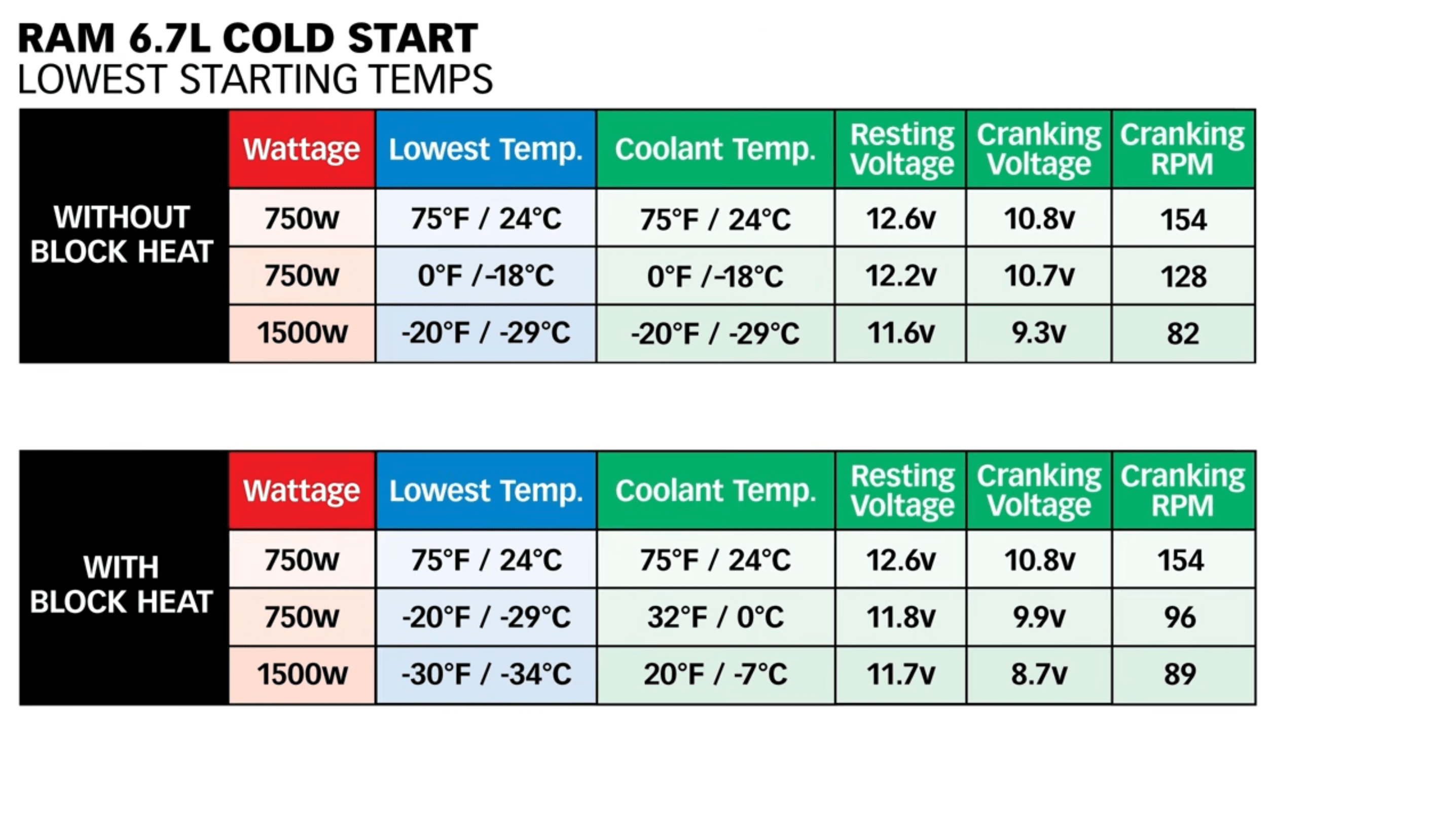
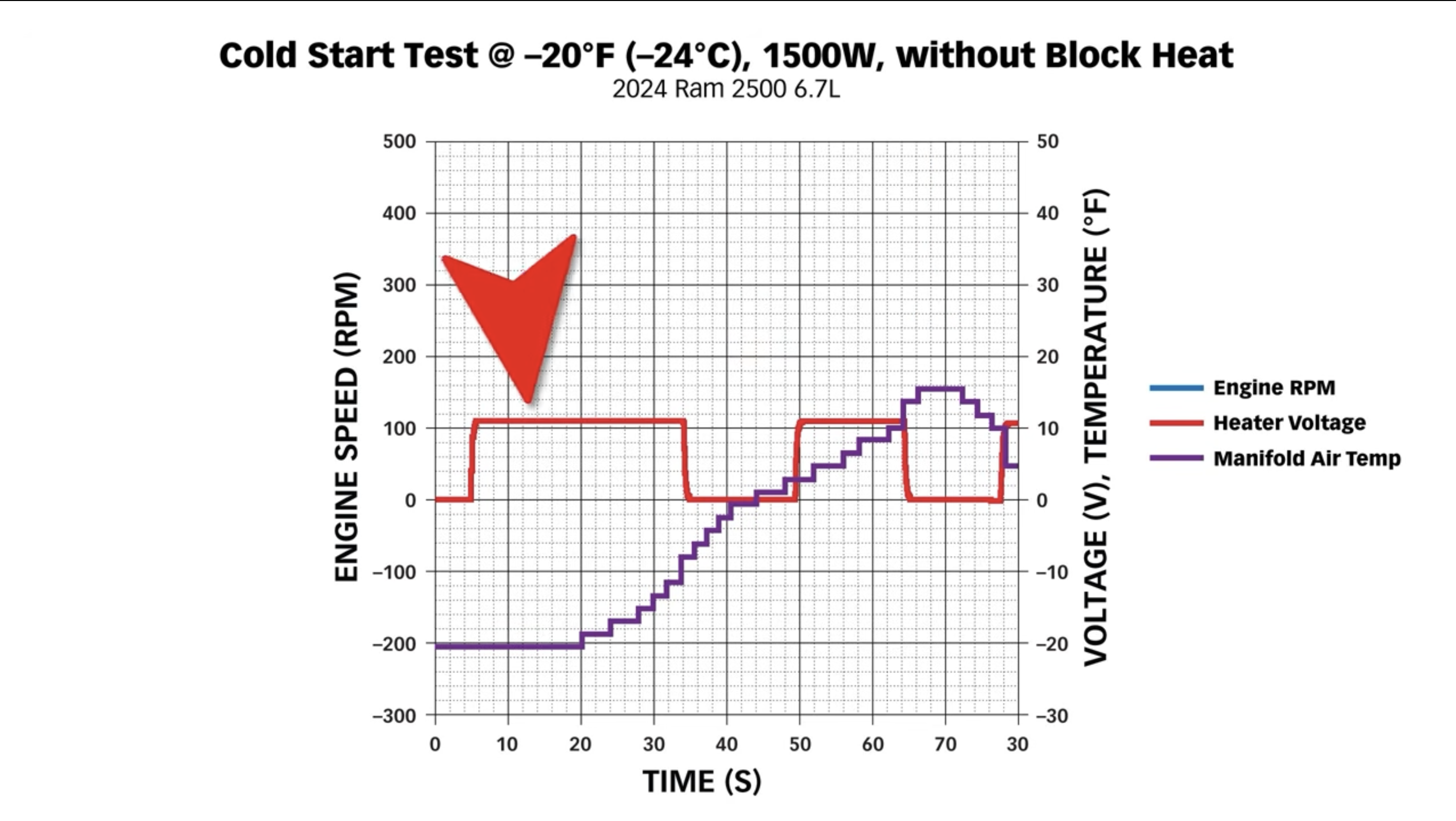
At -20 degrees Fahrenheit without a block heater, the coolant temperature matches the outside air. This makes it very difficult for the engine to start and reach optimum operating temperature. You can see proof of this because during that test the engine could only crank at 82 rpm – a 46.9% loss in the piston speed that a diesel engine depends on to start. And keep in mind that this test was conducted with 1,500 watts of intake air heating power supplied by a dual-element Banks Power Monster RAM.
If you look at the chart below, you’ll see that the block heater heated the coolant temperature to 32 degrees Fahrenheit despite the -20 degree ambient temperature. This results in significantly less wear on the engine, considering that internal cylinder temperatures can exceed 300 degrees at startup. If the coolant is warm in the water jacket around the cylinder, and the temperature difference is not that big, you have a better engine in the long run. (It’s worth noting that piston speed is still reduced by 38% compared to the beginning of the warm season, although the -20 degree ambient temperature test with block heat was only conducted with a 750-watt intake air heater element.)
Even at -30 degrees Fahrenheit, the block heater helped raise the coolant temperature by 20 degrees. The truck also achieved 89 cranking rpm with heat from the 1,500-watt, dual-element monster ram intake.
The falling temperatures took a toll on the truck as at -40 degrees the truck completely failed to start. With a cranking voltage of only 6.4 volts, the batteries could not provide the juice needed to keep the ECU active. Needless to say, the Monster RAM didn’t get a chance to help, although the block heater kept the coolant temperature at 9 degrees Fahrenheit.

We froze a truck to -40°. What happened here?
These tests show why hardware is so important. Block heaters shouldn’t be an easy task for diesel truck owners in cold weather states, and frankly, heated intake air matters too. Cummins installs factory grid heaters on pickups like the 2024 model used in this test, though many have suffered from faulty bolts that melt and find their way into the engine. You have to believe that’s why Cummins switched to glow plugs in 2025, and it’s definitely one of the biggest benefits of the monster RAM intake. Now, they also sell with a triple-element setup that uses 2,250 watts.
Have a suggestion or question for the author? Contact him directly: caleb@thedrive.com