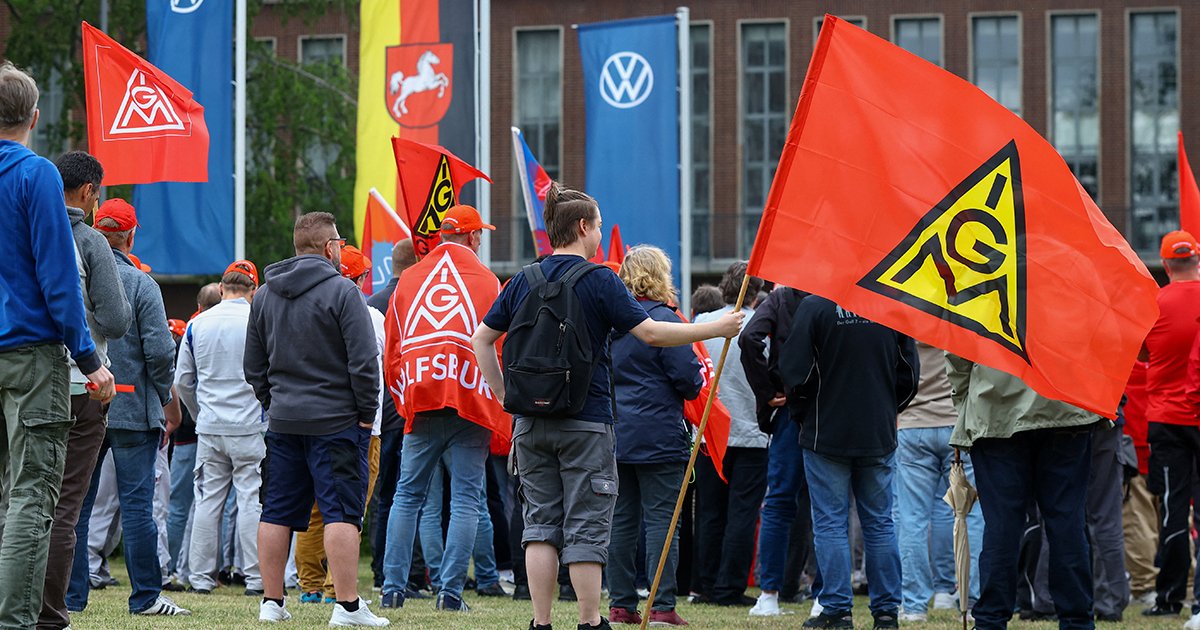
Volkswagen employees and members of the IG Metall union rally on the grounds of Volkswagen headquarters on the day of the supervisory board meeting in Wolfsburg, Germany. (Lissi Niesner/Pool Photo via AP)
key takeaways:
- Volkswagen reported on July 10 that global sales fell 8.6% to less than 2.1 million vehicles in the second quarter, with the decline being heavy in China.
- Sales in China declined by more than a third and major brands declined, reflecting increased competition, tariff and regulatory pressure in a challenging global environment.
- The company is facing opposition from employees as it plans to reduce its model lineup by half and undertake a sweeping restructuring to improve competitiveness.
BERLIN – Volkswagen reported weak sales numbers on July 10, a day after the giant German automaker announced plans to nearly halve the number of models due to declining sales, particularly in China.
The Wolfsburg, Germany-based company said group sales fell 8.6% in the second quarter to less than 2.1 million vehicles, as sales in China alone dropped by more than a third.
Read more: VW labor leaders vow to fight deep cuts made by CEO
Following a board meeting on July 9, Volkswagen said its “fundamental restructuring” over the past three years has reached its next stage, announcing plans to streamline the model lineup by half, without giving details.
Citing an “increasingly demanding environment”, CEO Oliver Blume planned to make VW faster and more competitive through reduced complexity, focused technologies, better alignment across regional markets and reduction of overcapacity, among other things.
Among its core brands, the core Volkswagen unit saw deliveries of more than 1 million vehicles in the second quarter, down 14% from a year earlier. Audi deliveries fell 8% and Porsche deliveries fell 18%.
Lamborghini, Skoda and truck units posted growth, and sales rose in the US and Europe.
Volkswagen cited dramatic changes over the past year, including geopolitical tensions, rising costs primarily through tariffs and increased regulatory requirements along with increased competition.
As recently as December, Volkswagen was betting big on China, where electric cars are taking more market share and competition is stiffer.
Research firm BernsteinSG expressed skepticism in a note after the July 9 announcement. “VW said it is expanding its technology lead, a claim that will likely raise eyebrows given the pace of innovation among its Chinese competitors,” she said.
Also on July 9, hundreds of workers led a protest outside the Volkswagen plant in Zwickau to demand protection for jobs and to voice opposition to plans to close the site. The factory has switched to manufacturing completely electric cars.