I’m in my car, in the parking lot of Trader Joe’s in South Pasadena. On the phone, my friend Monica is telling me about a lost dog in her Salt Lake City neighborhood, a blue heeler who has been seen limping and has escaped capture.
I passively scroll through Instagram as I try to imagine what a blue heeler would look like. Then I saw this, a post from a literary organization announcing the death of Marjan Satrapi. The family said he died of a broken heart.
Degh card, we will call it like this in Persian. More poetic and subtle.
I am overcome with a tremendous and unexpected sadness. I tell Monica the news.
“she wrote Persepolis,” I say.
Then, I turn off the phone and cry.
Ten minutes later, pushing a cart into the store, I was heavy with grief and confused by the weight of my reaction.
She was not someone I knew personally. I was not an avid fan or follower of his work and had neither read nor seen Persepolis Since its release two decades ago. Yet, as the day wore on, I was plunged into darkness.
This person who occupied no place in my life while I was alive, left a deep void after death.
*
I came here, to this country, with my mother. Both of us, refugees from Iran. I was nine years old. I had brought a bag full of books and a suitcase full of clothes. I brought a Cabbage Patch doll, a stuffed animal, a fox I had since birth, given to me by my older brother, and a square foot powder blue quilt that I have held over my chest every night since I can remember. I called him Azizam. Dear!
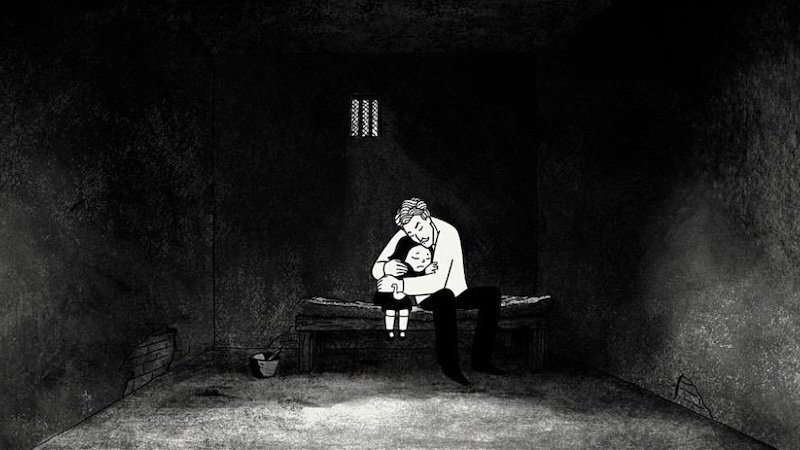
When we arrived I was told not to say anything about what happened in Iran. I can say that my father had died. I can understand how he died. But I could not say this, he was imprisoned by the Islamic regime. I cannot say that I visited him eleven times in different prisons, including Evin. Or that I touched the tips of her fingers through the holes in the plexi glass that divided us; that I took off my hijab and showed him how long my hair had grown while he was in prison; That I sat on his lap for the last time, and looked out the window, wishing he would walk with us in the sunshine. Didn’t know it was the last time.
That’s why I remained silent. I didn’t talk about it at home because it was too painful. And I didn’t mention anything in school because I entered fourth grade without speaking English.
At that time, my classmates did not bother me because of my dead father. It was my unruly curly hair, my budding breasts (extremely developed for my age), my inability to speak their language and finally, the country I was from.
My classmates and their parents couldn’t point to Iran on the map. They couldn’t even tell its name. What they knew about Iran was that it was a bad place full of bad people. His image of my home – the birthplace of human rights, first enshrined by Cyrus the Great 2500 years ago – was mirrored by a decade’s worth of footage on the nightly news showing American hostages being held at gunpoint, and sheet-wearing women and bearded men punching the air and shouting “Death to America” in protest of those great American values of “liberty” and ‘equality’.
The worst part is that I came out the same year that Sally Field played Betty not without my daughter. Excited to see our country on the big screen, my family and I went to the cinema. What was reflected before us still haunts me.
In the film, which was based on the Pulitzer Prize-nominated memoir, Betty escapes the clutches of her savage Iranian husband (played by Alfred Molina) and courageously gets herself and her daughter out of Iran.
Sweet, white, brave, American daughter. My classmates’ moms loved him.
Those first years were very difficult. As I worked on assimilation, I let go of my past. I have let go of what happened to my father. I let go of the battle I had been through. I forgot the bombs and sirens. I lost part of my language. And my memories of Iran, its streets and markets became blurry.
I learned english. I watched 90210. I bought my clothes at The Gap, lost my accent, rolled my eyes at my mom. I started saying I don’t care. I don’t care. I don’t care.
Still, I didn’t fit in. Neither with his Iranian family nor with his other children. This is the tragic plight of the child immigrant. The person in the middle who tries to be normal, cool, nice, liked, and tries to fit in.
*
Until PersepolisBefore Satrapi’s most famous work was published, I was attending a small liberal arts university in the Pacific Northwest. On a campus drenched in Gore-Tex, sneakers and carabiners, I was a strange creature, walking to class wearing an electric blue wig and extravagantly embellished heels. I wanted to be a writer and a filmmaker. Like most people around me, I was on a hard path of finding myself. But unlike most of my (white, American) friends, in the culture that raised me after immigrating, I had no role models to reach for.
What I could not say, Satrapi finally said for me.
There were no Iranian characters in TV shows or movies, no Iranian women who were famous directors or actors. There are no “great American novels” written by Iranians. The most famous Iranian on TV was Christiane Amanpour. In hopes of motivating me, my uncle used to send me burned DVDs of his news broadcasts from CNN. But she was not good at all. And she was not Iranian like me. She was middle-aged and half-white, born in London to a wealthy family and educated outside Iran.
Persepolis This was important because it was the first time I had seen a young Iranian woman and her work assimilated into American pop culture. Satrapi was an artist, writer and filmmaker. And, she was undeniably quiet, even when she wrote about Iran. Even though she was Iranian! And, all my American friends, who never asked me anything about my life in Iran, were blabbering Persepolis!
I picked up two books and read them in one sitting. Later I watched the film and told my family about it.
Finally, there we were: Iranians no one saw, reflected in the culture. Satrapi has said that he wrote the book to refute misconceptions about Iran in the West.
“I wanted to at least give another perspective,” she said. “My own personal.”
*
I come home from Trader Joe’s and put away the groceries. I cut gerberas and peonies and arrange them in vases. I give the dogs their treats. I do all this in panic. I’m still thinking about Satrapi and the books I read long ago. I go to my office and look for them in my book shelves, but after changing houses and cities several times, they are no longer with me.
My spouse sees my sadness and asks if there is something he can do.
I consider going to the bookstore to pick up another copy and then I remember the movie.
“I want you to see Persepolis With me.”
I need to see it again for myself. And I want him to see it too.
An hour after the news of his death, I’m lying on the couch sobbing as we all watch Persepolis And my spouse catches me.
In the film, I see everything that I have kept away for so many years.
I see a strange Marjane who is exactly like me. Defiant, angry and brave in Iran and in exile. Grew up in the shadow of revolution. I see Marjane and her family running towards the bomb shelter, stricken with fear. And I remember I did that too. I see people dying from heartache and I see my parents’ friends dying from that particular Iranian experience after the revolution. I see a young man in a wheelchair who has just come back from the war and I am reminded of the handsome young soldier I met as a child, sitting on the floor in the corner of a family friend’s house, unable to talk to anyone. I remember she gave me a paper rose folded from a gum wrapper. I see the secret dores (meetings) organized by my parents, the illicit liquor and moonshine that my father used to make in our house. Marjan reflects our terrible teachers, violent morality police, and our collective and perpetual fear that we might be caught, hurt, arrested, killed. I see him visiting an uncle in Evin prison just before his execution. And I say to my spouse, “I was there too when I was little. Saying goodbye to my father.”
I’ve also watched her leave Iran and struggle to fit in with her European classmates who can’t understand the pain we’ve gone through.
I remember all the things I couldn’t say.
I realize that it was not just because she brought Iran to life in culture, but that her books were good and she became famous, which influenced me very deeply. Even more than that, it means that as long as she lived, there was someone in the world who felt what I felt, saw what I saw, was as scared and brave as I was.
What I could not say, Satrapi finally said for me. And in saying them out loud, in showing them to the world, she opened the door and motioned for me to follow her.