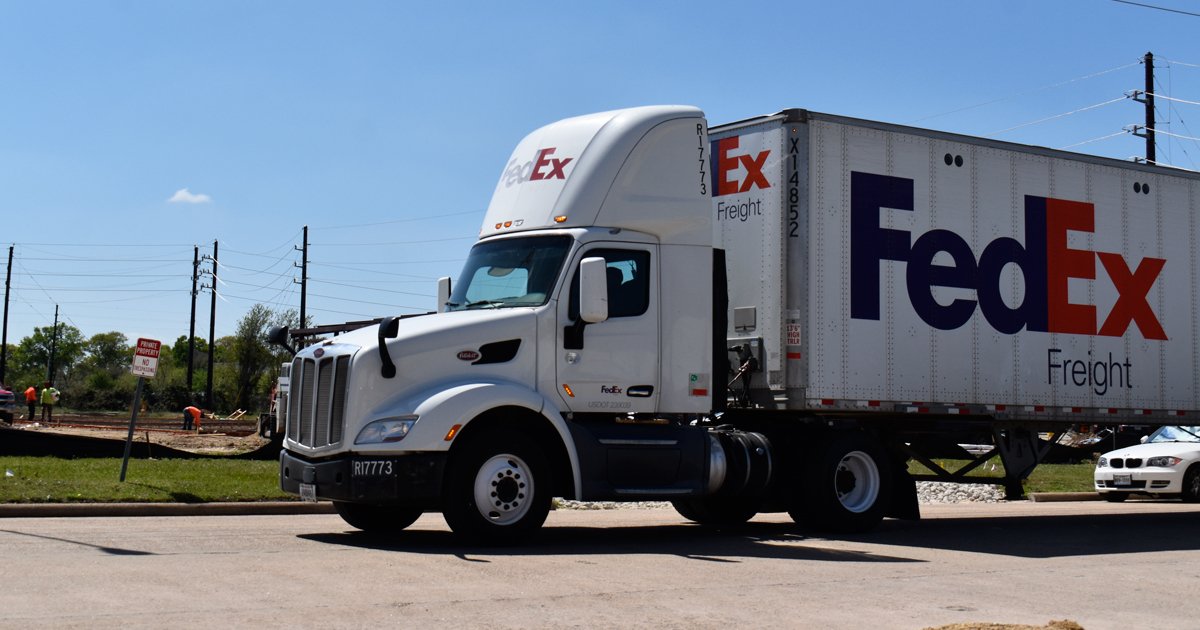
FedEx Freight posted revenue of $2.41 billion in the most recent quarter, up 4.8% from $2.30 billion in the year-ago period. (Artistic Operations/Getty Images)
key takeaways:
- FedEx Freight said the tightness of the truckload market boosted fiscal fourth-quarter earnings as heavy backhaul spillovers supported revenue in the quarter ended May 31.
- The company said revenue rose 4.8% to $2.41 billion due to higher shipment loads despite fuel charges and lower volumes.
- FedEx Freight expects 4%-6% revenue growth through 2026 as it targets LTL customers and higher-margin verticals following the spinoff, executives said.
The tightness of the truckload market as a result of capacity constraints boosted FedEx freight earnings in the three months ended May 31, according to company executives.
FedEx Freight — the largest less-than-truckload carrier in North America — benefited from spillover in backhaul lanes with particularly heavy shipments, executives said June 25 during the company’s fourth-quarter fiscal 2026 earnings call.
“We’re seeing truckload pricing get to some level where we’re now a very good fit for that,” Chief Financial Officer Marshall Witt told analysts and investors. “Not only is it benefiting our balance, it’s benefiting our revenues.”
FedEx Freight posted revenue of $2.41 billion in the most recent quarter, up 4.8% from $2.30 billion in the year-ago period.
The three months through May 31 were the Memphis, Tennessee-based carrier’s final quarter as part of FedEx Corp. after its separation from the parent company on June 1.
The company said the increase in revenue was primarily driven by the favorable impact of fuel surcharges and higher weight per shipment, although this was partially offset by lower volume and a slight decline in revenue per hundredweight basis. Carrier weight per shipment averaged 948 pounds, up 3% from 920 pounds in the year-ago period.
FedEx Freight, which now trades under the FDXF ticker, recorded average daily shipments of 86,734 in the most recent quarter, down 5.9% from 92,129 a year earlier. Revenue per shipment averaged $415.22, up 11.5% from $372.55 in the year-ago period.
Capacity in the truckload sector has tightened from the beginning of 2026 as a result of the federal government’s enforcement initiative on non-domiciled commercial driver licenses, the closure of some driving schools and visas for foreign drivers.
As a result, FedEx Freight CEO John Smith told analysts: “We’ve seen some of those (truckload) volumes come back to us. The thing about it is that it’s really helping us not only with backhaul, but some of those larger shipments that typically run the milk from a truckload perspective. They’re moving back to full truckload, which is moving those larger shipments back into the LTL market.
FedEx Freight, which is set to conform to a calendar-year reporting schedule, is optimistic about the freight market’s prospects, Smith and Witt said.
The company’s top executive said although volumes were soft in the recent quarter, the trend line is now reversing.
Smith told Transport Topics in late May that the freight market’s recovery would accelerate.
But in the call with analysts, he said: “We’re seeing some very good encouraging signs that demand conditions are beginning to stabilize and even grow across the industry. The key indicators, as you well know, we’re seeing are (Institute for Supply Management) trends in manufacturing activity, truckload spot rates and capacity, and early signs — demand is showing positive signs across the industry.”
FedEx Freight now expects revenue growth in the range of 4% to 6% through the remainder of 2026, marginally higher than expectations provided at its first investor day in April, which Witt said was partly due to the “dynamic fuel environment.”
The last average price of diesel nationwide was $3.809 a gallon before the US and Israel began bombing Iranian targets on February 28, according to Energy Department data. The average reached $5.596 per gallon for the week beginning May 18, and the last estimate for June 22 was $4.832 per gallon.

Cox Fleet’s Kevin Clark discusses how fleets must rethink their maintenance strategies to remain efficient and flexible. Tune in by going above or RoadSigns.ttnews.com.
While benchmark crude oil futures prices are now below pre-war levels, the diesel supply chain is expected to take longer to readjust.
It is also expected to see revenue growth from the more focused FedEx Freight, whose sales force will now pursue only LTL customers and have been tasked by Smith and the management team with targeting higher-margin verticals.
Officials laid out the pillars of that attack plan during an April investor day. FedEx Freight aims to improve its market share in the small to medium-sized business, grocery, healthcare, data center and energy sectors.
Chief Specialized Services and Commercial Officer Mike Lyons said in April that FedEx Freight has only minimal access to the $9 billion small to medium-sized business sector of the LTL market, with a high percentage of revenue from large corporate customers.
“Basically, we are doing zero business in the food and beverage market,” Smith told TT in late May. “We feel like this is one of those markets that is doing well – whether the market is good or the market is down – due to the fact that people are going to eat and people are going to drink.”
The company will also benefit from a relatively low level of unbundling of contracts entered into prior to the spinoff.
About 10% of the company’s revenue consists of bundled contracts and it has an average discount of between 1%-3%, which Bank of America analyst Ken Hoexter said was much lower than expected.