In a new audiobook version of Homer’s nearly 3,000-year-old epic poem “The Odyssey,” the voice of British actor Michael Caine delivers the story’s soaring opening lines in his distinctive, gravelly staccato.
“Tell me, O Muse, of the wise man who overthrew the sacred city of Ilium, wandered far and visited the capitals of many nations, learned the customs of their inhabitants, and endured great suffering in the deep,” Kane’s voice is heard over a soft, sad orchestral score.
Following acclaimed narrations of the “Odyssey” by actors like Claire Danes and Ian McKellen, Kane is the latest celebrity to lend his voice to Homer’s epic. But Cain isn’t really telling the story. Instead, he licensed his voice to ElevenLabs, a company that produces audiobooks and other content voiced by artificial intelligence, which used an AI clone of his voice for the project.
A team of four creators created the 13-hour audiobook, which came out Tuesday and is available for free on the company’s ElevenReader platform. The production involves a clone of Kane’s voice and a supporting cast of 20 different AI voices layered with AI-generated sound effects and a musical score, and was put together in just six weeks.
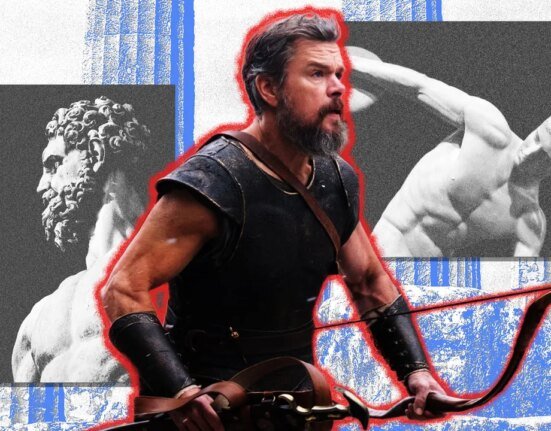
Jack McDermott, who leads mobile growth and marketing at ElevenLabs, explained that the project aims to showcase the creative potential of voice clones and AI narration — all while taking advantage of the growing interest in Christopher Nolan’s Hollywood adaptation of “Odyssey,” which will be released in July and stars Matt Damon, Tom Holland and Anne Hathaway.
“The idea was what would be an amazing piece of content that shows what’s possible in the responsible use of an AI voice featuring an iconic voice?” McDermott said. “On the one hand, it’s about great storytelling. At the same time, it has a great impact on showing creators and writers around the world what can be done with ElevenReader.”
In a way, “The Odyssey,” about the warrior Odysseus’s long and dangerous journey to Ithaca after the Trojan War, works especially well in the audiobook format. The poem, along with Homer’s other great work, the “Iliad,” was composed to be recited by performers.
“If you want to be pedantic, the real way to experience these epics is to listen to them,” said classicist Daniel Mendelssohn, whose translation of the “Odyssey” was released last year.
But some listeners may have trouble hearing a spoken masterpiece from ancient Greece narrated by AI-generated voices, and they may question whether such a presentation can capture the emotional and dramatic scope of Homer’s story.
The audiobook comes at a time when “Odyssey” is all over social media thanks to Nolan’s film. The timing is intentional. Seeing an opportunity to take advantage of the growing interest in Homer’s poetry to demonstrate ElevenLabs’ technology, company executives selected Kane for the project.
Caan, an Academy Award winner, was an obvious choice: He had inked a deal with the company to feature his voice in ElevenLabs’ Iconic Marketplace, which allows companies to license famous voices.
The AI version of “Odyssey,” with its high-profile synthetic narrator and splashy rollout, could become a test case for whether audiobook listeners are open to an AI version of a beloved actor’s voice.
While synthetic narration has spread in recent years, with AI-generated audiobooks now available on major platforms both legally and illegally, it is unclear how popular they are among listeners, who often value a narrator’s performance as much as the book itself. According to a survey Only 16 percent of audiobook listeners reported listening to an AI-voiced audiobook, according to a survey conducted in June by the trade group Audio Publishers Association.
This hasn’t stopped professional narrators from fearing a future where publishers and audiobook production companies could eliminate human narrators altogether by ordering faster, cheaper AI narrations featuring replicas of famous voices.
“Of course, the slippery slope of synthetic celebrity voices is that publishers will license those voices for more and more projects, resulting in fewer possibilities for everyone else,” said Edoardo Ballerini, a prominent audiobook narrator who believes synthetic narration poses a threat to the industry.
ElevenLabs executives say the company uses AI narration mostly to create audiobooks for titles that might not otherwise get audio versions, and that the technology is adding to the audiobook landscape rather than jeopardizing the careers of human narrators. As to whether AI narration results in a poor audience experience, company executives say the market will be the decider.
“At the end of the day the audience will decide,” said Dustin Blank, who oversees ElevenLabs’ talent and strategic partnerships, including Iconic Marketplace. “It’s up to them. No one is forcing it into our ears.”
ElevenLabs “Odyssey” will likely be polarizing. When the company announced in November that Caine and actor Matthew McConaughey had made deals People, clone your voices with ElevenLabs Social media reacted with angerAccused him of selling out and endangering the careers of actors and storytellers.
“‘Odyssey’ is one of the greatest stories ever told,” Kane said in a statement released by ElevenLabs. “Combining classical storytelling with digital innovation, this timeless epic has been reimagined for a modern audience, vividly brought to life through ElevenReader’s cutting-edge technology.”
ElevenLabs uses an English-language translation of the “Odyssey” by American poet William Cullen Bryant, which was published in the early 1870s and is now in the public domain. Kane’s replica voice delivers the omniscient narration’s lines in his slightly gruff Cockney British accent. While the voice clone clearly sounds like Ken, the performance looks reserved and distant with little emotional modulation.
To voice other characters such as Odysseus and his family and a large group of warriors, monsters, gods and goddesses, the ElevenLabs team employed dozens of other AI voices from their catalog. Executives said the casting process was mostly seamless – although for some characters, such as the goddess Athena, the producers tried multiple AI voices before getting it right.
Some of the story’s most dramatic and emotional scenes – such as the sequence in which Odysseus returns to Ithaca – fall flat. There is no trace of anger in Odysseus’s voice when he warns the lovers who were wooing his wife Penelope in his absence that they are about to die. And when the scared lovers respond, they seem more calm than scared.
Scholars and translators have mixed feelings about whether AI narration can do justice to Homer’s poetic lines.
Translator Emily Wilson, whose groundbreaking translation of the “Odyssey” was released in 2017, worries that synthetic voices can’t recreate the emotional nuance of the text. “Odyssey” is an adventure story, but it is also an intimate story about marriage, memory, family, loss and home.
Wilson said, “Translation and other interpretive activities are both about human judgment.” With a human narrator, “the voice and thinking behind the character can emerge during the performance,” he said, “it’s hard to see how AI could actually do that.”
Others see the potential for AI to attract new audiences to “Odyssey”, either because the narration is free and widely available online or because people are eager to hear AI Michael Caine.