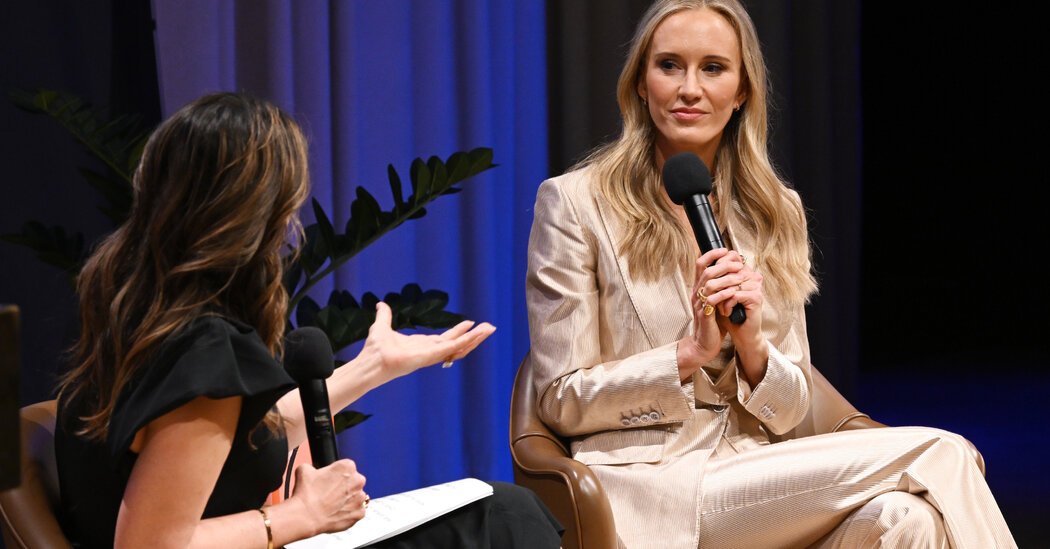
Amy Griffin, author of the memoir “The Tale,” filed a lawsuit Monday saying a childhood classmate defamed her by alleging she appropriated the classmate’s experience of sexual abuse and presented it as her own in the book.
Ms. Griffin’s lawsuit, which was filed on Monday in U.S. District Court in Nevada, accused Classmate of falsely portraying Ms. Griffin as a “fraudster and thief.”
It is the latest legal twist surrounding the book, in which Ms. Griffin, a billionaire and philanthropist, describes sexual abuse at the hands of a school teacher when she was in middle school in Texas in the 1980s. In the book, she says she recalled memories of the abuse 30 years later when she was undergoing therapy using MDMA, an illegal psychedelic drug.
Published in March 2025, “The Tale” became an instant best seller. Ms. Griffin, a first-time author, was helped by a ghostwriter and social media support from a network of famous friends and business partners.
The former classmate learned about “The Tale” after being contacted by New York Times reporters in the summer of 2025 — months after the book’s publication — as the newspaper investigated how Ms. Griffin rose to the top of the publishing charts.
The Times published an article in September 2025 under the title “The Billionaire, the Psychedelics and the Best-Selling Memoir”. In it, the classmate, who spoke to The Times on condition of anonymity to protect her privacy, said that parts of Ms. Griffin’s book were similar to her own experience of sexual assault in the middle school they both attended in the 1980s. The classmate is named in Ms. Griffin’s suit, but is not widely named elsewhere.
In March, the classmate filed a lawsuit in California, highlighting two episodes in the book: an assault at a middle-school dance and another in a school bathroom, in which Ms. Griffin said the teacher tied her hands behind her back with a bandana. The classmate said that those attacks had occurred to him, but Ms. Griffin presented them as her recovered memories.
The classmate told The Times for its September 2025 article that the teacher who attacked her was not the teacher Ms. Griffin alleges in her book.
The woman also said in her lawsuit that she met Ms. Griffin at a California coffee shop in 2019 to discuss her childhood in Texas.
However, in her lawsuit filed this week, Ms. Griffin said the two women had not spoken since they went to school together 35 years ago.
Ms Griffin said she began writing her memories of the abuse in 2020, long before the classmate publicly disclosed her experience. She has denied that any element of her experience or her memory was fabricated, and said in her lawsuit that “every element” of her old classmate’s allegations were “false”.
“‘The Tale’ describes Mrs. Griffin’s own abuse,” Ms. Griffin’s lawsuit says.
In an email statement, Classmate’s lawyer, Zack Rosenblatt, described Ms. Griffin’s lawsuit as “part of a public relations damage-control campaign.” He said he found it “extremely ironic” that Ms. Griffin used a pseudonym for the abusive teacher in her book, while using the name of her former classmate in her lawsuit.
The email included a statement from a classmate, who described “unimaginable” shame and humiliation after being sexually assaulted at a school dance.
He said, “I was harassed again after reading about my experiences in Amy’s book, where she falsely claimed it was her own experience.” “When The New York Times found me and contacted me, I told them the truth.”
Ms. Griffin’s lawyer, Thomas A. Clair said in an emailed statement that Ms Griffin’s “accuser has had every opportunity to set the record straight.”
“The purpose of this trial is to uncover the truth,” Mr. Clair said. “The New York Times knowingly promoted her false allegations and must also be held accountable.”
Ms. Griffin’s lawsuit accuses the Times of publishing the classmate’s account to defame Ms. Griffin. The lawsuit said the Times story was “a search for a reason to disbelieve ‘The Tale’.”
The Times denied those allegations and defended its reporting.
“The filing repeatedly misrepresents The New York Times’ story and its reporting,” Danielle Rhodes Ha, a spokeswoman, said in a statement. “Our story was about a publishing phenomenon, the reliability of memories retrieved under the influence of MDMA, and the impact of a best-selling memoir on the author’s hometown.”
“The sole agenda of our journalists was to pursue the facts, including corroborating accounts from all sources,” he said.